
Perspectives; Thoughts; Comments; Opinions; Discussions

Posts tagged ‘nationwide injunctions’

For Playing Political Games With Trump’s Deportations, Judge Ho Gives SCOTUS The Smackdown It Deserves


By: Shawn Fleetwood | May 28, 2025

Read more at https://thefederalist.com/2025/05/28/for-playing-political-games-with-trumps-deportations-judge-ho-gives-scotus-the-smackdown-it-deserves/

Judge Ho giving remarks at Heritage.
‘I worry that the disrespect they have been shown will not inspire continued respect for the judiciary, without which we cannot long function.’

Author Shawn Fleetwood profile

Shawn Fleetwood

Visit on Twitter@ShawnFleetwood

More Articles

The refusal by a majority on the U.S. Supreme Court (SCOTUS) to shut down leftists’ lower court judicial coup against President Trump has drawn sharp rebukes from conservatives across America. These critics (correctly) argue that the high court’s unwillingness to stop (and at times, its willingness to participate in) this effort both subverts the power of the executive branch and undermines the will of the more than 77 million Americans who voted for the president in the 2024 election. But it’s not just judicial commentators and everyday citizens who are getting fed up with the justices’ political gamesmanship.

Last week, a three-judge panel on the Fifth Circuit Court of Appeals issued an order “expedit[ing] to the next available randomly designated regular oral argument panel” the case known as A.A.R.P. v. Trump. The matter centers around Trump’s use of the Alien Enemies Act to deport Venezuelan Tren de Aragua gang members.

The order came as part of the lower court’s compliance with a May 16 SCOTUS decision, in which a majority (7-2) on SCOTUS remanded the case back to the Fifth Circuit. As described by Fox News, the ruling — in which Associate Justices Samuel Alito and Clarence Thomas dissented — “revolved around the alleged illegal immigrants not having enough time to reasonably file a challenge to their deportations.”

While the Fifth Circuit panel’s order followed the Supreme Court’s instructions, it also included a multi-page concurring opinion from Judge James Ho. In addition to arguing that the identified Tren de Aragua members “should not be allowed to proceed in this appeal,” the Trump appointee excoriated the high court for the “disrespect” it has shown “the district judge as well as the President and other officials” in the case.

“As an inferior court, we’re duty-bound to follow Supreme Court rulings — whether we agree with them or not. … So, I concur in our order today expediting our consideration of this matter, as directed by the Supreme Court,” Ho wrote. “But I write to state my sincere concerns about how the district judge as well as the President and other officials have been treated in this case. I worry that the disrespect they have been shown will not inspire continued respect for the judiciary, without which we cannot long function.”

Ho went on to note that it “is not the role of the judiciary to check the excesses of the other branches, any more than it’s our role to check the excesses of any other American citizen” — an apparent rebuke to recent remarks by Chief Justice John Roberts. While speaking at an event in his hometown of Buffalo, New York, earlier this month, the Bush appointee tacitly endorsed the concept of judicial supremacy, claiming the courts can unilaterally “strike down … acts of Congress or acts of the president” they believe to be unlawful or unfavorable.

“Judges do not roam the countryside looking for opportunities to chastise government officials for their mistakes,” Ho wrote. “Rather, our job is simply to decide those legal disputes over which Congress has given us jurisdiction.”

Much like Alito did in his dissenting opinion in SCOTUS’s May 16 decision, Ho ardently defended District Court Judge James Wesley Hendrix’s handling of petitioners’ requests for emergency relief, saying he “conducted himself in a reasonable and indeed admirable manner” and “any criticism of [him] is unwarranted and unfortunate.” He further echoed Alito’s criticisms of the Supreme Court’s characterization of Hendrix’s declination to immediately abide by petitioners’ late-night requests as “misleading.”

“We seem to have forgotten that this is a district court — not a Denny’s. This is the first time I’ve ever heard anyone suggest that district judges have a duty to check their dockets at all hours of the night, just in case a party decides to file a motion,” Ho wrote. “If this is going to become the norm, then we should say so. … If this is not to become the norm, then we should admit that this is special treatment being afforded to certain favored litigants like members of Tren de Aragua —and we should stop pretending that Lady Justice is blindfolded.”

The Fifth Circuit judge concluded his fiery opinion by underscoring that Trump deserves the same level of respect all presidents before him have been afforded. He specifically pointed to former President Obama’s attack on the Supreme Court during his 2010 State of the Union address and former President Bill Clinton’s inability to practice law before the high court as examples of presidents who — despite having disagreements with court rulings — were entitled to said respect.

“Yet I doubt that any court would deny any of those Presidents the right to express their views in any pending case to which they are a party, before issuing any ruling. Our current President deserves the same respect,” Ho wrote.

Whether Roberts and his colleagues take Ho’s criticisms seriously remains to be seen. But what is certain is that the longer the high court continues to entertain leftists’ judicial coup, the more credibility it loses with the American people.


Shawn Fleetwood is a staff writer for The Federalist and a graduate of the University of Mary Washington. He previously served as a state content writer for Convention of States Action and his work has been featured in numerous outlets, including RealClearPolitics, RealClearHealth, and Conservative Review. Follow him on Twitter @ShawnFleetwood

Ousted From Power by Voters, Dems Turn to Activist Judges to Defy Trump


By: John Daniel Davidson | February 11, 2025

Read more at https://thefederalist.com/2025/02/11/ousted-from-power-by-voters-dems-turn-to-activist-judges-to-defy-trump/

Trump
Lower federal court judges have no constitutional authority to govern by injunction and undermine the executive branch.

Author John Daniel Davidson profile

John Daniel Davidson

Visit on Twitter@johnddavidson

More Articles

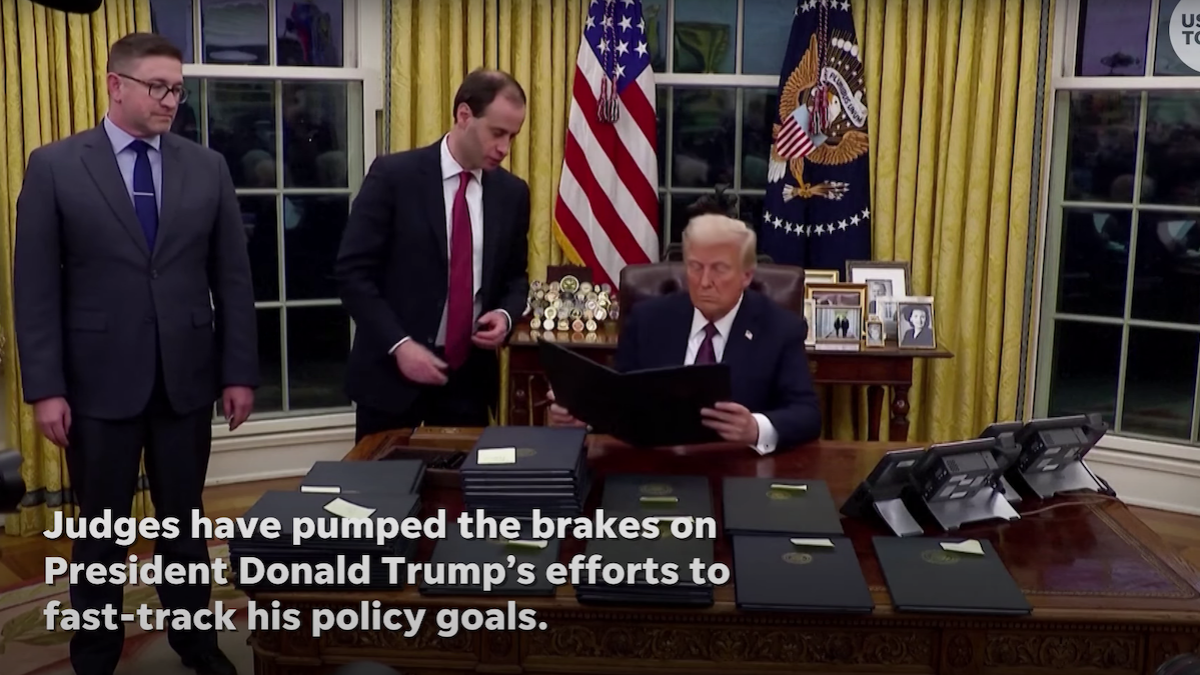
What’s happening right now is that Democrats, having been thrown out of power by American voters in a landslide victory for Trump, have decided they’re going to deploy a widely-used tactic from Trump’s first term to thwart the president’s agenda: use the federal judiciary. Under the false pretext that the lower federal courts are part of a “coequal branch of government” with the executive, they’re aiming to shut down Trump’s reform efforts with a fusillade of preliminary injunctions.

In recent days dozens of lawsuits have been filed against the Trump administration by Democrat attorneys general and various left-wing groups. These groups have carefully selected their venues, ensuring the lawsuits come before rabidly anti-Trump activist judges. So far, the tactic seems to be working. As of this past weekend, eight different rulings from the federal bench have temporarily halted the president’s executive orders.

Federal judges in Democrat-majority districts have issued preliminary injunctions blocking Trump’s executive actions to end birthright citizenship, reform and downsize the United States Agency for International Development, and offer buyouts to federal bureaucrats. A federal judge this past weekend blocked Elon Musk’s Department of Government Efficiency and all other political appointees in the Trump administration — including the Treasury secretary and his deputies — from accessing payment data at the Treasury Department.

One judge even issued a restraining order halting a Trump order that would have ensured federal inmates are housed according to biological sex, not transgender identity, and also would have prevented tax dollars from being used to pay for “gender transitions” for federal inmates. (Another judge, appointed by Obama, took the extraordinary step of ordering the administration to pay back every cent of federal funding that’s been paused or canceled — and threatened anyone who violates his order with criminal contempt.) 

What all this lawfare amounts to is a kind of judicial coup against the sitting president. By doling out injunctions like they’re USAID grants for LGBTQ awareness programs in Mali, Democrats have been able to hamstring key aspects of Trump’s agenda — at least for the moment. It’s a simple enough tactic. All Democrats have to do is shop for a venue to find the most activist, rabidly anti-Trump federal judges in the country, file their lawsuits, and wait for the injunctions to come raining down.

By doing this, Democrats and their allies in the judiciary turn the Constitution on its head, and effectively govern negatively through injunction, making major reform of the federal bureaucracy impossible. In nearly every case so far, the federal judiciary is siding with the permanent bureaucracy in Washington, preventing the Trump administration from doing anything to reform it despite Trump having campaigned on precisely that promise.

The problem is, as my colleague Sean Davis noted recently on X, federal judges have no actual authority to do this. They can’t decide on their own who the president can talk to or what data he can access. They can’t bind the president at all. According to the U.S. Constitution they’re “inferior” courts and therefore don’t have any authority over the executive branch. Yes, the three branches of the federal government are coequal, but the only part of the federal judiciary that’s equal to the presidency is the Supreme Court, not all the federal district courts scattered across the country.

“John Roberts and SCOTUS have two options here: they can bring these inferior malcontents to heel, or they can get used to the President simply ignoring these inferior courts or Congress eliminating them entirely,” wrote Davis. “Congress created these inferior courts so the Supreme Court wouldn’t have to deal with every federal case by itself. But if these rogue inferior judges are going to routinely issue lawless decisions that the Supreme Court has to deal with anyway, Congress would be well within its rights to just eliminate them.”

The issue might come to a head before Congress gets around to eliminating the federal courts, though. If the Supreme Court steps in on just one of these cases where a federal judge has blocked a lawful executive order from Trump, it might not go well for Democrats. In the 2018 Supreme Court case Trump v. Hawaii, which reversed a lower court’s decision to uphold a nationwide injunction on Trump’s travel ban, Justice Clarence Thomas called into question the idea that a federal judge in Hawaii (or anywhere else) can simply issue an injunction against a presidential executive order and apply it to the entire country. 

“District courts, including the one here, have begun imposing universal injunctions without considering their authority to grant such sweeping relief,” wrote Thomas. “These injunctions are beginning to take a toll on the federal court system — preventing legal questions from percolating through the federal courts, encouraging forum shopping, and making every case a national emergency for the courts and for the Executive Branch.”

He went on to say he is “skeptical that district courts have the authority to enter universal injunctions,” that such injunctions didn’t emerge until a century and a half after the Founding, and that they “appear to be inconsistent with longstanding limits on equitable relief and the power of Article III courts. If their popularity continues, this Court must address their legality.”

Only a few weeks into Trump’s second term, the popularity of injunctions is back with a vengeance, which means the Supreme Court might well step in to decide whether any federal district judge, anywhere in the country, can bind the actions of the White House by issuing nationwide injunctions.

It’s long past time to settle this. The American people overwhelmingly elected Trump precisely because they wanted to see his agenda for America enacted. Lower court federal judges, whom no one voted for, have no right to assert their will over and against the will of the American people. The sooner the Supreme Court takes this up and settles the obvious question, the sooner Democrat lawfare against Trump’s agenda will come to an end. Instead of relying on activist judges, Democrats might then have to figure out how to compete at the ballot box — something they are obviously loath to do.


John Daniel Davidson is a senior editor at The Federalist. His writing has appeared in the Wall Street Journal, the Claremont Review of Books, The New York Post, and elsewhere. He is the author of Pagan America: the Decline of Christianity and the Dark Age to Come. Follow him on Twitter, @johnddavidson.

Tag Cloud