Making women eligible for a military draft, as the Senate contemplates, would ignore deeper military recruitment issues and undermine readiness. (Photo illustration: Sean Murphy/Getty Images)
Wilson Beaver is a policy adviser for defense budgeting in the Allison Center for National Security at The Heritage Foundation.
As the Senate embarked Aug. 2 on its monthlong August recess, Majority Leader Chuck Schumer, D-N.Y., left a significant piece of legislation unaddressed: the annual National Defense Authorization Act, or NDAA. Included in this year’s Senate NDAA bill is a controversial provision to amend the Military Selective Service Act and mandate that women between the ages of 18 and 26 register for a military draft. This measure, sometimes known as “Draft Our Daughters,” not only is misguided but ignores the underlying issues facing military recruitment and readiness.
“The Senate defense bill’s provision for mandatory registration of all young women for conscription puts ‘fairness’ over military necessity,”notes Victoria Coates, The Heritage Foundation’s vice president for national security. “It would waste time and resources during a war in order to evaluate and train thousands of draft-age women to find the subset qualified for the requirements of military service. Including women in the selective service is pointless virtue-signaling from those who believe the military should be a social experiment and not a lethal fighting force.”
“Draft Our Daughters” is just the beginning. The provision alters the language of the Selective Service Act by replacing the word “man” with “person,” equating gender equality with sameness while ignoring the diverse and different ways in which men and women may contribute to national security.
Intentionally ambiguous language like this expands woke ideology, which undermines military readiness and distracts the military from its core mission: Defend America and its interests by deterring or killing its enemies.
The U.S. hasn’t had a military draft since 1973, when the armed forces became entirely made up of volunteers. Congress and the president, however, may authorize a draft in the event of a national emergency or war.
The U.S. military has faced substantial recruitment challenges in recent years, with the Army, Navy, and Air Force missing goals by a staggering 41,000 recruits in 2023 alone. In this context and amid a more dangerous security landscape globally, some argue that expanding the draft to include women is a necessary step to address these shortfalls. However, including women in the draft wouldn’t resolve the fundamental problems leading to today’s low recruitment numbers, nor would it improve the existing system of voluntary recruitment. This provision overlooks deeper, systemic issues that deter young Americans from enlisting in the first place. Some of these issues include fewer young men who qualify, more opportunities in civilian careers, and fewer instances of families with a history of military service.
Rather than addressing the root causes of recruitment struggles, this provision opts for a superficial solution that raises both ethical and practical concerns.
The argument for “Drafting Our Daughters” typically is framed around the principle of equity. Proponents claim that if men and women are truly equal, then women should be subject to the same draft requirements as men. This logic is fundamentally flawed. Women and men are innately different.
Divisive, politicized initiatives, such as including women in the draft, do nothing to enhance the military’s core mission of creating a capable and lethal force or to rebuild trust with the American people the military defends.
Registering all women for the draft is a misguided idea. Congress should instead focus on enacting measures that support military recruitment, such as quality-of-life improvements for service members, and not resort to drafting our daughters.
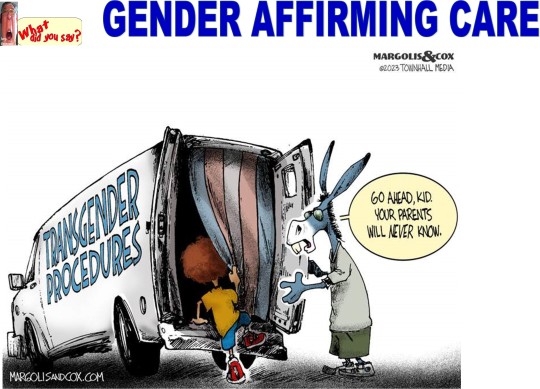
Parents across the United States are being restricted from accessing their adolescent children’s online electronic health records. Not only are military parents barred from accessing all but basic information on their 13- to 17-year-olds in the military’s online health care portal, but the adolescent minor also is not allowed to have a user logon until 18. Though elected officials are tackling this issue on the state level, military parents will need to be their own advocates as they appeal to Congress to restore their parental rights.
Military insurance provider Tricare finally issued a press release in March explaining Department of Defense (DOD) policies that restrict parents from adolescent records in the portal, Military Health System (MHS) Genesis, as well as from “sensitive” physical records.
Last year, I wrote about my experience of spending months trying to obtain the official policy that barred parents from these records. Now that the policy is out in the open, it must not be allowed to stand, as it is ultimately harmful to children.
Many military parents object to providers’ having a confidential relationship with their children because they do not trust activist MHS doctors who believe a child can be born in the wrong body to counsel their children on anything in secret — as some are doing.
One sobering example of what can happen when parents are excluded occurred in Louisiana, where two civilian parents were treated as the enemy. After less than an hour behind closed doors with their 13-year-old, the provider tried to manipulate them into affirming their daughter’s new identity as a boy by asking them if they would “rather have a dead daughter or a live son.” One of the doctors involved, Dr. Ryan Pasternak, is a leader in adolescent medicine and has co-written recommendations for the Society of Adolescent Health and Medicine (SAHM) on the management of electronic health records. SAHM’s ideal method includes permitting full access only to the adolescent, while actively blocking parents so they receive only nonconfidential information.
Even as state legislatures are moving to restore parental access to unemancipated minor medical records, the MHS seems to be plowing ahead with its efforts to keep parents in the dark. With all I’ve uncovered about adolescent confidentiality and gender activists within the MHS, parents are right to be concerned.
Congress Fails to Act
In 2017, the Defense Health Board, a federal committee that advises the secretary of defense, acknowledged in a report that the emerging field of adolescent medicine had “recently made a profound shift from its traditional role. Instead of providing preemptive guidance to parents, providers now work to reduce risk-taking behaviors with their focus aimed directly at the adolescent.” The board also recommended expanding the use of puberty blockers and cross-sex hormones to address gender dysphoria and suggested possibly including surgeries for gender-confused children in the future. The board pointed out that the Tricare Mental Health and Substance Use Disorder Treatment final rule on Sept. 2, 2016, “permits ‘coverage of all non-surgical medically necessary and appropriate care in the treatment of gender dysphoria.’” This was a final rule that came from unelected bureaucrats — not Congress.
Nevertheless, recent efforts in Congress to prohibit coverage for transgender procedures for minor military children were removed by the Senate from the House-passed fiscal 2024 National Defense Authorization Act. Language to prevent the Exceptional Family Member Program from being used to facilitate child transgender transitions was also removed.
Bases, Schools Push Transgenderism
Today, adolescents can receive confidential care on military bases and in school-based clinics. For example, Joint Base Lewis-McChord’s Madigan Army Medical Center’s adolescent clinic offers subspecialty care for transgender confusion, sexuality issues, and substance use, among other services. Madigan also runs a system of school-based health clinics in 10 area schools; dependents on Tricare Prime insurance can visit the clinic once each week.
If military parents aren’t “affirming” of a transgender identity, activist group PFLAG recommends that children talk with “a school counselor, the on-base youth Military Family Life Counselor (MFLC), a chaplain (if from an affirming denomination), or an online friend or peer.” PFLAG also reveals that MHS Genesis “now allows patients to mark their gender identity in addition to their sex assigned at birth.” This will “allow transgender youth to receive appropriate care without as many obstacles.” And “military LGBTQ+ organizations are currently working with DoDEA [schools for children of military families] to incorporate the same procedures in school documents.”
In the school-to-scalpel age, confidential care being provided to adolescents should cause alarm bells to go off. Ian Prior, founder of Fight for Schools, in his article, “Queer Whistleblower Exposes Evils of the School to Scalpel Pipeline,” shows how indoctrination into transgenderism can begin at school as young as kindergarten. In many cases, children are encouraged to socially transition at school. By the time parents find out, children can be convinced they were born in the wrong body, and doctors who favor the “gender affirmation” approach steer parents and their dysphoric children down that path of care.
Thanks to an official Department of Defense Education Activity (DODEA) teacher training in May 2021, we know that secret transgender transitions are happening in overseas schools for military children. Former Rep. Vicky Hartzler wrote a letter to DOD in 2021 asking why teachers were being trained at a DODEA teachers summit to transition children at school without parents’ knowledge. She never received a response — and DODEA has avoided accountability even to this day.
I spoke with a military mom whose daughter, Cami (not her real name), was enrolled in a public school in Fairfax County, Virginia, that concealed from her parents that she had transitioned to a boy at school. Though the mother only wanted Cami to see a therapist to address her depression, military medicine additionally referred her to a so-called gender clinic in the Washington, D.C., area. When the mother didn’t take her daughter to the clinic, she received a call from a military doctor who suggested Cami might need puberty blockers to give her time to decide about her sex. At the time of our conversation, the family was still reeling from the harm that “trusted” adults at school had caused.
MHS Treats Thousands of Confused Dependents
Armed with this information about a gender clinic on base, I found research conducted by active-duty medical doctors and a medical school professor that mentioned a regional referral-based adolescent medicine clinic that opened in 2014 and serves dependents between the ages of 9 and 24. It provides “services including diagnosis, puberty suppression, affirming-hormone treatment, reproductive health services … and affirming counseling, and refers for surgical, ancillary (e.g., voice therapy) and complex mental health services.”
Ft. Belvoir in Virginia fit the clinic’s description, and transgender-confused children do, indeed, seek care there. Dr. David Klein was chief of adolescent medicine at Ft. Belvoir in 2016. He and his associates have diligently documented their research on transgender-identifying military dependents. They reveal that from 2009 until 2017, more than 2,500 military dependents, ages 4 to 25, sought treatment for gender confusion from the MHS. When Tricare began to pay for puberty blockers and cross-sex hormones for dependents in 2016, they observed a marked increase in the number of patients seeking such care. One can only imagine how high the figures are today when taking into account estimates that the number of transgender-identifying youth in the United States nearly doubled between 2016 and 2022.
Another Klein study looked at 53 gender-confused adolescents and measured parental support for their care. Researchers looked at MHS data from 2014 to 2017 and rated strong support of parents for initiation or continuation of “gender transition” at 55.8 percent, non to moderately supportive at 25 percent, and conflicted support at 19.2 percent.
Though numerous studies show that military kids suffer from a higher rate of anxiety and depression than their civilian peers, key recommendations from Klein and his co-authors provide advice to doctors as if wrongly named “gender affirmation” is the only approach for treating gender dysphoria. They claim a transgender diagnosis is not necessarily related to other mental health concerns and that attempts “to convert a person’s gender identity to align with their sex assigned at birth are unethical and incompatible with current guidelines and evidence.”
Klein and colleagues made the news last year and caught congressional attention when they stated in their latest research, in a discussion about understanding the risks and benefits of “gender-affirming” care, that 7-year-olds can begin participating in medical decision-making. Fortunately, as former Rep. Tulsi Gabbard pointed out to Tucker Carlson, 53 percent of MHS physicians in that study said they would refuse to prescribe hormones even if trained to do so. Sadly, others would be willing to, and Klein is now the Family Adolescent Medicine Program director at Travis Air Force Base in California — training the next generation of military physicians.
Falling out of Favor Around the World
Even as MHS leaders continue to promote this harmful medicating of children, it is rapidly falling out of favor among doctors around the world, who are opting for psychotherapy as a first line treatment for gender dysphoria, after studies have shown “no demonstrable, long-term benefit” on “psychosocial well-being of adolescents with gender dysphoria.”
Additionally, the leading organization for transgender care, WPATH, was recently exposed for its lack of evidence and safeguards that led to members performing pseudoscientific surgical and hormonal experiments on minors. And, similarly, the Cass Review, released this month, detailed how England’s leading specialist youth transgender “clinic,” now permanently closed, was untethered from evidence-based medicine.
As the rationale for transgender drugs and surgeries unravels, a legal reckoning is being led in the United States by detransitioners such as Chloe Cole, who began transitioning at 12 and had a double mastectomy by 15. DOD and affirming doctors in the MHS must be included in this reckoning and held accountable for any harm suffered by military dependents under their care.
Laws and policies that allow medical records and medical treatment of adolescents to be hidden from parents are potentially harmful to children and destructive to families, and this is why military parents must urge Congress to strike DOD’s policies that drive a wedge between them and their children and to pass legislation that clarifies their right to guide the medical care of their children.
Amy Haywood is a former senior legislative assistant for a U.S. House representative. She writes The Primary Educator newsletter, which can be found at theprimaryeducator.com.
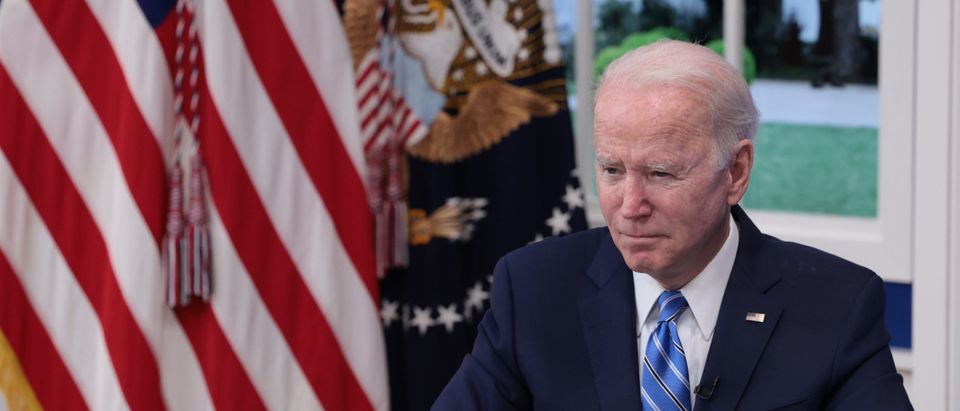
President Joe Biden signed a $770 billion defense bill on Monday that marks an increase in spending in almost every faction of the military. The $770 billion National Defense Authorization Act (NDAA) ended up being $24 billion more than Biden asked for, according to The New York Times. It passed both the House and Senate with bipartisan support in December, though it did face some opposition from certain Republican and Democratic lawmakers.
The NDAA increased spending aimed at helping Ukraine defend itself, countering military expansion in China and obtaining more advanced aircraft and ships, according to the NYT. The Biden administration previously identified China as a “top challenge” while making the budget proposal.
“The discretionary request prioritizes the need to counter the threat from China as the Department’s top challenge. The Department would also seek to deter destabilizing behavior by Russia,” Biden’s budget request, issued in April and asking for $715 billion, reads.
The agreed-upon NDAA also increases pay for more service members by 2.7% – a provision that was overwhelmingly bipartisan, even garnering the support of lawmakers who ultimately voted against passing the NDAA in the House.
“The Act authorizes fiscal year appropriations principally for the Department of Defense, for Department of Energy national security programs, and for the Department of State,”Biden said in a statement on Monday following the bill’s signing. “The Act provides vital benefits and enhances access to justice for military personnel and their families and includes critical authorities to support our country’s national defense.”
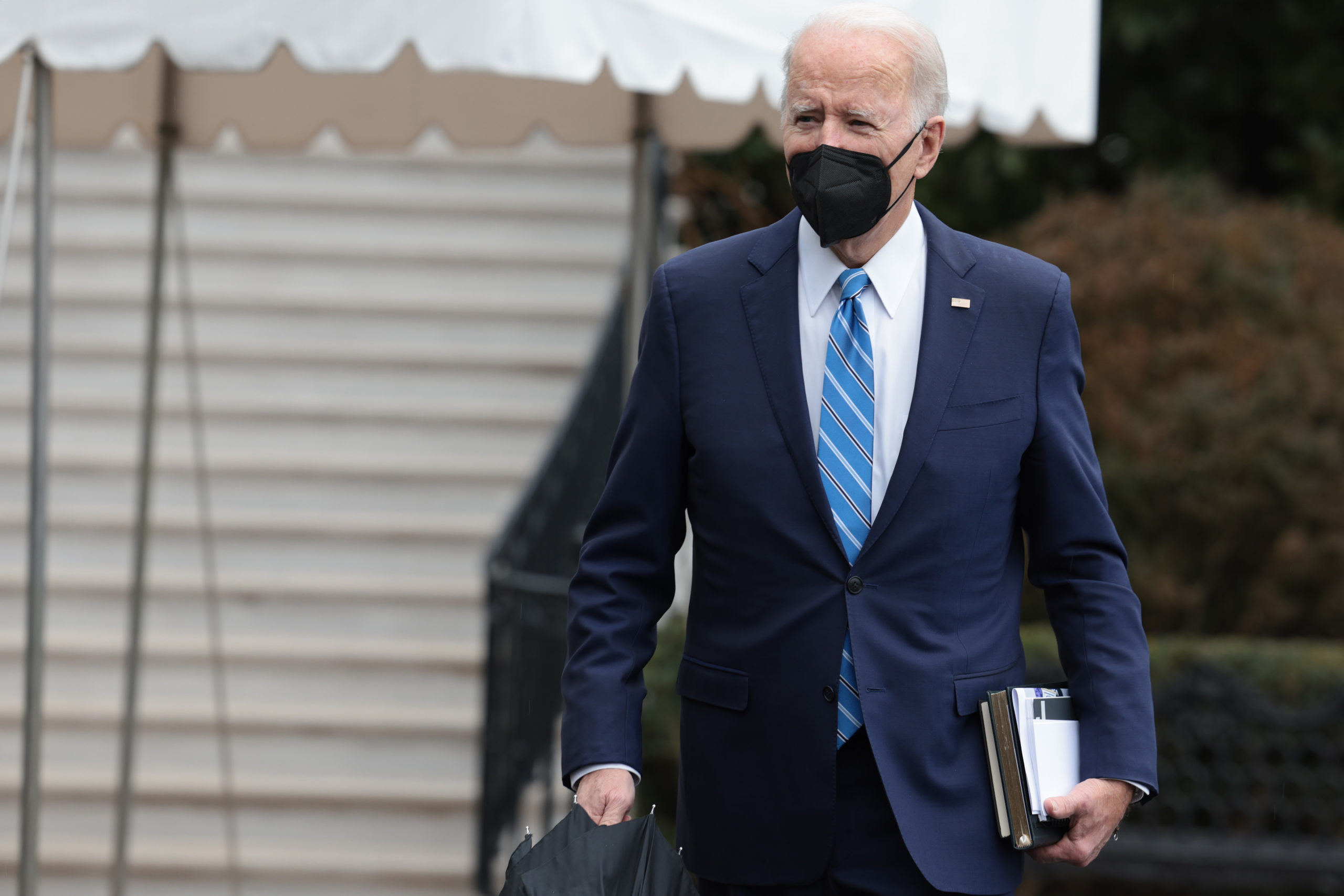
WASHINGTON, DC – DECEMBER 27: U.S. President Joe Biden walks to speak with reporters on the South Lawn before departing from the White House on Marine One on December 27, 2021 in Washington, DC. President Biden and First Lady Dr. Jill Biden are traveling to Rehoboth Beach, Delaware for the New Year’s holiday. (Photo by Anna Moneymaker/Getty Images)
The president criticized various portions of the bill in a statement following its signing. Some were relating to Guantanamo Bay, with Biden calling it unfortunate that one section “continues to bar the use of funds to transfer Guantanamo Bay detainees to the custody or effective control of certain foreign countries.” He also called out a second portion of the bill that “bars the use of funds to transfer Guantanamo Bay detainees into the United States unless certain conditions are met.”
“It is the longstanding position of the executive branch that these provisions unduly impair the ability of the executive branch to determine when and where to prosecute Guantanamo Bay detainees and where to send them upon release,” Biden argued.
Still, the NDAA, which covers the fiscal year 2022, includes some marked changes. One agreement included in the bill will overhaul how the military handles internal criminal investigations, according to the NYT. Now, military commanders will lose much of the previous authority they had to prosecute sexual assault cases, for example. They’ll often be replaced by independent military prosecutors. In another new move, sexual harassment in the military will now be criminalized under the Uniform Code of Military Justice. Independent investigation will also be required for crimes such as kidnapping and murder. Lawmakers praised the bill as transformative.
“These reforms, which are supported by longstanding advocates for survivors of the sexual assault crisis in the military, will take the prosecution of all sex crimes in the military away from the control of the military commander,” Democratic Washington Rep. Adam Smith said, according to the NYT. “Instead, qualified, independent, uniformed attorneys — ultimately overseen by the civilian service secretaries — will have the sole authority for charging decisions and the responsibility to prosecute those charges.”
Justin Johnson wrote earlier this week on President Obama’s veto of the National Defense Authorization Act:
Instead of dealing with the bill on its merits, Obama is using the defense bill for political leverage. This is the wrong way to handle our national security.
Many Americans rightfully find Washington’s way of doing things disturbing. Instead of treating issues individually, politicians will often attach unpopular policies to popular bills in order to ram them through. For example, just this summer, members of Congress were trying to attach the Export-Import Bank reauthorization to the Highway Bill, two completely unconnected issues.
Conservatives and liberals alike find this practice of linking unconnected issues disturbing. A particular proposal or issue should be considered on its own merits. If it can’t pass alone, it probably shouldn’t pass.
Holding Defense Budgets Ransom
If Congress shouldn’t do this, than the president shouldn’t either. But that’s just what Obama is doing by vetoing the defense authorization bill. The president is not vetoing the defense bill for any policies that are in the bill, but is simply using the veto for political leverage to increase non-defense spending.
To be clear, the defense bill cannot increase non-defense spending.
In fact, the defense bill doesn’t spend any money—it just establishes authorized budgets and policies for our military. But in this case, the facts don’t matter. Obama has been clear that he wants more spending for his domestic, liberal priorities and he is willing to use the defense bill as leverage.
Important Reforms
This defense bill has a wide range of important provisions, some of which the president may not like. The bill keeps terrorist detainees at Guantanamo Bay in Cuba. It provides for lethal defensive aid to Ukraine. It cuts overgrown Pentagon bureaucracies and begins reforming the military’s retirement system.
A debate about any of the provisions in the bill is legitimate and important. But vetoing the bill for political leverage is not how Washington should operate.
What makes this move by Obama even more concerning is that non-defense spending has been steadily increasing, while defense spending has been steadily decreasing. Since 2008, non-defense discretionary spending has increased by 7 percent while defense discretionary spending has decreased by 14.6 percent.
If you include the major entitlement expansions under Obama, the numbers are even more striking. Social and economic spending has increased 37 percent from 2008 to 2015.
In short, the president’s domestic priorities have been seeing significant funding increases while defense has been cut, but the president wants more and is willing to hold defense at risk.
Obama should not be using our military for political leverage. The budgets for the president’s liberal priorities have gone up significantly while he has been in office, but the president isn’t satisfied and is willing to use a national security bill as leverage for more. Vetoing the defense bill in order to increase domestic spending is wrong and is Washington at its worst.
American Family Association
American Family Association (AFA), a non-profit 501(c)(3) organization, was founded in 1977 by Donald E. Wildmon, who was the pastor of First United Methodist Church in Southaven, Mississippi, at the time. Since 1977, AFA has been on the frontlines of Ame
NEWSMAX
News, Opinion, Interviews, Research and discussion
Opinion
American Family Association
American Family Association (AFA), a non-profit 501(c)(3) organization, was founded in 1977 by Donald E. Wildmon, who was the pastor of First United Methodist Church in Southaven, Mississippi, at the time. Since 1977, AFA has been on the frontlines of Ame
American Family Association
American Family Association (AFA), a non-profit 501(c)(3) organization, was founded in 1977 by Donald E. Wildmon, who was the pastor of First United Methodist Church in Southaven, Mississippi, at the time. Since 1977, AFA has been on the frontlines of Ame
You Version
Bible Translations, Devotional Tools and Plans, BLOG, free mobile application; notes and more
Political
American Family Association
American Family Association (AFA), a non-profit 501(c)(3) organization, was founded in 1977 by Donald E. Wildmon, who was the pastor of First United Methodist Church in Southaven, Mississippi, at the time. Since 1977, AFA has been on the frontlines of Ame
NEWSMAX
News, Opinion, Interviews, Research and discussion
Spiritual
American Family Association
American Family Association (AFA), a non-profit 501(c)(3) organization, was founded in 1977 by Donald E. Wildmon, who was the pastor of First United Methodist Church in Southaven, Mississippi, at the time. Since 1977, AFA has been on the frontlines of Ame
Bible Gateway
The Bible Gateway is a tool for reading and researching scripture online — all in the language or translation of your choice! It provides advanced searching capabilities, which allow readers to find and compare particular passages in scripture based on








 What Did You Say?
Justin Johnson wrote earlier this week on President Obama’s veto of the National Defense Authorization Act: