It’s clear by now that the U.S. Secret Service is not a very elite security detail. Random, weaponless rallygoers paid more serious attention to the would-be assassin before he fired than the allegedly professional team assigned to Donald Trump on Saturday. Trump’s security detail did not secure him. Someone else did.
The Person who saved Trump’s life — and our nation from dangerous social unrest — is Jesus Christ. It is not random that wind gusts were present in just the right amount to have shifted the bullet’s course from fatal to flesh wound. It is not accidental that Trump turned his head at precisely the right second to avoid sudden death.
To phrase it as Whittaker Chambers did in explaininghis conversion from atheism to Christianity, which began when he watched his toddler eating: “My eye came to rest on the intricate convolutions of her ear — those intricate, perfect ears. The thought passed through my mind: ‘No, those ears were not created by any chance coming together of atoms in nature. … They could have been created only by immense design.’ … I did not then know that, at that moment, the finger of God was first laid on my forehead.”
The finger of God was also laid on Trump’s forehead Saturday night, turning it in the precise direction at the precise moment to spare his life. The chances of everything occurring as it did by random chance are impossibly improbable. No, the only Person who saved Trump is the same Person Who saves anyone who is ever saved: Jesus Christ, the God of the universe in human flesh.
He Who Controls Both Body and Soul
The whole world watched a miracle in live-time on global TV Saturday night. We watched in striking color the reality that the life and death of every person — and nation — is held in God’s hands. It is Jesus Christ who proclaims:
[D]o not fear those who kill the body but cannot kill the soul. Rather fear him who can destroy both soul and body in hell. Are not two sparrows sold for a penny? And not one of them will fall to the ground apart from your Father. But even the hairs of your head are all numbered.
Fear not, therefore; you are of more value than many sparrows. So, everyone who acknowledges me before men, I also will acknowledge before my Father who is in heaven, but whoever denies me before men, I also will deny before my Father who is in heaven.
This is why the Christian martyrs often surprised their captors by boldly declaring that no one could put them to death. For the true God promises that “he that believeth in me, though he were dead, yet shall he live.” The good man who died saving other people’s lives in Pennsylvania Saturday, Corey Comperatore, believed in Him Who Is “the resurrection, and the life,” and Who promises, “[W]hosoever liveth and believeth in me shall never die.”
According to Comperatore’s daughter, he was a “man of God” who “loved Jesus fiercely.” No one took Comperatore’s life. Like his Savior, Jesus Christ, he laid it down for those he loved. Also, like Jesus Christ, he will rise again. In the same chapter of Matthew quoted above, Jesus promises, “Whoever finds his life will lose it, and whoever loses his life for my sake will find it.” See you in eternity, brother.
The Power of Life and Death Is God’s
Saturday was not Trump’s Day to die. His near-death experience was a very visible divine event displaying to all the world Who holds full power over life and death: Jesus Christ. It is a spiritual shock treatment to increase the faith of those who believe and ignite new faith in those ready to believe.
Even with a highly competent Secret Service, Trump could fall at any time God chooses, to any malady. Like every one of us, he could have — God forbid, of course — a heart attack, an aneurysm, or myriad other fatal events. Not even the world’s best doctors or warriors can stop death. The best they can do is sometimes delay it.
As Proverbs says, “The king’s heart is in the hand of the Lord, Like the rivers of water; He turns it wherever He wishes.” Yes, the king’s heart and his head as well. The psalmist says, “But thou, O Lord, art a shield for me; my glory, and the lifter up of mine head. … I will not be afraid of ten thousands of people, that have set themselves against me round about.”
No one but God shifted Trump’s head that day, and no one but God decides when Trump will meet his Maker. It’s direct and clear evidence that, yes, there is a God, and he divinely intervenes in human affairs.
Miracles Are Proof God Is Real
Miracles are everywhere. They are proof that God is real. And the fact that He’s real should change all of us every moment of our lives.
Miracles are both a rare and everyday occurrence. Every time a child is conceived is a miracle. That happens hundreds of thousands, possibly millions, of times each day. It’s a miracle there aren’t more wars, that millions of people have clean and even hot water, that billions of people can eat enough to stay alive every day. Such quotidian miracles are typically hidden: inside mothers’ bodies, plastic pipes, farmers’ tools, the everyday.
Miracles like the one we saw Saturday are rarer and thus a special call for us all to stop, reflect, and pray. That’s because, if we’re honest, we all understand that any of us could die at any moment and face God’s just judgment, yet so many of us are mercifully spared each minute. This highly visible mercy for our undeserving nation calls for national and international gratitude, repentance, faith, and prayer.
Joy Pullmann is executive editor of The Federalist. Her new book with Regnery is “False Flag: Why Queer Politics Mean the End of America.” A happy wife and the mother of six children, her ebooks include “Classic Books For Young Children,” and “101 Strategies For Living Well Amid Inflation.” An 18-year education and politics reporter, Joy has testified before nearly two dozen legislatures on education policy and appeared on major media including Tucker Carlson, CNN, Fox News, OANN, NewsMax, Ben Shapiro, and Dennis Prager. Joy is a grateful graduate of the Hillsdale College honors and journalism programs who identifies as native American and gender natural. Joy is also the cofounder of a high-performing Christian classical school and the author and coauthor of classical curricula. Her traditionally published books also include “The Education Invasion: How Common Core Fights Parents for Control of American Kids,” from Encounter Books.
In 1999, doctors diagnosed Nepali Christian Gita Shakya with a painful, paralyzing spinal growth. Doctors told Gita and her Christian son, Suroj, that her best option for healing was a risky, potentially lethal surgery, Suroj said in a written testimony shared with The Christian Post.
Surgery was also expensive, and Gita’s husband, Babukaji, a Buddhist priest, refused to pay his Christian wife’s expenses. Doctors in Singapore gave 19-year-old Suroj two days to decide whether to let his mother live in terrible pain or risk her death. He prayed, then decided it was best to do the surgery. But he didn’t know what he would tell his family if Gita died, he said.
“At that time, I felt so alone in Singapore because it was my first visit, and I had nobody to share my problems with besides talking with the Lord in prayer,” he added.
Suroj heard a knock at the door. It was a group of local church members who wanted to pray for Gita. After 20 minutes of prayer, a miracle happened, he said. Gita stood up. She kicked out with her left foot, which hadn’t moved for years. She punched out with her left arm. Suddenly, she could move. Gita started to weep and praise God, Suroj recalled.
“There was no pain and sadness, which she had before. Her face was changed into joy and happiness,” he said.
Afterward, Suroj said doctors didn’t believe Gita was the same woman. Babukaji didn’t believe his wife had been healed without surgery until he saw she had no scars. Then along with his son, Suman, he became a Christian.
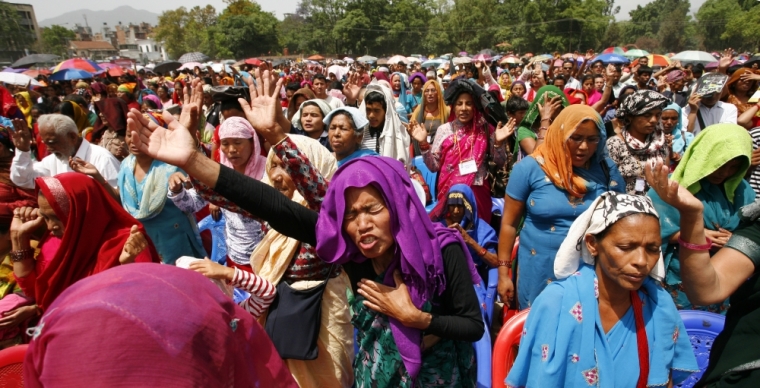
Such stories happen often in Nepal, said Suroj, who’s now a 41-year-old church elder. Despite persecution and poverty, the Nepalese church has grown incredibly quickly. The South Asian country has one of the fastest-growing Christian populations in the world.
To secular Westerners, it might seem impossible. But the mountains of Nepal have witnessed incredibly fast church growth in part because of miraculous healings. Suroj told CP that he became a Christian at 8 years old after God healed him from food poisoning.
“Firstly, church growth is because of miracles,” Suroj asserted. “[If] people don’t [get healed] from the hospital, they go to the church and ask for prayer from the church leaders. When the church family and church leaders pray for the sick people, they are getting healed.”
To those who see the world from a materialistic viewpoint, reports of miracles might sound impossible or far-fetched. The miraculous break nature’s laws and can’t be replicated. But that alone doesn’t disprove their existence, Wheaton College Intercultural Studies Professor Scott Moreau told CP. Not all of reality can be understood by using scientific methods.
“It’s not that science clashes with religion [when it comes to miracles],” he said. “They have completely different toolkits to get at the understructure of reality. One has testable formulae, but miracles don’t work that way.”
While miracles can’t be explained by natural laws, Moreau said they can be observed or verified.
“You can examine whether the reports of a miracle are consistent with each other,” he said.
People around the world agree that miracles exist, Moreau added. The fastest-growing Christian denominations around the world emphasize the miraculous.
Church growth in Nepal
In 1951, Nepal reported no Christians in its government census. And by 1961, that number increased to just 458. Today, the World Christian Database ranks the country as the 12th fastest-growing Christian population in the world with 1,285,200 believers, said database co-director Gina Zurlo. The real number might be higher.
“In some countries, fast growth rates of Christians are due to migration. In other countries, high birth rates may contribute more. But in Nepal, the main factor for growth is conversion from other religions,” she explained. “We estimate that Nepal is 4.25% Christian.”
Most Nepalese people today practice Hinduism, the world’s third-largest religion. The polytheistic Hindu religion values behavior and community belonging over belief. Until 2008, Nepal was a Hindu kingdom. For Hindu radicals, being Nepali means being culturally Hindu, Pastor Tanka Subedi told CP.
Subedi leads Nepal’s Family of God Church and serves as director of the International Nepal Fellowship. Although most Hindus live in peace with Christians, he said some fiercely oppose the Gospel.
“The prime minister himself says he doesn’t believe in God but is Hindu,” said Subedi. “State media and government officials [say] Christianity is coming to Nepal to destroy our culture. It’s challenging to evangelize people who have that mindset.”
The pressure and violence Christians experience from Hindus places the country at No. 34 on Open Doors USA’s global persecution watch list. Nepal is known for criminalizing actions that lead people to change their religion, International Christian Concern South Asia Regional Manager Will Stark told CP. Hindus fear Christianity because it threatens the Hindu caste system, Stark said. They believe that people get reincarnated based on what they did in their past lives. Bad people are reborn to do degrading or “unclean” jobs. They are “low caste” or “untouchable” because it’s believed that they spiritually pollute other Hindus. Hindus in higher caste positions often treat them with cruelty or contempt.
When Christians preach equality before God, Hinduism crumbles, Stark asserted.
“The Gospel tells you that all people are equal and Jesus cares about you and being your personal Savior,” he detailed. “The caste system is based on dividing out or stratifying the community. Without the bottom of the pyramid, the rest of it doesn’t really exist.”
Nepal’s anti-conversion law says that “‘any act that causes a religious conversion will be punished.” This broad wording gives police the right to punish Christians for even mentioning the name of Jesus in public, Stark noted. Hindu radicals who attack Christians also justify their actions by saying they were enforcing the law.
Bishwa Raj Pokharel, spokesman for the Nepalese National Police, claimed, “One can choose the religion they want to follow,” in a statement to the Global Press Journal in response to a January article about Christians who accused police of targeting them for their faith.
“But one cannot take advantage of a person’s situation and induce them to change their religion. The law says that you can change your religion, but you cannot change someone else’s religion.”
Persecution increasing
Government persecution has increased recently, said Subedi. In 2019, Nepalese authorities threw 73-year-old Christian Cho Yusang in jail for distributing Bibles. Two weeks in prison damaged his health so severely that he had to be admitted to a hospital.
After an orphanage closed this year, Nepalese Pastor Hari Tamang opened his home to shelter children for 10 days. In response to his generosity, police arrested him on false charges of trafficking and attempted religious conversion.
According to Open Doors USA, Christian persecution in Nepal rose during the watchdog organization’s 2020 reporting period as pressure is high for Christians “in every sphere of life.” The group reports that governing authorities in Nepal “make life difficult for followers of Christ.”
China and India both support Nepal’s government in its persecution of Christians, but for different reasons, Subedi said. India wants Nepal to remain Hindu, while China fears that Christians will support political movements to free Tibet, he explained. Despite rising persecution, Christians continue to share their faith, Subedi said, because the government can’t arrest them all.
“We come from a persecuted background. We were never free. We are used to it,” he said. “There’s not necessarily a state apparatus to use [the anti-conversion] law for mass arrests.”
People also feel eager to become Christians because of the reality of the Christian faith, Subedi added. God works visible miracles in churches and traditional healers can’t compete. Christians point to a historical Jesus in contrast to mythical Hindu gods.
“If you go deeper [into Hinduism], you find nothing. They’re just stories from different places with different gods,” the pastor contended. “When you hear about Jesus, it is solid. It is a fact. It happened in history and people can accept it. People are looking for a real God. All the Christians pray for healing and healings happen.”
Suroj stressed that Christianity also changes the lives of believers.
“When a man comes to the church and accepts Jesus, his life will be changed,” he said. “Before coming to the church, he used to take alcohol and smoke. But after coming to the church, he leaves all these things. The people who are not Christian want to come to the church and leave all the negative things in their life. People from other faiths feel excited and amazed that these things happened.”
Subedi noted that so many people become Christians in Nepal that it’s difficult for current believers to teach them all. He estimated that the church grows between 5% and 10% per year.
“The Hindu people are so scared of the Christians,” said Suroj. “They know that the Christian community is growing in very large ways. They are scared that if it happens for a few more years, in Nepal there will be no more Hindu people.”
In an increasingly connected world, many religions have spread far from their original homelands. Buddhism has gained popularity in America over the decades, and ideas from Hinduism influence popular American movies like “Star Wars” and “The Matrix.” In Asia, Christianity has grown more rapidly than ever before. But there’s a difference between the way Western people have sampled Eastern religions and the way Eastern people have believed in Christianity, according to Wheaton College Anthropology Professor Brian Howell.
“They are two really different phenomena. In the West, people are picking up Eastern religious influences in a very piecemeal fashion. They are doing it as self-expression,” he told CP. “With people finding Christianity, they are finding a community and a tradition they can connect to globally.”
Americans want some Eastern religious ideas; Nepalese people want to become Christians, Howell said.
Nepalese believers tend to gather in churches smaller than 100 people, although some churches are far larger, said Suroj. Believers in rural villages want practical teachings on how to live out their faith, while believers in cities want to know more about Christian theology.
“Giving, repentance, all these practical things, we teach in the church. We also teach the theological part of the Bible because the church believers we have in Nepal are about 60% uneducated people,” he said. “They love to learn and hear practical things.”
Church members in Nepal also help and care for each other, he said. They become family.
“The Christian people face many problems from his or her [Hindu] family and community,” Suroj added. “The church helps these Christian brothers and sisters in whatever way the church can. We are staying as one family. We help each other, we care for each other, we teach and we support each other.”
As it grows, the Nepalese church faces many difficulties, said Subedi. Poverty and persecution cause problems, but the biggest need is pastors who can help people fully understand their faith.
“This is one of the biggest challenges, to disciple people,” he said. “A lot of pastors in the villages haven’t gone to school. My organization tries to teach them at home. There is a huge need for training pastors and leaders in the villages.”
New Testament communities
In countries with heavy persecution, small churches grow faster, Moreau explained. House churches split as they grow larger and believers commit to share their faith. Small churches also resemble the New Testament Church.
“If it’s a house gathering, it tends to be more organic. If it’s in buildings, it tends to be more programmatic. The biblical evidence seems to point to the more organic method as the norm,” he said. “In the Muslim world, the organic churches have grown bigger faster simply because when a church becomes visible in the public arena it can get shut down very quickly.”
As Nepal’s church has grown in size and reputation, a small number of people have tried to join for the wrong reasons, Suroj said. Christians in Nepal have a reputation for politeness, hard work and honesty, so people become Christians in an attempt to get a job or visa.
“They think, ‘If I become a Christian, I can easily get a job,’” he said. “One family came to my church office and was asking for a Christian certificate even though they are not Christian, churchgoers or baptized. They offered money to the church and said if the church wants money, we need the baptism certificate.”
In many ways, the church in Nepal resembles the church of the New Testament.
At once hated and admired, it’s a new community that people join even at the cost of their families. It heals the sick, helps the poor and transforms sinners. People want the life the church gives, sometimes even for the wrong reasons. Despite persecution, it multiplies.
“It’s like the time of Jesus for Nepal. Believing in Jesus means you are a second-class citizen. You may be disconnected from your family,” Subedi said. “It’s a big sacrifice to follow Jesus. It was bigger in the past, but it has not changed a lot. We’re still considered second-class citizens, outcasts from many things. It costs you a lot.”
American Family Association
American Family Association (AFA), a non-profit 501(c)(3) organization, was founded in 1977 by Donald E. Wildmon, who was the pastor of First United Methodist Church in Southaven, Mississippi, at the time. Since 1977, AFA has been on the frontlines of Ame
NEWSMAX
News, Opinion, Interviews, Research and discussion
Opinion
American Family Association
American Family Association (AFA), a non-profit 501(c)(3) organization, was founded in 1977 by Donald E. Wildmon, who was the pastor of First United Methodist Church in Southaven, Mississippi, at the time. Since 1977, AFA has been on the frontlines of Ame
American Family Association
American Family Association (AFA), a non-profit 501(c)(3) organization, was founded in 1977 by Donald E. Wildmon, who was the pastor of First United Methodist Church in Southaven, Mississippi, at the time. Since 1977, AFA has been on the frontlines of Ame
You Version
Bible Translations, Devotional Tools and Plans, BLOG, free mobile application; notes and more
Political
American Family Association
American Family Association (AFA), a non-profit 501(c)(3) organization, was founded in 1977 by Donald E. Wildmon, who was the pastor of First United Methodist Church in Southaven, Mississippi, at the time. Since 1977, AFA has been on the frontlines of Ame
NEWSMAX
News, Opinion, Interviews, Research and discussion
Spiritual
American Family Association
American Family Association (AFA), a non-profit 501(c)(3) organization, was founded in 1977 by Donald E. Wildmon, who was the pastor of First United Methodist Church in Southaven, Mississippi, at the time. Since 1977, AFA has been on the frontlines of Ame
Bible Gateway
The Bible Gateway is a tool for reading and researching scripture online — all in the language or translation of your choice! It provides advanced searching capabilities, which allow readers to find and compare particular passages in scripture based on






 What Did You Say?
You must be logged in to post a comment.