Has a single member of the White House staff ever held a dying American soldier in his arms as he bled out, calling for his mother? Have any of them ever loaded the blood-soaked bodies of his wounded and killed onto a medivac helicopter and then endured sleepless nights thinking about the visits their families are about to get and the ensuing destruction of their lives and dreams?
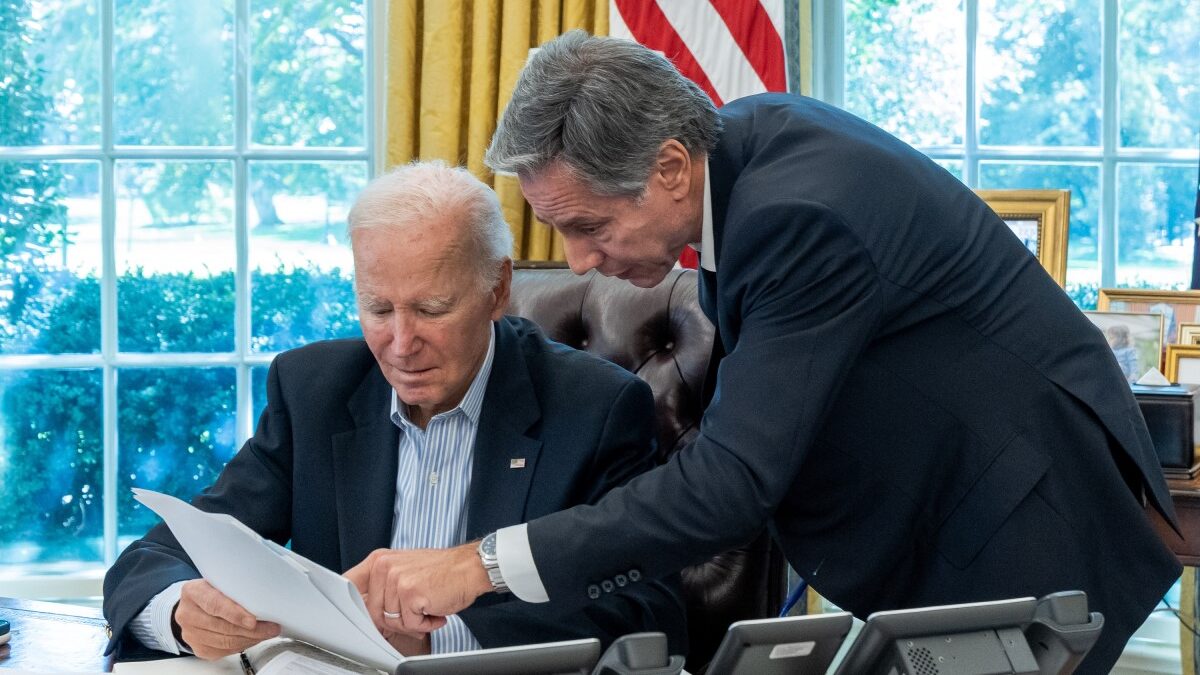
These were the first questions that popped into my mind when I saw the report from Politico that the Biden administration is promoting the war in Ukraine because it is good for American business. I think the members of the administration could not have experienced these things because, if they had, and if they had one ounce of humanity in them, they could not possibly have promoted war on the “it’s good for business” rationale.
Apparently, multiple White House aides have been involved in this abomination because Politico is quite specific:
The White House has been quietly urging lawmakers in both parties to sell the war efforts abroad as a potential economic boom at home.
Aides have been distributing talking points to Democrats and Republicans who have been supportive of continued efforts to fund Ukraine’s resistance to make the case that doing so is good for American jobs, according to five White House aides and lawmakers familiar with the effort and granted anonymity to speak freely.
The Biden administration is fearful that it cannot sell its most recent aid package on the merits and on national security grounds, because “The talking points are an implicit recognition that the administration has work to do in selling its $106 billion foreign aid supplemental request — and that talking about it squarely under the umbrella of national security interests hasn’t done the trick,” Politico states.
The reprehensibility of these comments cannot be overstated. Biden’s administration is peopled with a number of “elites” who probably are familiar, at least in a theoretical, intellectual sense, with John Stuart Mill’s dictum, “War is an ugly thing.” But, hey, if it’s good for business, particularly in electoral swing states, let’s go for it.
I am old enough to remember how the left tarred George Bush, Dick Cheney, and others in the GOP with the argument that they wanted war because it was good for their supporters in big business. I never put any stock in these arguments because I thought no American could be so evil as to support war as a sop to big business. The Biden administration has changed my mind.
My contempt and revulsion for these people knows no bounds.
John Lucas is a retired attorney who has tried and argued a variety of cases, including before the U. S. Supreme Court. Before entering law school at the University of Texas, he served in the Army Special Forces as an enlisted man, later graduating from the U. S. Military Academy at West Point in 1969. He is an Army Ranger who fought in Vietnam as an infantry platoon leader. He is married with five children. He and his wife now live in Virginia. John also is published at johnalucas6.substack.com.
Unlike the military-industrial complex, the Censorship Complex affects all aspects of governance, controlling the information available to you on every topic.
The Biden administration may have abandoned plans to create a “Disinformation Board,” but a more insidious “Censorship Complex” already exists and is growing at an alarming speed.
This Censorship Complex is bigger than banned Twitter accounts or Democrats’ propensity for groupthink. Its funding and collaboration implicate the government, academia, tech giants, nonprofits, politicians, social media, and the legacy press. Under the guise of combatting so-called misinformation, disinformation, and mal-information, these groups seek to silence speech that threatens the far-left’s ability to control the conversation — and thus the country and the world.
Americans grasped a thread of this reality with the release of the “Twitter Files” and the Washington Examiner’s reporting on the Global Disinformation Index, which revealed the coordinated censorship of speech by government officials, nonprofits, and the media. Yet Americans have no idea of the breadth and depth of the “Censorship Complex” — and how much it threatens the fabric of this country.
In his farewell address in 1961, President Dwight D. Eisenhower cautioned against the “potential for the disastrous rise of misplaced power” via the new sweeping military-industrial complex. Its “total influence — economic, political, even spiritual — [was] felt in every city, every statehouse, every office of the federal government.” Replace “military-industrial” with “censorship,” and you arrive at the reality Americans face today.
Origins of the Censorship Complex
Even with the rise of independent news outlets, until about 2016 the left-leaning corporate media controlled the flow of information. Then Donald Trump entered the political arena and used social media to speak directly to Americans. Despite the Russia hoax and the media’s all-out assault, Trump won, proving the strategic use of social media could prevail against a unified corporate press. The left was terrified.
Of course, Democrats and the media couldn’t admit their previous control over information converted to electoral victories and that for their own self-preservation, they needed to suppress other voices. So instead, the left began pushing the narrative that “disinformation” — including Russian disinformation — from alternative news outlets and social media companies handed Trump the election.
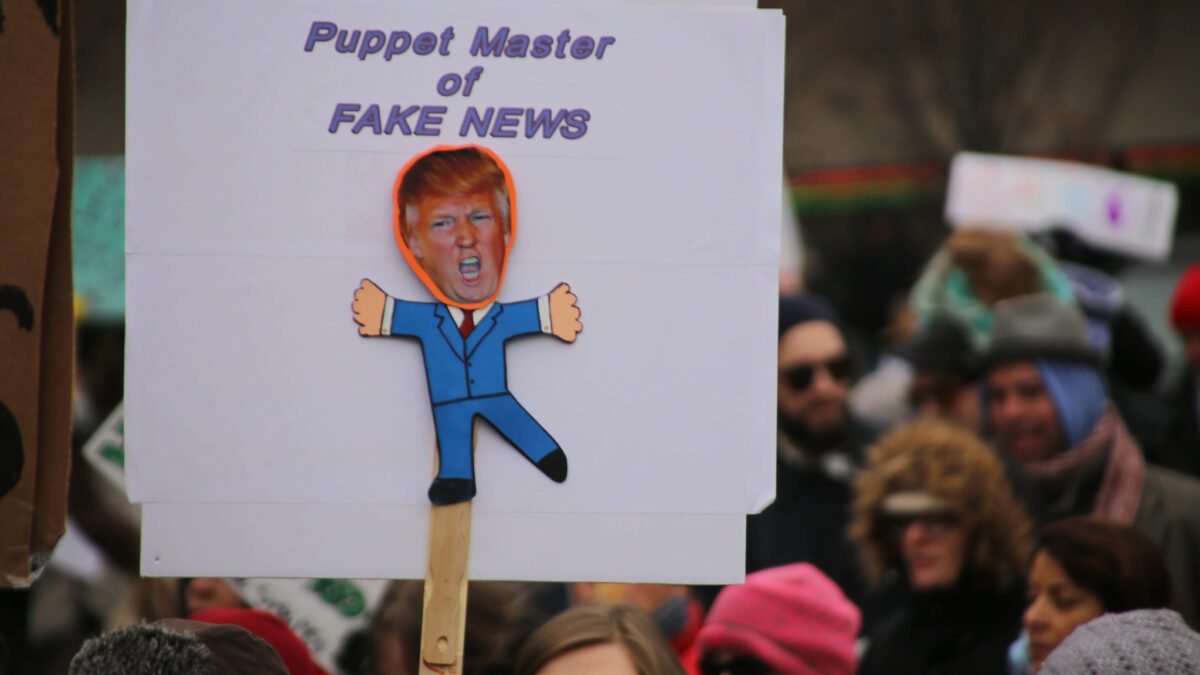
The New York Times first pushed the “disinformation” narrative using the “fake news” moniker after the 2016 election. “The proliferation of fake and hyperpartisan news that has flooded into Americans’ laptops and living rooms has prompted a national soul-searching, with liberals across the country asking how a nation of millions could be marching to such a suspect drumbeat. Fake news, and the proliferation of raw opinion that passes for news, is creating confusion,” the Times wrote, bemoaning the public’s reliance on Facebook.
“Narrowly defined, ‘fake news’ means a made-up story with an intention to deceive, often geared toward getting clicks. But the issue has become a political battering ram, with the left accusing the right of trafficking in disinformation, and the right accusing the left of tarring conservatives as a way to try to censor websites,” the Times wrote, feigning objectivity. But its conclusion? “Fake and hyperpartisan news from the right has been more conspicuous than from the left.”
Two days later, Hillary Clinton repeated the narrative-building phrase, condemning what she called “the epidemic of malicious fake news and false propaganda that flooded social media over the past year.” But then, as if to remind Democrats and the legacy press that he had wrestled control of the narrative from them, Trump branded left-wing outlets “fake news” — and just like that, the catchphrase belonged to him.
Disinformation Is Scarier if It’s Russian
That didn’t deter the left in its mission to destroy alternative channels of communication, however. The media abandoned its “fake news” framing for the “disinformation” buzzword. “Misinformation” and “mal-information” were soon added to the vernacular, with the Department of Homeland Security even defining the terms.
But silencing conservatives would require more than merely labeling their speech as disinformation, so the various elements of the Censorship Complex deployed what they called “the added element of Russian meddling” in the 2016 election, with Clinton amplifying this message and blaming the spread of social media misinformation for her loss.
Priming the public to connect “disinformation” with Russia’s supposed interference in the 2016 election allowed the Censorship Complex to frame demands for censorship as patriotic: a fight against foreign influence to save democracy!
The Censorship Complex Expands
The Censorship Complex’s push to silence speech under the guise of preventing disinformation and election interference hit its stride in 2017, when FBI Director Christopher Wray launched the Foreign Influence Task Force (FITF) purportedly “to identify and counteract malign foreign influence operations targeting the United States.”
The “most widely reported” foreign influence operations these days, Wray said, “are attempts by adversaries — hoping to reach a wide swath of Americans covertly from outside the United States — to use false personas and fabricated stories on social media platforms to discredit U.S. individuals and institutions.” Wray’s statement perfectly echoed the claims Clinton and Democrats had peddled ad nauseam in the press, and it foreshadowed how the Censorship Complex would soon mature.
The launch of the FITF in 2017 brought together numerous representatives from the deep state. The FBI’s Counterintelligence, Cyber, Criminal, and Counterterrorism Divisions worked closely with the Office of the Director of National Intelligence, the Department of Homeland Security, and other intelligence agencies, as well as “state and local enforcement partners and election officials.”
Significantly, the FITF viewed “strategic engagement with U.S. technology companies, including threat indicator sharing,” as crucial to combatting foreign disinformation. That perspective led to the FBI’s hand-in-glove relationship with Twitter, which included monthly and then weekly meetings with the tech giant, some of which CIA representatives attended. This symbiotic relationship also led to the censorship of important — and true — political speech, such as the New York Post’s reporting on the Hunter Biden laptop, which exposed the Biden family’s pay-to-play scandal right before a critical presidential election.
State Department Renovates Its Wing
In 2011, by executive order, the Department of State established the Center for Strategic Counterterrorism Communications to support government agencies’ communications “targeted against violent extremism and terrorist organizations.” While renamed the Global Engagement Center in 2016, the center’s counterterrorism mission remained largely unchanged. But then at the end of that year, Congress expanded the Global Engagement Center’s authority, directing it “to address other foreign state and non-state propaganda and disinformation activities.” And with language straight out of the Russia hoax playbook, the John S. McCain National Defense Authorization Act for Fiscal Year 2019 further refined the Global Engagement Center’s mission:
The purpose of the Center shall be to direct, lead, synchronize, integrate, and coordinate efforts of the Federal Government to recognize, understand, expose, and counter foreign state and foreign non-state propaganda and disinformation efforts aimed at undermining or influencing the policies, security, or stability of the United States and United States allies and partner nations.
Together, the State Department and the many intelligence agencies behind the FITF worked not just with Twitter but with the array of tech giants, such as Google and Facebook, pushing for censorship of supposed mis-, dis-, and mal-information. But the deep state was not alone. The “disinformation” contagion also reached the Hill, nonprofits, think tanks, and academic institutions with both politics and a desire to suckle at the federal teat driving a frenzied expansion of the project. Together these groups pushed for even more silencing of their opponents, and the Censorship Complex boomed.
The danger Eisenhower warned the country of in 1961 is mild in comparison to the threat of the Censorship Complex. Unlike the military-industrial complex that reached only one function of the federal government, the Censorship Complex affects all aspects of governance, controlling the information available to you and your fellow Americans on every topic.
Margot Cleveland is The Federalist’s senior legal correspondent. She is also a contributor to National Review Online, the Washington Examiner, Aleteia, and Townhall.com, and has been published in the Wall Street Journal and USA Today. Cleveland is a lawyer and a graduate of the Notre Dame Law School, where she earned the Hoynes Prize—the law school’s highest honor. She later served for nearly 25 years as a permanent law clerk for a federal appellate judge on the Seventh Circuit Court of Appeals. Cleveland is a former full-time university faculty member and now teaches as an adjunct from time to time. As a stay-at-home homeschooling mom of a young son with cystic fibrosis, Cleveland frequently writes on cultural issues related to parenting and special-needs children. Cleveland is on Twitter at @ProfMJCleveland. The views expressed here are those of Cleveland in her private capacity.
Americans Voted To End War In Syria, But This Unelected Bureaucrat Lied To Overrule Them
Defense One, a subsidiary of The Atlantic, came out with a story last week about a man named Jim Jeffrey. If you haven’t heard of him, don’t feel bad, but he’s pretty important in Washington, D.C. Under his fancy title, he’s been appointed to oversee the U.S. fight against ISIS and what are supposed to be the limited operations of the American troops who still remain in Syria.
Jeffrey is now also a hero in D.C., because in the interview with Defense One he bragged about how he misled President Donald Trump and other top White House officials about the real number of U.S. troops in Syria.“We were always playing shell games to not make clear to our leadership how many troops we had there,” Jeffrey told the Defense One reporter.
The Establishment Wants War in Syria
To say that the D.C. foreign policy establishment wants a U.S. ground presence in Syria is an understatement. During the Obama administration, partisan former Central Intelligence Agency Director John Brennan spent $1 billion from taxpayers per year trying to arm “moderate” rebels in Syria. What Brennan got was loads of American weapons in the hands of jihadists, including ISIS affiliates. In one example, a particular program trained 15,000 rebels in Jordan and returned them to Syria. Only “four or five” recruits out of the 15,000 turned up to fight. The rest either joined jihadist forces, including ISIS, or sold their American weapons to these forces.
The futility of regime change efforts didn’t deter official Washington, however. Western media raved about “the white helmets.” They also glossed over the fact that there were few moderate rebels and that many of America’s preferred rebels to take on the dictatorship of Bashar al-Assad were guilty of unspeakable brutalities.
Meanwhile, a civil war pitting Muslim Sunnis against Shias — which was partly fueled by American money and weapons and certainly fueled by weapons and money from Gulf Sunni states, including Saudi Arabia — caused a humanitarian crisis. Millions of refugees flooded Europe. Into this chaos and power vacuum stepped ISIS, which at its pinnacle had amassed a huge amount of territory in Iraq and Syria.
On the campaign trail in 2016, Trump repeatedly promised to destroy ISIS and then get U.S. troops out of Syria. This was a large difference between Trump and his Republican primary opponents and then later Hillary Clinton, who argued that U.S. involvement in Syria should not be limited to destroying the Islamic State and that the United States should topple Assad.
Trump’s view was that if Assad was toppled, the power vacuum would be greater, and the jihadist problem would worsen. He also argued that such a move was not in America’s interest, had no clear exit strategy, and would cause an even greater humanitarian disaster, including thousands of dead American troops.
As president, Trump routinely called Syria a place of “sand and death.” Multiple times he attempted to pull the United States out of Syria, only to be met with Assad allegedly striking civilians and official Washington clamoring for a response. Finally, in December 2018, Trump gave a withdrawal order. This led to the resignation (or firing) of Defense Secretary Jim Mattis, along with Brett McGurk, the former special envoy for Syria. Trump repeated that order in October 2019.
Jeffrey called Trump’s decision to fulfill his campaign promise and remove U.S. troops from Syria “the most controversial thing in my fifty years in government.” Each time Trump gave the withdrawal order, according to Jeffrey, Trump was“convinced to leave a residual force in Syria and the fight continued.” In reality, officials kept troops behind far above the “residual force,”unbeknownstto the president.
“What Syria withdrawal? There was never a Syria withdrawal,”Jeffrey bragged. “When the situation in northeast Syria had been fairly stable after we defeated ISIS, [Trump] was inclined to pull out. In each case, we then decided to come up with five better arguments for why we needed to stay. And we succeeded both times. That’s the story.”
Officially, America has 200 to 400 troops on the ground in northeast Syria, ostensibly to guard the oil fields in that area held by U.S. Kurdish allies. Anonymous officials say the number is more like 900 today, however, and Jeffrey told Defense One that the number of troops in Syria is “a lot more than” the roughly 200 troops that Trump agreed to leave behind there in October 2019.
Defense One concluded its story by noting that Jeffrey didn’t support Trump but agrees with Trump’s “realpolitik” Middle East foreign policy and efforts to make North Atlantic Treaty Organization members pay more for defense. Jeffrey also said he views Joe Biden favorably. In fact, after signing a letter in 2016 that said Trump was unfit for the presidency, it appears as if Jeffrey still opposes Trump: “I know what I did in 2016, I do not disagree with that,”Jeffrey said.
While Defense One quoted colleagues who said Jeffrey is a “consummate apolitical public servant,” many others were upset by Jeffrey’s admissions. Republican Rep. Jim Banks of Indiana, a member of the House Armed Services Committee, is furious and called for Jeffrey to be “punished.”
Who Has the Power in America?
People in Middle America should be enraged by Jeffrey’s interview. Washington, D.C., should be terrified that the American people might realize people like Jeffrey are only the tip of the iceberg. Jeffrey might be completely right about his view of the world and probably thinks he was doing the right thing, but that doesn’t matter. It doesn’t make Jeffrey’s behavior any less abhorrent.
People didn’t elect Jeffrey to anything. They elected Trump in 2016, and one factor in a bunch of working-class Americans opting for Trump was his promise not to start a new war in the Middle East. A large majority of Americans don’t want U.S. ground troops in Syria. Even a large chunk of Democrats who abhor Trump technically agree with his Syria policy. Labeling Jeffrey a “public servant” is a sick joke. Jeffrey is serving himself, or at least serving his ideology — and he does have an ideology.
Yes, it was Trump’s fault he hired people like John Bolton, a neoconservative ideologue who thought it was his job to stop Trump from following through with his campaign promises. Yet Trump isn’t ideological, and he often filled positions based on the recommendations of those around him, many of whom were card-carrying members of the Republican establishment.
Either way, Trump took a lot of heat for his order to pull troops out of Syria. Mattis resigned, and Democrats, media outlets, and Republicans such as Liz Cheney attacked Trump. Detractors hurled constant accusations that Trump wanting to get U.S. troops out of Syria was yet further proof he was a stooge of Russian President Vladimir Putin. Trump’s differences on foreign policy compared to the D.C. establishment, including over Syria policy, was even a significant factor in the FBI’s decision to legitimize baseless conspiracy theories that Trump was an agent of Russia.
Let’s step back for a second. Millions of working-class Americans, who also voted for Barack Obama, voted for Trump in 2016 because they wanted a change to policy. Now assume Trump is gone, and, truthfully, not much has changed on a fundamental level for many of these working-class citizens. What will happen when a large chunk of the American people realize their votes don’t affect policy?
Trump was considered norm-breaking and obnoxious to these D.C. insiders. Have these insiders not considered that the same people who sent Trump to the White House to shake things up might eventually opt for someone even more norm-breaking than Trump?
Willis L. Krumholz holds a JD and MBA degree from the University of St. Thomas. The views expressed are those of the author only. You can follow Willis on Twitter @WillKrumholz.
American Family Association
American Family Association (AFA), a non-profit 501(c)(3) organization, was founded in 1977 by Donald E. Wildmon, who was the pastor of First United Methodist Church in Southaven, Mississippi, at the time. Since 1977, AFA has been on the frontlines of Ame
NEWSMAX
News, Opinion, Interviews, Research and discussion
Opinion
American Family Association
American Family Association (AFA), a non-profit 501(c)(3) organization, was founded in 1977 by Donald E. Wildmon, who was the pastor of First United Methodist Church in Southaven, Mississippi, at the time. Since 1977, AFA has been on the frontlines of Ame
American Family Association
American Family Association (AFA), a non-profit 501(c)(3) organization, was founded in 1977 by Donald E. Wildmon, who was the pastor of First United Methodist Church in Southaven, Mississippi, at the time. Since 1977, AFA has been on the frontlines of Ame
You Version
Bible Translations, Devotional Tools and Plans, BLOG, free mobile application; notes and more
Political
American Family Association
American Family Association (AFA), a non-profit 501(c)(3) organization, was founded in 1977 by Donald E. Wildmon, who was the pastor of First United Methodist Church in Southaven, Mississippi, at the time. Since 1977, AFA has been on the frontlines of Ame
NEWSMAX
News, Opinion, Interviews, Research and discussion
Spiritual
American Family Association
American Family Association (AFA), a non-profit 501(c)(3) organization, was founded in 1977 by Donald E. Wildmon, who was the pastor of First United Methodist Church in Southaven, Mississippi, at the time. Since 1977, AFA has been on the frontlines of Ame
Bible Gateway
The Bible Gateway is a tool for reading and researching scripture online — all in the language or translation of your choice! It provides advanced searching capabilities, which allow readers to find and compare particular passages in scripture based on




 What Did You Say?