Perspectives; Thoughts; Comments; Opinions; Discussions

Posts tagged ‘Kurds’

Rand Paul Blocks Vote on House Measure Condemning Trump’s Syria Withdrawal


Written by Joshua Caplan | 

URL of the original posting site: https://www.breitbart.com/politics/2019/10/17/rand-paul-blocks-vote-on-house-measure-condemning-trumps-syria-withdrawal/

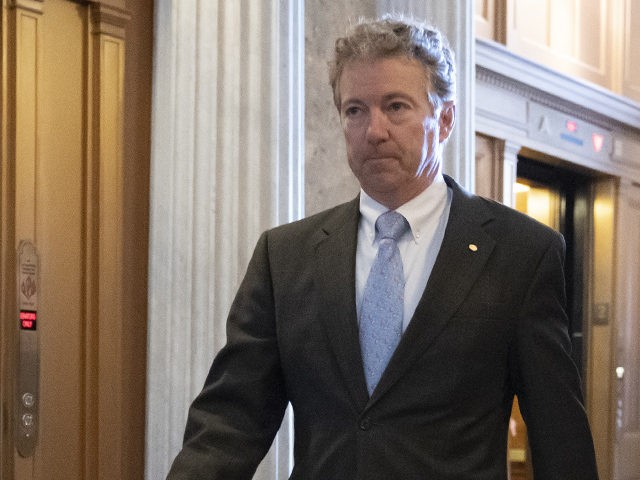
Sen. Rand Paul, R-Ky., walks to the Senate as an 11th-hour Republican rescue mission to keep President Donald Trump from a Senate defeat on his signature issue of building barriers along the southwest border seems near collapse, at the Capitol in Washington, Wednesday, March 13, 2019. (AP Photo/J. Scott Applewhite)

Sen. Rand Paul (R-KY), one of Congress’s most prominent non-interventionists, blocked a move on Thursday to bring a House-approved measure formally condemning President Donald Trump’s withdrawal of U.S. troops from northern Syria.

Senate Minority Leader Charles Schumer (D-NY) attempted to gain consent to introduce the measure to the upper chamber’s floor, but because it requires unanimous consent, any senator has the ability to thwart it.

“The most important thing we can do right now is send President Trump a message that Congress, the vast majority of Democrats and Republicans, demand he reverse course,”Schumer said.

Paul argued Schumer was attempting to circumvent the U.S. Constitution by bringing the measure to a vote.

“He should come to the floor and say that we are ready to declare war. We are ready to authorize force, and we are going to stick our troops in the middle of this messy, messy, five-sided civil war where we would be ostensibly opposed to the Turkish government that has made an incursion,” he said.

The House had passed a resolution Wednesday condemning President Trump’s decision to withdraw U.S. troops from Syria in a 354-60 vote.

The move by Paul comes as U.S. officials said Turkish President Recep Tayyip Erdogan has agreed to stop its offensive in Syria, signaling an end to a military campaign that has so far killed dozens of Kurdish fighters and drawn international condemnation.

Vice President Mike Pence announced the agreement for a five-day cease-fire after hours of bilateral meetings in Ankara among U.S. and Turkish officials — which included Erdogan and Secretary of State Mike Pompeo. The situation will be re-evaluated at the end of the five-day deal.

Erdogan’s forces began Operation Peace Spring a week ago in northeast Syria, to clear border territories of Kurdish fighters so Ankara can send back Syrian refugees who fled to Turkey. The Turkish leader has previously insisted he would accept no cease-fire.

“The United States and Turkey have both mutually committed to a peaceful resolution and future for the safe zone, working on an international basis to ensure that peace and security defines this border region with Syria,” Pence stated.

The UPI contributed to this report. 

Obama Breathes Life Into Syrian Marxist Movement, With Millions In Aid


waving flagAuthored by Saagar Enjeti / Reporter / 01/08/2017

URL of the original posting site:  http://dailycaller.com/2017/01/08/obama-breathes-life-into-syrian-marxist-movement-with-millions-in-aid/#ixzz4VJBvKkQ2

U.S. anti-ISIS military assistance is emboldening Syrian Kurdish Marxist rebels, threatening to destabilize the region for decades.

The Kurdish rebels, known as the Yekîneyên Parastina Gel‎ (YPG), subscribe to a Marxist ideology propagated by a jailed terrorist leader. The YPG has deep ties to the Turkish, Kurdistan Worker’s Party (PKK), which is a Kurdish independence group and recognized as a terrorist organization by the U.S. government.

The YPGhowever, has proven to be the most effective force in the anti-ISIS fight in Syria. Hundreds of U.S. military advisors are embedded with Kurdish militias, and they frequently receive aerial assistance from the U.S. military. The increasing reliance on such groups by the Obama administration has caused a major rift between the U.S. and Turkey, and made the YPG stronger than it has ever been before.

Turkey regards the YPG as big of a threat to its existence as the Islamic State, and invaded northern Syria in late August to deny any further Kurdish attempts at establishing a de-facto state along its border.

“The military support has boosted the YPG’s confidence to move beyond Kurdish populated areas and grow their ambitions even beyond Syria,” International Crisis Group expert Maria Fantappie told The Washington Post. “It has huge political implications not only for Syria but also for neighboring ­countries,” she continued.

Reporters overheard several Marxist screeds in a recent visit to Kurdish-controlled northern Syria. One man was heard saying, “The state is an instrument of oppression.” Another said of the ideology, “It is like having a democratic mother who does not discriminate against her children.”

President-elect Donald Trump has not indicated what his anti-ISIS strategy will be, but has expressed sympathy for Iraqi Kurds in the past. A recent Syrian ceasefire struck by Russia, Syria, Turkey, and Iran may indicate that the Kurds will not have as large as a say in the future of Syria. Turkey is highly unlikely to cede any major power to the Kurdish rebel groups.

Islamic State attack on Iraqi base leaves hundreds missing, shows army weaknesses


Obamacare

http://www.washingtonpost.com/world/middle_east/islamic-state-attack-on-iraqi-base-leaves-hundreds-missing-shows-army-weaknesses/2014/09/22/9a8b9e4d-0fea-4650-8816-5e720dbffd04_story.html

A Kurdish fighter stands guard at a temporary military camp in Gwar, northern Iraq, as his colleagues train before deploying to fight the Islamic State. (Ahmed Jadallah/Reuters)

 By Loveday Morris September 22 at 6:23 PM

BAGHDAD — The army base in Iraq’s western Anbar province had been under siege by Islamic State militants for a week, so when a convoy of armored Humvees rolled up at the gate, the Iraqi soldiers at Camp Saqlawiyah believed saviors had arrived.

But this was no rescue attempt. The vehicles were driven by militants on suicide missions, and within seconds on Sunday the base had become a bloody scene of multiple bombings.

On Monday, a day after the attack, five survivors — including three officers — said that between 300 and 500 soldiers were missing and believed to be dead, kidnapped or in hiding. Army officials said the numbers were far lower, leading to accusations that they were concealing the true toll.

If the survivors’ accounts are correct, it would make Sunday the most disastrous day for the Iraqi army since several divisions collapsed in the wake of the Islamic State’s capture of the northern city of Mosul amid its cross-country sweep in June.

In any case, the chaotic incident has highlighted shortcomings in an army that the United States has spent billions of dollars training and equipping, and it has further undermined the force’s reliability as a partner as President Obama expands airstrikes into provinces including Anbar.Battling ISIS 01 Battling ISIS 02 Battling ISIS 03 Battling ISIS 04 Battling ISIS 05  Battling ISIS 07 Battling ISIS 08 Battling ISIS 09 Battling ISIS 10 Battling ISIS 11 Battling ISIS 12 Battling ISIS 13 Battling ISIS 14 Battling ISIS 15 Battling ISIS 16 Battling ISIS 17 Battling ISIS 18 Battling ISIS 19 Battling ISIS 20 Battling ISIS 21 Battling ISIS 22 Battling ISIS 23 Battling ISIS 24 Battling ISIS 25 Battling ISIS 26 Battling ISIS 27

It has also heightened pressure on new Prime Minister Haider al-Abadi, whose opponents have already seized on the incident to accuse him of a soft-handed approach to terrorists.

While U.S. aircraft have carried out strikes in support of Iraqi forces in other recent clashes, there was no indication that any American airstrikes were made against these Islamic State attackers, other than unconfirmed reports from Iraqi officials. Accounts released Sunday and Monday by U.S. Central Command made no mention of the overrun Iraqi base.

The lead-up to Sunday’s crisis began a week ago, when the last road to Camp Saqlawiyah, just north of insurgent-controlled Fallujah, was cut by Islamic State militants. One of two tanks that were among the vehicles guarding the road left to refuel, and the militants took the opportunity to attack those that remained, said a 9th Division soldier who was present and spoke on the condition of anonymity because he was not authorized to speak to the news media.

The fall of the units protecting the supply route meant that the five battalions inside the base were completely besieged.

“There were no reinforcements, no food supplies, no medicine, no water, and then our ammunition began to run out,” said 1st Lt. Haider Majid, 28. “We called our leaders so many times. We called our commanders, we called members of parliament, but they just left us there to die.”

Soldiers said they sought help from Lt. Gen. Rashid Fleih, the head of Anbar Military Command. He told Iraq’s al-Sumaria news on Monday that the troops on the base were just complaining because they were trapped and “bored.”

Fleih said the army had delivered supplies while the base was under siege. But soldiers maintained that they received nothing, and thirst eventually forced them to dig a hole to dirty, salty water.

“Even if it was dangerous for helicopters, it was their duty to try to help us,” Majid said.

Survivors said they faced daily attacks during the week, including one using chlorine gas, a claim that was impossible to verify Monday. While some said colleagues had suffocated in the attack, Col. Ihab Hashem, the deputy commander of an 8th Division battalion, said canisters had fallen short of the base. 

Attackers in disguise

The major assault came Sunday. Soldiers interviewed said army commanders had sent word via walkie-talkie that a rescue mission was on its way and had taken control of a nearby bridge.

Shortly afterward, Iraqi army armored vehicles and military trucks arrived, and the men inside were dressed in the uniforms of Iraqi counterterrorism forces, the surviving soldiers said.

“We thought this was the support we were promised was on the way,” said Capt. Ahmed Hussein of the 8th Division. “The first three Humvees were ahead of the rest with some military trucks. We just let them in.”

One Humvee exploded in the middle of the camp. The two others drove to the perimeter and detonated. The rest of the Islamic State convoy was held back at the entrance, where the survivors said the militants carried out several more suicide bombings as they tried to break in.

“I gathered my soldiers and said: ‘We are going to die anyway. Let’s try to get out,’ ” Hussein said, adding that he and about 400 other soldiers escaped under heavy fire in a convoy. Others were left behind.

Those who got away divided into three groups, eventually leaving their vehicles after some were hit by roadside bombs. They continued on foot, traversing nearly two miles of territory held by the Islamic State until they reached Camp Tariq, about four miles away.

“I was in the first group; there were about 150 soldiers in each,” Hussein said. “Only about half of each group made it.”

The rescue mission that the soldiers had been told was coming “100 percent failed,” he said. On the bridge that they were told had been secured, they found the remnants of that mission: burned army vehicles.

“No one knows how many people died,” said the 9th Division soldier, who spent days stranded in a house with 60 other soldiers. “We kept moving and never looked behind. Those who died, died. Those who were captured, were captured. We just ran for our lives.”

Hussein estimated that 250 soldiers died at Camp Saqlawiyah, and 100 to 150 are missing. Hashem put the number of dead and missing at 400 to 500.

But there were hopes that some might still make it back. A group of 13 has been in contact, according to Hashem, to say they are hiding in marshlands, another 13 in a grove of trees. He advised them to wait until the cover of night to try to make the rest of the journey.

Government’s response

The Iraqi Defense Ministry acknowledged Sunday that it had lost contact with some of its soldiers during the incident but did not say how many were missing. Fleih said that it was possible to “count them on one hand.”

“It looks like the Defense Ministry is trying to push the numbers down,” said Mithal al-Alusi, a member of the Iraqi parliament’s defense and security committee. “If we have lost people or not, this proves military structure and military strategy is not able to fight ISIS,” he said, using an acronym for the Islamic State.

He added: “Mosul they said was a surprise — what’s the excuse this time?”

Abadi, who also holds the position of commander in chief of the armed forces, issued a statement Monday saying army commanders would be interrogated on charges of negligence. The statement said the prime minister had ordered supplies to be delivered to the stranded soldiers four days ago.

For some soldiers, the incident was the latest — and last — in a series of humiliations. Hussein, for his part, said he would leave the army to join a Shiite militia.

“We don’t have any leadership,” he said. But for the militias, “their leadership is with them in the field; they look after their soldiers.”

Mustafa Salim contributed to this report.

Kurdish Soldiers: ISIS Close to Surrounding Baghdad


http://www.breitbart.com/Big-Peace/2014/06/25/Kurdish-Soldiers-ISIS-Close-to-Surrounding-Baghdad

25 Jun 2014

An extensive McClatchy report quotes several Kurdish military leaders who are significantly concerned that Baghdad could fall to ISIS. At least two critical towns that hold a supply route to Baghdad have been captured, they reported, and ISIS appeared to be traveling south to capture routes on the other side of the capital.

ConfusedJabbar Yawar, the spokesman for the Kurdish peshmerga militia, told McClatchy that ISIS was reportedly six miles from Baghdad at times. “This area controls access to southern Iraq, and it appears as if they might try to push into Baghdad or even south towards the city of Hilla,” he stated.

ISIS moving south of Baghdad is significant because of strongholds they already possess in Anbar province, to the west, and their initiatives to control the north. They have also been moving ISIS jihadists east to attempt to cut off the remaining roads to the city.

The Kurdish peshmerga forces reportedly are the biggest force standing between ISIS and a complete control of Iraq, as many Iraqi soldiers have either been killed in mass executions or deserted. Kurdish areas have remained largely in peace, and ISIS has rarely clashed with peshmerga forces directly. Nonetheless, the Kurdish forces appear to have little interest in collaborating with the government of Prime Minister Nouri al-Maliki, instead aiming to sever their territory from Iraqi sovereignty.

The Iraqi government has largely denied many of ISIS’s gains in the country. According to CNN, the Iraqi government claims they still control the nation’s largest oil refinery in Baiji after reports surfaced that ISIS jihadists had taken it over. Deputy Prime Minister for Energy Affairs Hussain al-Shahristani said in a statement that the Iraqi army is not in full control of the oil refinery but continues to fight and is slowly encircling it. Iraqi state media also claims the army has killed the jihadist allegedly leading the attack on Baiji, Abu Qutada.

Obama defending muslimsKurdish leaders told McClatchy that they, too, were told Iraqi forces were still fighting in Baiji and had not fully lost control of the refinery.

While the Kurds continue to fight ISIS and remain the most organized and feared military in Iraq, the United States government is urging Kurdish leaders to abandon dreams of sovereignty. During a visit to Iraqi Kurdistan this week, Secretary of State John Kerry urged Kurdish leaders to promote national unity and participate in the Iraqi government.

Who is better off

Wake up America
Article collective closing


Just in Case You Do Not Know


Trigger the Vote

Click on image to see movie trailer and more

Click on image to see movie trailer and more


I went to Wikipedia to get information for you in case you do not know the difference between Sunni Islam, Shea Islam and the Kurds. Without doing any of my editorializing, here are parts of what Wikipedia had to say;


Sunni Islam

From Wikipedia, the free encyclopedia

Jump to: navigation, search

This article contains Arabic text. Without proper rendering support, you may see question marks, boxes, or other symbols.

The Al-Azhar University in Cairo, Egypt. Built by the Fatimids, it has become an important centre of Sunni Islamic learning ever since.

Part of a series on
Sunni Islam
Beliefs
Five Pillars
Rightly-Guided Caliphs
Schools of Law
Schools of theology
Political movements
Hadith collections

Sunni Islam (/ˈsni/ or /ˈsʊni/) is the largest branch of Islam; its adherents are referred to in Arabic as ahl as-sunnah wa l-jamāʻah (Arabic: أهل السنة والجماعة‎), “people of the tradition of Muhammad and the consensus of the Ummah” or ahl as-sunnah (أهل السنة) for short. In English, they are known as Sunni Muslims, Sunnis, and Sunnites. Sunni Islam is the world’s second largest religious body, after Christianity [1] and largest religious denomination for any religion in the world. Sunni Islam is sometimes referred to as the orthodox version of the religion.[2][3] The word “Sunni” is believed to come from the term Sunnah (Arabic: سنة‎), which refers to the sayings and actions of the Islamic prophet Muhammad as recorded in hadiths.[4]

The primary collections consisting of Kutub al-Sittah accepted by Sunni orthodoxy, in conjunction with the Quran and binding consensus, form the basis of all jurisprudence within Sunni Islam. Laws are derived from these basic sources; in addition, Sunni Islam’s juristic schools recognize differing methods to derive verdicts such as analogical reason, consideration of public welfare and juristic discretion.

Shia Islam

From Wikipedia, the free encyclopedia

Jump to: navigation, search

“Shia” and “Shias” redirect here. For other uses, see Shia (disambiguation) and Shias (disambiguation).

This article contains Arabic text. Without proper rendering support, you may see question marks, boxes, or other symbols.


[hide] 

Part of a series onShīa Islam

Beliefs and practices
Holy days
History
Current Branches of Shi’ism

o    Ethnā‘asharī

o    Ghulāt

o    NīzārīIsmāʿīlīs

o    Mustā‘līTāyyībīs

Ahl al-Kisa
Holy Women

The Shia (Arabic: شيعة‎ Shīʿah) represent the second largest denomination of Islam and adherents of Shia Islam are called Shias or the Shi’a as a collective or Shi’i individually.[1] Shi’a is the short form of the historic phrase Shīʻatu ʻAlī (شيعة علي) meaning “followers”, “faction” or “party” of Muhammad‘s son-in-law and cousin Ali, whom the Shia believe to be Muhammad’s successor in the Caliphate. Twelver Shia (Ithnā’ashariyyah) is the largest branch of Shia Islam and the term Shia Muslim is often taken to refer to Twelvers by default. Shia Muslims constitute 10-20% of the world’s Muslim population and 38% of the Middle East‘s entire population.[2]

Shi’i Islam is based on the Quran and the message of the Islamic prophet Muhammad attested in hadith recorded by the Shia, and certain books deemed sacred to the Shia (Nahj al-Balagha).[3][4] Shia consider Ali to have been divinely appointed as the successor to Muhammad, and as the first Imam. In the centuries after the death of Muhammad, the Shia extended this “Imami” doctrine to Muhammad’s family, the Ahl al-Bayt (“the People of the House”), and certain individuals among his descendants, known as Imams, who they believe possess special spiritual and political authority over the community, infallibility, and other quasi-divine traits.[5]

Although there are myriad Shi’i subsects, modern Shi’i Islam has been divided into three main groupings: Twelvers, Ismailis and Zaidis.[6][7][8][9]

Kurds

From Wikipedia, the free encyclopedia

Jump to: navigation, search

“Kurd” redirects here. For other uses, see Kurd (disambiguation).

Kurdsکورد, Kurd
Saladin Sharaf Khan Bidlisi Nizami Qazi Muhammad Said Nursi
Ihsan Nuri Simko Shikak Mustafa Yamulki Husni al-Za’im Mahwi
Ostad Elahi Mustafa Barzani Jalal Talabani Massoud Barzani Muhsen al-Barazi
Saleh Muslim Leyla Zana Zaro Aga Karim Sanjabi Soad Hosny
Widad Akrawi Mohammad Bagher Ghalibaf Ahmet Kaya Dilsa Demirbag Sten Bahman Ghobadi
Total population
estimated 30[1] to 38 million[2][3]
Regions with significant populations
   Turkey 11–18.6 million 15.7–25%[1][2][3][4]
   Iran 6.5–7.9 million 7–10%[1][2]
   Iraq 6.2–6.5 million 15–23%[1][2]
   Syria 2.2–3 million 9–15%[2][5][6][7]
   Azerbaijan 150,000–180,000[8][9]
   Russia 63,818[10]
   Armenia 37,470[11]
   Georgia 20,843[12]

Diaspora

   Germany 800,000[13]
   Israel Over 150,000[14]
   France 135,000[8][dead link]
   Sweden 90,000[8][dead link]
   Netherlands 75,000[8][dead link]
   Belgium[dead link] 60,000[8]
   United Kingdom 49,921[15][16][17]
   Kazakhstan 41,431[18]
   Denmark 30,000[19]
   Jordan 30,000[20]
   Greece 28,000[21]
   United States 15,361[22]
    Switzerland 14,669[23]
   Kyrgyzstan 13,171[24][25]
   Canada 11,685[26]
   Finland 10,075[27]
   Australia 6,991[28]
   Turkmenistan 6.097[29]
   Austria 2,133[30]
Languages
Kurdish and Zazaki–Gorani In their different forms: Sorani, Kurmanji, Fayli, Southern Kurdish, Laki, Zazaki, Bajalani, Gorani
Religion
Mostly Islam (predominately Sunni, but also Shia and Sufism) with minorities of Atheism, Agnosticism, Yazdânism, Zoroastrianism, Christianity and Judaism
Related ethnic groups
other Iranian peoples
Footnotes
All population numbers are estimates by 3rd parties.

Turkey, Iran and Syria do not track or provide population statistics.

The Kurdish people, or Kurds (Kurdish: کورد, Kurd), are an ethnic group in Western Asia, mostly inhabiting a region known as Kurdistan, which includes adjacent parts of Iran, Iraq, Syria, and Turkey.

They are an Iranian people and speak the Kurdish languages, which are members of the Iranian branch of Indo-European languages.[31] The Kurds number about 30 million, the majority living in West Asia, with significant Kurdish diaspora communities in the cities of western Turkey, in Armenia, Georgia, Israel, Azerbaijan, Russia, Lebanon and, in recent decades, some European countries and the United States.

The Kurds have had partial autonomy in Iraqi Kurdistan since 1991. Nationalist movements in the other Kurdish-populated countries (Turkey, Syria, Iran) push for Kurdish regional autonomy or the creation of a sovereign state.

VOTE 02

Tag Cloud