
Perspectives; Thoughts; Comments; Opinions; Discussions

Posts tagged ‘July 4’

How The Declaration of Independence Inspired George Washington’s Underdog Army to Win


REPORTED BY: SCOTT POWELL | JULY 04, 2022
Read more at https://thefederalist.com/2022/07/04/how-the-declaration-of-independence-inspired-george-washingtons-underdog-army-to-win/

Declaration of Independence

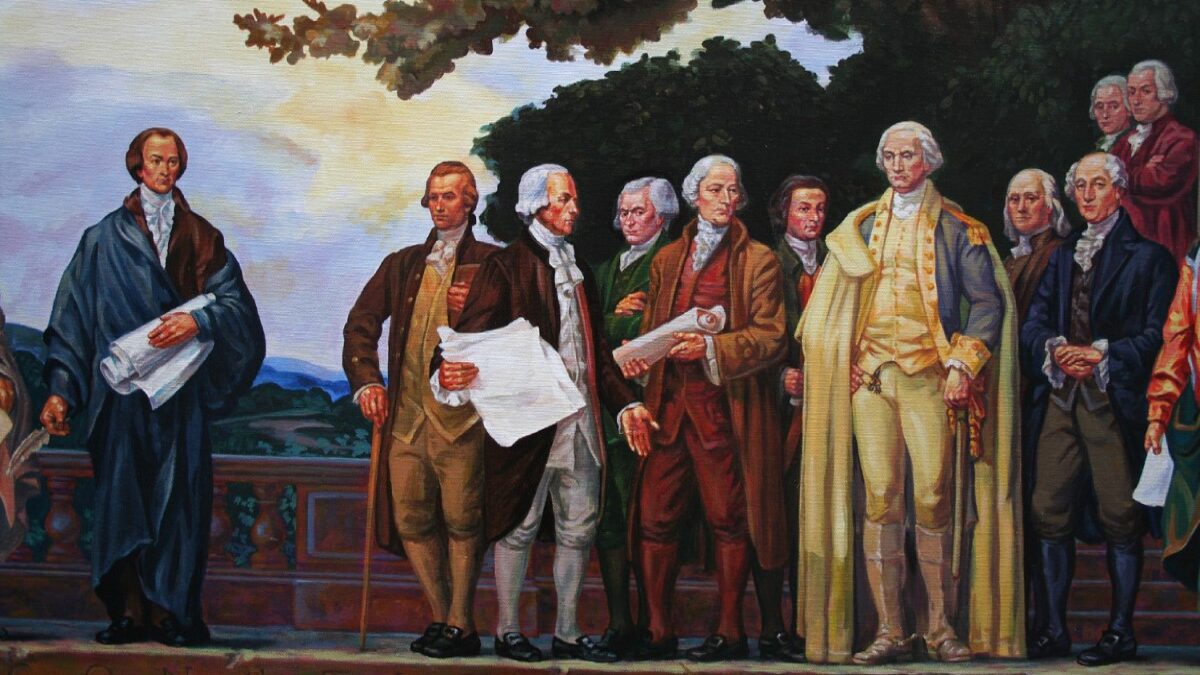
Deeply moved by the power of the Declaration’s words, George Washington ordered copies sent to all generals in the Continental Army.

Author Scott Powell profile

SCOTT POWELL

MORE ARTICLES

Most Americans celebrating the July 4 holiday today don’t fully realize that the power of ideas in the Declaration of Independence was the critical enabling factor for the Americans to win the War of Independence. Compared to the British professional military, the American colonial army was simply no match—it was undermanned, underfunded, underequipped, inexperienced, and undertrained. At the outset of the war, the British Royal Navy had 270 warships deployed in American waters, while the Continental Navy had seven ships.

On July 4, 1776, in what is now Manhattan, New York, Gen. George Washington was preparing for battle. He had no idea that a Declaration of Independence was being released in Philadelphia that day, as he pondered the sobering stream of British ships coming through the Narrows and anchoring off Staten Island in New York Harbor.

A month before, Washington had written a letter to his brother, saying: “We expect a very bloody summer of it in New York… If our cause is just, as I do most religiously believe it to be, the same Providence which in many instances appeared for us, will still go on to afford its aid.”

On July 4, 1776, in Philadelphia, it was also a somber day when those 56 members of the Continental Congress committed to signing the Declaration of Independence. Each knew that becoming a signatory put a death warrant on their heads for being a traitor to Great Britain.

Thus, the first Declaration of Independence that was signed on July 4 did not have signatures identifying the committed delegates. Rather, there were two signatures on that first document: John Hancock, president of the Continental Congress, and Charles Thomson, secretary of the Continental Congress.

It took more than two weeks for the Declaration to be “engrossed”—that is, written on parchment in a clear hand. Many of the 56 delegates to the Continental Congress who had agreed to sign the document did so on August 2, but new delegates replaced some six of the original delegates and an additional seven delegates could not sign until many weeks later. Recognizing the long odds against the small and underequipped American colonial army defeating the British army and navy—the most formidable military force in the world—the Continental Congress decided to hold the 56-signatory Declaration for release at a later time.

Washington’s First Read of the Declaration

Washington was in New York preparing its defense when on July 6, 1776, a courier arrived to deliver a copy of the two-signature Declaration of Independence that had been released in Philadelphia several days before. Deeply moved by the power of the Declaration’s words, Washington ordered copies sent to all generals in the Continental Army and that chaplains be hired for every regiment to assure that, “every officer and man, will endeavor so to live and act, as becomes a Christian Soldier, defending the dearest Rights and Liberties of his country.” 

Like the Mayflower Compact, the Declaration was a true covenant with God of absolute commitment, with its last sentence invoking: “with a firm reliance on the Protection of Divine Providence, we mutually pledge to each other our Lives, our Fortunes, and our sacred Honor.”

Washington read the Declaration repeatedly and became so moved that, on July 9, he called a halt to his troops’ battle preparations and announced a respite and gathering to read the Declaration to his soldiers and the townspeople. The crowd hustled down to lower Manhattan, where they gazed out at a forest of masts of the British ships at anchor in New York harbor. After the reading, when a few of the rowdies in the group spotted a statue of King George III, they pulled it down, to others’ tumultuous cheers.

By August, about 35,000 professionally trained and well-equipped British and Hessian mercenary soldiers had arrived on some 400 British ships. The number of soldiers under Washington’s command had some turnover since leaving Boston, but had grown slightly to about 18-19,000, with recent enlistees—primarily farmers, fishermen, and artisans—having no training.

When engagement with the British finally commenced on Long Island on August 27, the colonial army was quickly overwhelmed, with more than 1,000 taken prisoners. Washington decided to retreat from Long Island back to Manhattan to regroup in hope of fighting more successfully another day.

Constant Defeats, and Only a Few Key Victories

It was not to be over the next two months, as Washington’s troops faced two more devastating routs in New York—with six times more casualties than the British suffered and several thousand taken as prisoners. Washington was forced to leave New York in total and abject defeat.

It had been decided to place half the remaining American troops active in the New York campaigns under generals Lee and Gates. Washington would lead the rest and make their way south through New Jersey to Philadelphia. But for a gallant few among some 3,500 marching with Washington, nearly all thought the War for Independence was lost. Washington’s greatest challenge then was maintaining the morale, confidence, and loyalty of his diminished and discouraged troops.

Crossing over into Pennsylvania in early December, Washington’s army encamped on the banks of the Delaware River. Washington’s faith in God’s providence and his belief in the cause of independence sustained him, but he knew at this point only a decisive victory could bring about a reversal of fortune.

Just days later, intelligence from a spy revealed that a large contingent of German Hessians under British command was occupying Trenton, only nine miles away. Washington immediately began planning what would become the legendary crossing of the Delaware on Christmas night to march and strike at Trenton.

The surprise attack that ensued early the morning of December 26 was a resounding victory. A few days later, another intelligence tip was delivered, and Washington decided to make a second surprise attack on British regulars encamped in nearby Princeton.

Leading from the front, Washington displayed such courage, “with a thousand deaths flying around him,” that his men fought with greater vigor than ever and inspired the local townspeople to grab their arms and join in the fight. In short order there were many more British than American casualties, resulting in defeat with the surrender of some 300 Redcoats.

Victory Inspired by the Declaration’s Ideas

Perceiving this dual miracle as a harbinger of more victories to come, and perhaps with many recognizing the power of providence and the vital importance in the ideas manifest in the Declaration, the Continental Congress ordered the reprinting and dissemination to all the colonies of the now-famous 56-signature Declaration of Independence on January 18, 1777—more than six months after the original document had been drafted and approved.  

The Revolutionary War would grind on for nearly four more years. In the end, although Washington’s continental army lost six major battles and won only three, Washington’s courage, sacrifice, and persistence inspired and sustained everyone around him.

Of the 56 signers of the Declaration, nine fought and died from wounds or hardships of the Revolutionary War. Two had sons serving in the Continental Army who died, and another five signers were captured and tortured as traitors, and later died. Twelve of the 56 Declaration signers had their homes looted and destroyed.

A Willingness to Sacrifice All, If Necessary

The Americans’ willingness to sacrifice was on display during the battle of Yorktown from September 28 to October 19, 1781—the decisive and final battle in the war for independence. Thomas Nelson, Jr. a signer of the Declaration of Independence, who succeeded Thomas Jefferson as governor of Virginia, was a native of Yorktown.

When Nelson learned that his Yorktown home had been taken over and occupied as the military headquarters for British Gen. Charles Cornwallis, he urged Washington to aim his cannons and open fire on his own home. Nelson’s home was destroyed and a few weeks later Cornwallis surrendered and acknowledged the American final victory for its complete independence.

In the minds of many, Washington remains the greatest Founding Father because of his fearless courage in battle, his incredible perseverance against unfathomable odds, and his faith in Providence that provided protection and empowered him to achieve the impossible.

As we reflect on the meaning of July 4 this year, we should celebrate and take heart that the same good ideas and principles—natural God-given rights—expressed in the Declaration of Independence that inspired Washington—are as today as they were then. With renewed courage, those who believe in these ideas will be empowered to make good triumph over evil.


Scott S. Powell is senior fellow at Discovery Institute. This article is a vignette adapted from his acclaimed book, “Rediscovering America,” now Amazon’s No. 1 new release in the history genre. Reach him at scottp@discovery.org

God Bless You on this “Independence Day”, 2014


About the time our original 13 states adopted their new constitution, in 1787, Alexander Tyler, a Scottish history professor at the University of Edinburgh, had this to say about the fall of the Athenian Republic some 2,000 years prior:

“A democracy is always temporary in nature; it simply cannot exist as a permanent form of government. A democracy will continue to exist up until the time that voters discover that they can vote themselves generous gifts from the public treasury. From that moment on, the majority always votes for the candidates who promise the most benefits from the public treasury, with the result that every democracy will finally collapse due to loose fiscal policy, which is always followed by a dictatorship.”

Read more at http://conservativebyte.com/2014/03/democracy-temporary/#46wBsQAh7fOpbecA.99

The Declaration of Independence

IN CONGRESS, July 4, 1776.

The unanimous Declaration of the thirteen united States of America,

When in the Course of human events, it becomes necessary for one people to dissolve the political bands which have connected them with another, and to assume among the powers of the earth, the separate and equal station to which the Laws of Nature and of Nature’s God entitle them, a decent respect to the opinions of mankind requires that they should declare the causes which impel them to the separation.

We hold these truths to be self-evident, that all men are created equal, that they are endowed by their Creator with certain unalienable Rights, that among these are Life, Liberty and the pursuit of Happiness.–That to secure these rights, Governments are instituted among Men, deriving their just powers from the consent of the governed, –That whenever any Form of Government becomes destructive of these ends, it is the Right of the People to alter or to abolish it, and to institute new Government, laying its foundation on such principles and organizing its powers in such form, as to them shall seem most likely to effect their Safety and Happiness. Prudence, indeed, will dictate that Governments long established should not be changed for light and transient causes; and accordingly all experience hath shown, that mankind are more disposed to suffer, while evils are sufferable, than to right themselves by abolishing the forms to which they are accustomed. But when a long train of abuses and usurpations, pursuing invariably the same Object evinces a design to reduce them under absolute Despotism, it is their right, it is their duty, to throw off such Government, and to provide new Guards for their future security.–Such has been the patient sufferance of these Colonies; and such is now the necessity which constrains them to alter their former Systems of Government. The history of the present King of Great Britain is a history of repeated injuries and usurpations, all having in direct object the establishment of an absolute Tyranny over these States. To prove this, let Facts be submitted to a candid world.

  • He has refused his Assent to Laws, the most wholesome and necessary for the public good.
  • He has forbidden his Governors to pass Laws of immediate and pressing importance, unless suspended in their operation till his Assent should be obtained; and when so suspended, he has utterly neglected to attend to them.
  • He has refused to pass other Laws for the accommodation of large districts of people, unless those people would relinquish the right of Representation in the Legislature, a right inestimable to them and formidable to tyrants only.
  • He has called together legislative bodies at places unusual, uncomfortable, and distant from the depository of their public Records, for the sole purpose of fatiguing them into compliance with his measures.
  • He has dissolved Representative Houses repeatedly, for opposing with manly firmness his invasions on the rights of the people.
  • He has refused for a long time, after such dissolutions, to cause others to be elected; whereby the Legislative powers, incapable of Annihilation, have returned to the People at large for their exercise; the State remaining in the mean time exposed to all the dangers of invasion from without, and convulsions within.
  • He has endeavored to prevent the population of these States; for that purpose obstructing the Laws for Naturalization of Foreigners; refusing to pass others to encourage their migrations hither, and raising the conditions of new Appropriations of Lands.
  • He has obstructed the Administration of Justice, by refusing his Assent to Laws for establishing Judiciary powers.
  • He has made Judges dependent on his Will alone, for the tenure of their offices, and the amount and payment of their salaries.
  • He has erected a multitude of New Offices, and sent hither swarms of Officers to harass our people, and eat out their substance.
  • He has kept among us, in times of peace, Standing Armies without the Consent of our legislatures.
  • He has affected to render the Military independent of and superior to the Civil power.
  • He has combined with others to subject us to a jurisdiction foreign to our constitution, and unacknowledged by our laws; giving his Assent to their Acts of pretended Legislation:
  • For Quartering large bodies of armed troops among us: For protecting them, by a mock Trial, from punishment for any Murders which they should commit on the Inhabitants of these States:
  • For cutting off our Trade with all parts of the world:
  • For imposing Taxes on us without our Consent:
  • For depriving us in many cases, of the benefits of Trial by Jury:
  • For transporting us beyond Seas to be tried for pretended offences
  • For abolishing the free System of English Laws in a neighboring Province, establishing therein an Arbitrary government, and enlarging its Boundaries so as to render it at once an example and fit instrument for introducing the same absolute rule into these Colonies:
  • For taking away our Charters, abolishing our most valuable Laws, and altering fundamentally the Forms of our Governments:
  • For suspending our own Legislatures, and declaring themselves invested with power to legislate for us in all cases whatsoever.
  • He has abdicated Government here, by declaring us out of his Protection and waging War against us.
  • He has plundered our seas, ravaged our Coasts, burnt our towns, and destroyed the lives of our people.
  • He is at this time transporting large Armies of foreign Mercenaries to complete the works of death, desolation and tyranny, already begun with circumstances of Cruelty & perfidy scarcely paralleled in the most barbarous ages, and totally unworthy the Head of a civilized nation.
  • He has constrained our fellow Citizens taken Captive on the high Seas to bear Arms against their Country, to become the executioners of their friends and Brethren, or to fall themselves by their Hands.
  • He has excited domestic insurrections amongst us, and has endeavored to bring on the inhabitants of our frontiers, the merciless Indian Savages, whose known rule of warfare, is an undistinguished destruction of all ages, sexes and conditions.

In every stage of these Oppressions We have Petitioned for Redress in the most humble terms: Our repeated Petitions have been answered only by repeated injury. A Prince whose character is thus marked by every act which may define a Tyrant, is unfit to be the ruler of a free people.

Nor have We been wanting in attentions to our British brethren. We have warned them from time to time of attempts by their legislature to extend an unwarrantable jurisdiction over us. We have reminded them of the circumstances of our emigration and settlement here. We have appealed to their native justice and magnanimity, and we have conjured them by the ties of our common kindred to disavow these usurpations, which, would inevitably interrupt our connections and correspondence. They too have been deaf to the voice of justice and of consanguinity. We must, therefore, acquiesce in the necessity, which denounces our Separation, and hold them, as we hold the rest of mankind, Enemies in War, in Peace Friends.

We, therefore, the Representatives of the united States of America, in General Congress, Assembled, appealing to the Supreme Judge of the world for the rectitude of our intentions, do, in the Name, and by Authority of the good People of these Colonies, solemnly publish and declare, That these United Colonies are, and of Right ought to be Free and Independent States; that they are Absolved from all Allegiance to the British Crown, and that all political connection between them and the State of Great Britain, is and ought to be totally dissolved; and that as Free and Independent States, they have full Power to levy War, conclude Peace, contract Alliances, establish Commerce, and to do all other Acts and Things which Independent States may of right do. And for the support of this Declaration, with a firm reliance on the protection of divine Providence, we mutually pledge to each other our Lives, our Fortunes and our sacred Honor.

The 56 signatures on the Declaration appear in the positions indicated:

Column 1 Georgia:    Button Gwinnett    Lyman Hall    George Walton

Column 2 North Carolina:    William Hooper    Joseph Hewes    John Penn South Carolina:    Edward Rutledge    Thomas Heyward, Jr.    Thomas Lynch, Jr.    Arthur Middleton

Column 3 Massachusetts: John Hancock Maryland: Samuel Chase William Paca Thomas Stone Charles Carroll of Carrollton Virginia: George Wythe Richard Henry Lee Thomas Jefferson Benjamin Harrison Thomas Nelson, Jr. Francis Lightfoot Lee Carter Braxton

Column 4 Pennsylvania:    Robert Morris    Benjamin Rush    Benjamin Franklin    John Morton    George Clymer    James Smith    George Taylor    James Wilson    George Ross Delaware:    Caesar Rodney    George Read    Thomas McKean

Column 5 New York:    William Floyd    Philip Livingston    Francis Lewis    Lewis Morris New Jersey:    Richard Stockton    John Witherspoon    Francis Hopkinson    John Hart    Abraham Clark

Column 6 New Hampshire:    Josiah Bartlett    William Whipple Massachusetts:    Samuel Adams    John Adams    Robert Treat Paine    Elbridge Gerry Rhode Island:    Stephen Hopkins    William Ellery Connecticut:    Roger Sherman    Samuel Huntington    William Williams    Oliver Wolcott New Hampshire:    Matthew Thornton

Reprinted from http://www.archives.gov/exhibits/charters/declaration_transcript.html


Tag Cloud