
Perspectives; Thoughts; Comments; Opinions; Discussions

Posts tagged ‘judicial activism’

Ousted From Power by Voters, Dems Turn to Activist Judges to Defy Trump


By: John Daniel Davidson | February 11, 2025

Read more at https://thefederalist.com/2025/02/11/ousted-from-power-by-voters-dems-turn-to-activist-judges-to-defy-trump/

Trump
Lower federal court judges have no constitutional authority to govern by injunction and undermine the executive branch.

Author John Daniel Davidson profile

John Daniel Davidson

Visit on Twitter@johnddavidson

More Articles

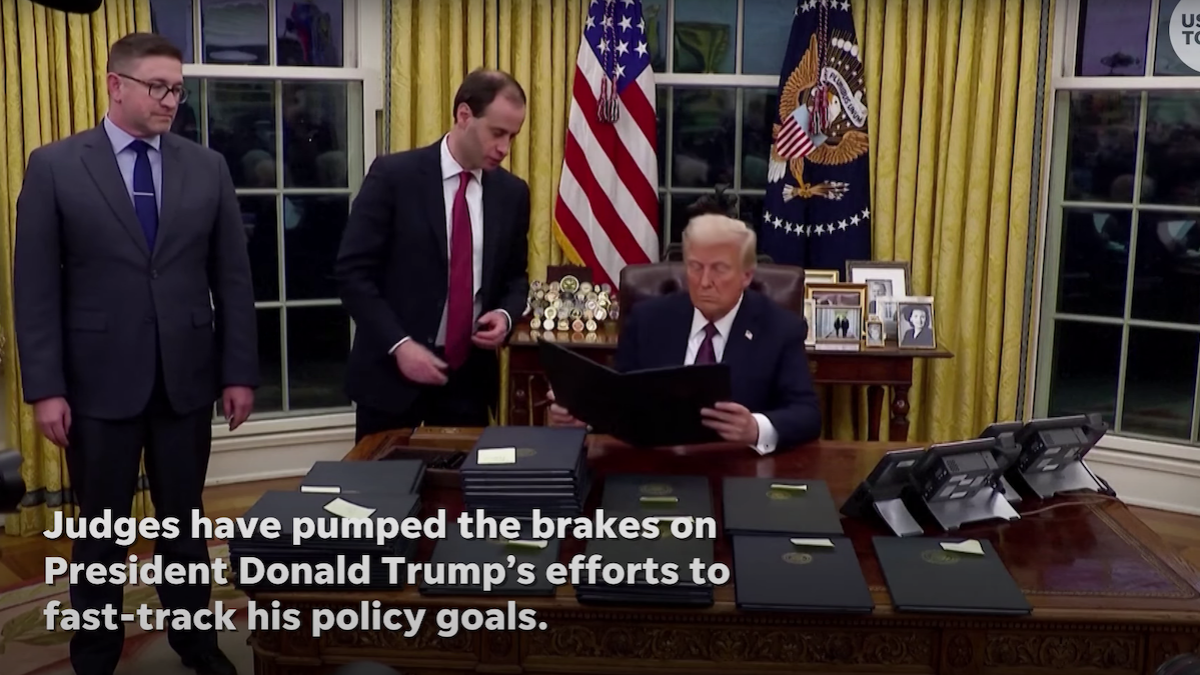
What’s happening right now is that Democrats, having been thrown out of power by American voters in a landslide victory for Trump, have decided they’re going to deploy a widely-used tactic from Trump’s first term to thwart the president’s agenda: use the federal judiciary. Under the false pretext that the lower federal courts are part of a “coequal branch of government” with the executive, they’re aiming to shut down Trump’s reform efforts with a fusillade of preliminary injunctions.

In recent days dozens of lawsuits have been filed against the Trump administration by Democrat attorneys general and various left-wing groups. These groups have carefully selected their venues, ensuring the lawsuits come before rabidly anti-Trump activist judges. So far, the tactic seems to be working. As of this past weekend, eight different rulings from the federal bench have temporarily halted the president’s executive orders.

Federal judges in Democrat-majority districts have issued preliminary injunctions blocking Trump’s executive actions to end birthright citizenship, reform and downsize the United States Agency for International Development, and offer buyouts to federal bureaucrats. A federal judge this past weekend blocked Elon Musk’s Department of Government Efficiency and all other political appointees in the Trump administration — including the Treasury secretary and his deputies — from accessing payment data at the Treasury Department.

One judge even issued a restraining order halting a Trump order that would have ensured federal inmates are housed according to biological sex, not transgender identity, and also would have prevented tax dollars from being used to pay for “gender transitions” for federal inmates. (Another judge, appointed by Obama, took the extraordinary step of ordering the administration to pay back every cent of federal funding that’s been paused or canceled — and threatened anyone who violates his order with criminal contempt.) 

What all this lawfare amounts to is a kind of judicial coup against the sitting president. By doling out injunctions like they’re USAID grants for LGBTQ awareness programs in Mali, Democrats have been able to hamstring key aspects of Trump’s agenda — at least for the moment. It’s a simple enough tactic. All Democrats have to do is shop for a venue to find the most activist, rabidly anti-Trump federal judges in the country, file their lawsuits, and wait for the injunctions to come raining down.

By doing this, Democrats and their allies in the judiciary turn the Constitution on its head, and effectively govern negatively through injunction, making major reform of the federal bureaucracy impossible. In nearly every case so far, the federal judiciary is siding with the permanent bureaucracy in Washington, preventing the Trump administration from doing anything to reform it despite Trump having campaigned on precisely that promise.

The problem is, as my colleague Sean Davis noted recently on X, federal judges have no actual authority to do this. They can’t decide on their own who the president can talk to or what data he can access. They can’t bind the president at all. According to the U.S. Constitution they’re “inferior” courts and therefore don’t have any authority over the executive branch. Yes, the three branches of the federal government are coequal, but the only part of the federal judiciary that’s equal to the presidency is the Supreme Court, not all the federal district courts scattered across the country.

“John Roberts and SCOTUS have two options here: they can bring these inferior malcontents to heel, or they can get used to the President simply ignoring these inferior courts or Congress eliminating them entirely,” wrote Davis. “Congress created these inferior courts so the Supreme Court wouldn’t have to deal with every federal case by itself. But if these rogue inferior judges are going to routinely issue lawless decisions that the Supreme Court has to deal with anyway, Congress would be well within its rights to just eliminate them.”

The issue might come to a head before Congress gets around to eliminating the federal courts, though. If the Supreme Court steps in on just one of these cases where a federal judge has blocked a lawful executive order from Trump, it might not go well for Democrats. In the 2018 Supreme Court case Trump v. Hawaii, which reversed a lower court’s decision to uphold a nationwide injunction on Trump’s travel ban, Justice Clarence Thomas called into question the idea that a federal judge in Hawaii (or anywhere else) can simply issue an injunction against a presidential executive order and apply it to the entire country. 

“District courts, including the one here, have begun imposing universal injunctions without considering their authority to grant such sweeping relief,” wrote Thomas. “These injunctions are beginning to take a toll on the federal court system — preventing legal questions from percolating through the federal courts, encouraging forum shopping, and making every case a national emergency for the courts and for the Executive Branch.”

He went on to say he is “skeptical that district courts have the authority to enter universal injunctions,” that such injunctions didn’t emerge until a century and a half after the Founding, and that they “appear to be inconsistent with longstanding limits on equitable relief and the power of Article III courts. If their popularity continues, this Court must address their legality.”

Only a few weeks into Trump’s second term, the popularity of injunctions is back with a vengeance, which means the Supreme Court might well step in to decide whether any federal district judge, anywhere in the country, can bind the actions of the White House by issuing nationwide injunctions.

It’s long past time to settle this. The American people overwhelmingly elected Trump precisely because they wanted to see his agenda for America enacted. Lower court federal judges, whom no one voted for, have no right to assert their will over and against the will of the American people. The sooner the Supreme Court takes this up and settles the obvious question, the sooner Democrat lawfare against Trump’s agenda will come to an end. Instead of relying on activist judges, Democrats might then have to figure out how to compete at the ballot box — something they are obviously loath to do.


John Daniel Davidson is a senior editor at The Federalist. His writing has appeared in the Wall Street Journal, the Claremont Review of Books, The New York Post, and elsewhere. He is the author of Pagan America: the Decline of Christianity and the Dark Age to Come. Follow him on Twitter, @johnddavidson.

ACLU Lawyer Admits Trump’s Travel Ban ‘Could Be Constitutional’ If Enacted By Clinton


URL of the original posting site: http://www.westernjournalism.com/aclu-lawyer-admits-trumps-travel-ban-could-be-constitutional-if-enacted-by-clinton/

While arguing before the Fourth Circuit Court of Appeals on Monday, American Civil Liberties Union Lawyer Omar Jadwat admitted that if former Democratic nominee Hillary Clinton had enacted President Donald Trump’s proposed travel ban, it may have been constitutional.

Jadwat, a senior staff attorney for the ACLU, had been arguing before the court that Trump’s revised ban was unconstitutional because of anti-Muslim comments he made on the campaign trail. Judge Paul Niemeyer then challenged his assertion.

The judge raised a hypothetical scenario in which a different outcome in the 2016 election could have changed the constitutionality of the exact same executive order.

“If a different candidate had won the election and then issued this order, I gather you wouldn’t have any problem with that?” Niemeyer asked.

Jadwat stumbled over his words and avoided answering the question directly.

Advertisement – story continues below


Niemeyer, a President George W. Bush appointee, repeated his question.

“We have a candidate who won the presidency, some candidate other than President Trump won the presidency and then chose to issue this particular order, with whatever counsel he took,” Niemeyer said. “Do I understand that just in that circumstance, the executive order should be honored?”

“Yes, your honor, I think in that case, it could be constitutional,” Jadwat said.

Advertisement – story continues below

Judge Shedd then chimed in, asking Jadwat if the “order was legitimate on its face.”

“I don’t think so your honor,” Jadwat replied. “The order is completely unprecedented in our nation’s history.”

Even if the Trump administration prevails in the 4th Circuit, the ban will not immediately go into effect.

The 9th Circuit Court of Appeals will begin hearing another case on Trump’s travel ban next Monday — a result of U.S. District Court Judge Derrick Watson’s ruling that the president’s executive order violates the Establishment Clause of the Constitution.

Judicial Activism From Supreme Court on Marriage. Here’s How to Respond.


waving flagWritten by Portrait of Ryan T. Anderson Ryan T. Anderson / / June 26, 2015 /

URL of the Original Posting Site: http://dailysignal.com/2015/06/26/judicial-activism-from-supreme-court-on-marriage-heres-how-to-respond

U.S. Supreme Court (Photo: Jonathan Larsen/Getty Images)

Today is a significant setback for all Americans who believe in the Constitution, the rule of law, democratic self-government, and marriage as the union of one man and one woman. The U.S. Supreme Court got it wrong: It should not have mandated all 50 states to redefine marriage. This is judicial activism: nothing in the Constitution requires the redefinition of marriage, and the court imposed its judgment about a policy matter that should be decided by the American people and their elected representatives. The court got marriage and the Constitution wrong today just like they got abortion and the Constitution wrong 42 years ago with Roe v. Wade. Five unelected judges do not have the power to change the truth about marriage or the truth about the Constitution.

The court summarized its ruling in this way—which highlights that they have redefined marriage, substituting their own opinion for that of the citizens:

The limitation of marriage to opposite-sex couples may long have seemed natural and just, but its inconsistency with the central mean­ing of the fundamental right to marry is now manifest. 

Manifest to five unelected judges that is. Not to the majority of American citizens who voted to define marriage correctly. As Chief Justice Roberts pointed out in dissent:

If you are among the many Americans—of whatever sexual orientation—who favor expanding same-sex marriage, by all means celebrate today’s decision. Celebrate the achievement of a desired goal. Celebrate the opportunity for a new expression of commitment to a partner. Celebrate the availability of new benefits. But do not celebrate the Constitution. It had nothing to do with it.

That’s exactly right. When it comes to the majority opinion, the Constitution “had nothing to do with it.”

We must work to restore the constitutional authority of citizens and their elected officials to make marriage policy that reflects the truth about marriage. We the people must explain what marriage is, why marriage matters, and why redefining marriage is bad for society. For marriage policy to serve the common good it must reflect the truth that marriage unites a man and a woman as husband and wife so that children will have both a mother and a father. Marriage is based on the anthropological truth that men and woman are distinct and complementary, the biological fact that reproduction depends on a man and a woman, and the social reality that children deserve a mother and a father.It HasNever Been About Marriage

The government is not in the marriage business because it’s a sucker for adult romance. No, marriage isn’t just a private affair; marriage is a matter of public policy because marriage is society’s best way to ensure the well-being of children. State recognition of marriage acts as a powerful social norm that encourages men and women to commit to each other so they will take responsibility for any children that follow.

Redefining marriage to make it a genderless institution fundamentally changes marriage: It makes the relationship more about the desires of adults than about the needs—or rights—of children. It teaches the lie that mothers and fathers are interchangeable.

Because the court has inappropriately redefined marriage everywhere, there is urgent need for policy to ensure that the government never penalizes anyone for standing up for marriage. As discussed in my new book, “Truth Overruled: The Future of Marriage and Religious Freedom,” we must work to protect the freedom of speech, association and religion of those who continue to abide by the truth of marriage as union of man and woman.burke

At the federal level, the First Amendment Defense Act is a good place to start. It says that the federal government cannot discriminate against people and institutions that speak and act according to their belief that marriage is a union of one man and one woman. States need similar policies.

Recognizing the truth about marriage is good public policy. Today’s decision is a significant setback to achieving that goal. We must work to reverse it and recommit ourselves to building a strong marriage culture because so much of our future depends upon it.War on Christians

ABOUT THE AUTHOR

Ryan T. Anderson, Ph.D., researches and writes about marriage and religious liberty as the William E. Simon senior research fellow in American Principles and Public Policy at The Heritage Foundation. He also focuses on justice and moral principles in economic thought, health care and education, and has expertise in bioethics and natural law theory. He’s the author of the forthcoming book, “The Future of Marriage and Religious Liberty.” Read his research.

Supreme Court Decisionfreedom combo 2

Law, Culture Wars, and the Christian


http://barbwire.com/2014/04/06/law-culture-wars-christian/#pgtW9pMsROJPdTmt.99
 
Bill Muehlenberg
on 6 April, 2014 at 06:50

biblicallaw-and-justiceLaw and legal issues are of course a vital component of life. And for good parts of human history the laws of God stood over, and greatly influenced, the laws of men. But in the secular West today this is becoming more and more rare, and increasingly we find the rise of ungodly, if not anti-God, law.

This comes in many forms, including so-called anti-discrimination, equal opportunity, and anti-vilification laws. These are being used to stifle Christians from sharing the gospel, forcing them to violate their own consciences, and keeping them from speaking out publicly about important social and moral issues. We see examples of this happening all the time.
Today law in the West is largely in the hands of those who adhere to the worldview of secular humanism. This is reflected on a daily basis in a whole host of areas: laws and legislation passed, court and judicial decisions, sentencing for crime, activist agendas promoted through law, and so on.

Judicial Activism

Let me focus on that last area I just mentioned: judicial activism. This is where judges who are pushing radical agendas effectively take the law into their own hands, and promote militant social engineering causes. The most recent example of this was when the High Court ruled on a NSW case, actually claiming that there are no longer two genders, but people can now have a “non-specific” third gender! I discuss that bizarre case in detail here: Aussie Court Rules Against Biology — and Redefines Reality.

The sad truth is, all over the Western world we are witnessing the rise of judicial activism. We find the active political involvement of judges in contentious social issues. The problem is, judges — often unelected and unaccountable — instead of legislators, are making and repealing laws, and internationalising law as well.

Judges have overstepped their bounds, and their agendas are often at odds with the majority of those they claim to serve. In fact, far too often the rule of law has been replaced by the rule of judges. This usurpation of the democratic process should be of concern to all of us.

The rule of law is of utmost importance, and judges are to be neutral in its application, and not seek to push their own political and social agendas. Judges are meant to serve the people and the laws the people helped to make, and not rewrite the law books and promote Political Correctness and social radicalism. But that sadly has been exactly the case for a number of decades now.

Judicial activism can take many forms: it may simply mean that judges are speaking out on controversial ethical and political issues when such pronouncements are not really proper to the role of a judge. Or worse, it can mean using one’s position as a judge to not just apply the law but to radically reinterpret and rewrite the law, to suit trendy political changes or to enforce a stifling Political Correctness.

This has certainly been the case in the US, where in the past half century a whole raft of radical judicial decisions have been made on such controversial issues as abortion, euthanasia and homosexual rights. As Robert Bork has commented, we are beginning to understand “what it means to be ruled by an oligarchy. The most important moral, political, and cultural decisions affecting our lives are steadily being removed from democratic control” and put into the hands of a few radical judges.

Phyllis Schlafly minces no words when she laments “the judicial supremacists who have been systematically dismantling the architecture of our unique, three-branch constitutional republic, and replacing it with an Imperial Judiciary.”

And with judicial decisions attacking the very nature of the moral order — as in its pro-death and anti-family decisions — one has to ask if the courts are still to be regarded as instruments of justice. As Robert George notes, the “worst abuses of human rights have come from the least democratic branch of government — the judiciary.”

And of course our radicalised law schools are fueling all this. Today we have feminist legal theory, queer legal theory, Marxist legal theory, deconstructionist legal theory, and so on. Every kind of radicalism around seems to gravitate towards our law schools. And with good reason. Activists know that if they can take over our legal faculties, our courts and our judiciaries, they can impose their radical agenda on the rest of society.

In addition to the law schools, there are a host of legal reform bodies, often government supported (and taxpayer funded). They too tend to have a radical and secular agenda they are promoting, be it drug decriminalisation, the legalisation of prostitution, the decriminalisation of abortion, or the promotion of homosexual rights.

Cultural Marxism

So how did all this arise? Antinomianism has always been with us, ever since the Garden of Eden of course. But the anti-God agenda of recent times — including judicial activism and the radicalisation of law — has come about, not by accident, but quite deliberately. The field of law, like so many other areas, has been strategically targeted by those who want to overthrow the West and its Judeo-Christian foundations.

Let me mention just one important component of this. In the 1930s Italian Marxist Antonio Gramsci said that there is more than one way to take over a nation. There is the obvious method of external use of force — armed rebellion and revolution and the like. But a nation can also be subverted from within — without firing a shot.

He made the case that radicals should take over the institutions of power and influence: the media, politics, the universities, and the courts. He spoke of the “long march through the institutions.” He knew that by so doing an internal revolution could easily take place. Sadly, we have seen his strategy almost fully realised now.

Indeed, no one could have foreseen how quickly and easily the institutions did crumble before the radical activists. The moral, cultural and social blitzkrieg has been as thorough as it has been all-consuming. And the success of this revolution, as Roger Kimball reminds, “can be measured not in toppled governments but in shattered values.”

How do we turn things around?

As to the radical law activists, much can be done: Their activities need to be exposed, and their public funding needs to be curtailed. In addition, alternative legal bodies need to be set up to reflect mainstream values, and to challenge the judicial activists. All these strategies are long term goals, and require time, effort and commitment from those concerned about the way things are now headed.

Indeed, reversing the decline of the West and its ungodly direction is no small task. And redeeming law in the West is just one part of this process. Much would need to be done in many areas. But let me speak to just one facet of this. A large part of our problem is that we Christians have allowed secular humanists and others to take over the field of law while we have simply pulled out.

Thus we are no longer being salt and light in this vital area as we are meant to be. By abandoning law — and most other spheres of power and influence — we have basically lost so many of these battles by default. We have handed these important areas over to our enemies, and we wonder why we keep losing here.

We need Christians to reclaim every area of life. That is because Christ should be Lord over every area of life. After all, he is the one who created politics, and law, and the arts, etc. These are parts of his original cultural mandate (see Genesis 1:28).

But we have sat back and allowed God’s enemies to take over all these areas. It is time for us to wake from our slumber, and get back into all these realms. So we need Christian lawyers and judges and law professors. And of course they need to be guided soundly by the Christian worldview.

Simply being a Christian in law, but soaking up the secular mindset and worldview, will not be all that helpful. We need to think Christianly here, and seek to promote Biblical values and ideas in the legal realm. So Christian participation in all areas of society, strongly informed by a biblical worldview, is imperative if we want to see some of these areas turned around for the glory of God.

For too long Christians have pulled out of the surrounding culture, and allowed the other side to take control. It is time we once again take seriously the idea of the Lordship of Christ, and take on board our responsibilities to be salt and light in every part of life — law included.

God is the ultimate source and author of law. But law in the West today has been hijacked by the secular humanists in their war against God. Christians need to re-enter the battle.

Image credit: http://www.peacemakersinstitute.com

Read more at http://barbwire.com/2014/04/06/law-culture-wars-christian/#zzMiyHpiIp0c1Ogc.99

Tag Cloud