
Clear and present danger: Hawaii looks to sign its citizens up for national gun registry
 By May 24, 2016

Hawaii State Sen. Will Espero (D-Ewa Beach) meets with Obama in the fall of 2015. (Image: Will Espero via Facebook)
 In every meaningful effect, that’s what this would be: through an end-around, Hawaii condemning its gun owners to be entered in a national gun registry. The law hasn’t been passed yet. It was introduced recently in the Hawaii legislature by state Senator Will Espero, a Democrat.
Hawaii could become the first state in the United States to enter gun owners into an FBI database that will automatically notify police if an island resident is arrested anywhere else in the country.
Most people entered in the “Rap Back” database elsewhere in the U.S. are those in “positions of trust,” such as school teachers and bus drivers, said Stephen Fischer of the FBI’s Criminal Justice Information Services Division. Hawaii could be the first state to add gun owners.

In other words, to be clear, if you’re a resident of the Aloha State, Hawaii would enter your name in the database because you’re a gun owner. That’s why you would be singled out.
This approach clarifies one thing most people rarely think about in a focused way. Registering guns is about registering the people. It’s not the guns the authorities care about; it’s disarming the people who possess them — or treating those people differently. Under Hawaii’s law, it’s not “your gun” that will be registered with the FBI. It’s you.
Advocates of the proposed law hope other states follow suit.
Supporters say the law would make Hawaii a leader in safe gun laws. Allison Anderman, a staff attorney at the Law Center to Prevent Gun Violence, said the bill was “groundbreaking,” and that she hadn’t heard of other states introducing similar measures.

(The San Francisco-based Law Center to Prevent Gun Violence gets its major funding from the anti-gun Joyce Foundation, on whose board Barack Obama served from 1994 to 2002. There’s a reason why Allison Anderman is the go-to anti-gun commentator for MSM coverage.)
The argument for gun rights opponents in Hawaii is that the state needs to know when its gun owners are arrested in other states, as those events may make them ineligible for continued gun ownership in Hawaii.
But since the FBI already maintains its Interstate Identification Index, there is no justification for the proposed Hawaii law.
The Interstate Identification Index or III (pronounced “triple-eye”) is a national index of criminal histories (or rap sheets) in the United States of America, maintained by the Federal Bureau of Investigation (FBI) at the National Crime Information Center. Included in this index are individuals who have been arrested or indicted for “a serious criminal offense anywhere in the country.”
The program is designed to facilitate the interstate exchange of criminal history records among State justice agencies. In addition to the interstate exchange, this index holds millions of fingerprint identification cards for criminals who have committed a serious enough crime to go to jail for over 24 hours.
If Hawaii feels that this database is not updated quickly enough, that point could be addressed without singling out gun owners for special notification from the FBI. The excuse for adding gun owners to the Rap Back database is superficial and unsupported.
Notably, Will Espero was one of the Hawaii lawmakers who huddled with Obama in Washington, D.C. last fall to take up the challenge of implementing his agenda at the state level. Although mainstream media reporting doesn’t indicate the anti-gun agenda was on their list, Obama has continued to push it through all available avenues.
Hawaiians buying guns in the state will be required to pay for the cost of entering their names into the Rap Back database.
BELOW ARE TWO ADDITIONAL ARTICLES PUBLISHEDIN 2013 AROUND NEW YOURKS GUN REGISTRATION/CONFISCATION LAW.
Proof: Gun Registration Leads To Confiscation
In the wake of New York’s latest gun control law, the New York Police Department is now sending out notices to registered gun owners demanding that they give up their firearms, clear proof that gun registration leads to outright confiscations.
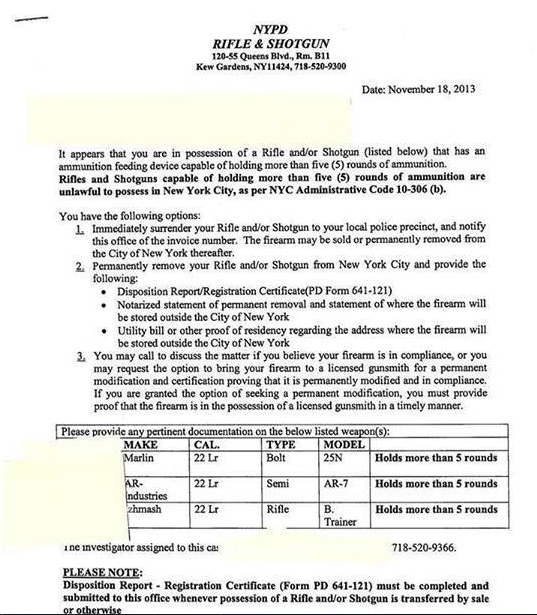
The notice provides gun owners, who possess firearms now prohibited under New York’s unconstitutional SAFE Act, the “options” to either surrender their firearms to the police, remove them from the city limits or otherwise render them inoperable.
The NYPD knew exactly who to send the notices to by using a centralized firearms registry which lists the city’s gun owners and what firearms they have in their possession.
With the gun database already in place, the police merely needed to compile a list of firearm makes and models now banned under the SAFE Act and send the notices to the appropriate owners.
The SAFE Act, which was passed by the state legislature and signed by the governor on the same day in January, has numerous, draconian provisions including, but not limited to:
– Outright ban of magazines holding over 10 rounds
– Restriction on more than seven rounds being loaded into a magazine; the limited exceptions do not include home defense
– Mandatory background checks for ammunition
– The creation of a firearms registry for what the state considers “assault weapons”
– A requirement for firearm permit holders to fill out a form to keep the state from publicly identifying them
These unconstitutional provisions and the overall law itself have met significant resistance.
Erie Co., N.Y. Sheriff Timothy B. Howard publicly stated that his department will not enforce the SAFE Act, adding that the law is one of the strongest examples of the government not listening to the people.
“It’s an unenforceable law and I believe it will ultimately be declared unconstitutional,” he said during a press conference. “Do you want law enforcement people that will say ‘I will do this because I’m told to do this, even if I know it’s wrong?’”
Earlier this month, Howard won his re-election due to his stance against the gun control law.
“The SAFE Act was a major issue in this [Erie Co. Sheriff] election,” Carl J. Calabrese, a political consultant, said to the Buffalo News. “A lot of people in Erie County, both Republicans and Democrats, are hunters, gun owners and shooters … These are motivated people who get out and vote.”
“In a low-turnout election year like this one, it can make a huge difference.”
Howard told the newspaper that he did what he thought was the right thing to do.
“People in Western New York feel strongly about the Constitution and Albany’s misreading of it,” he added.
While the NYPD’s notice proves that gun registration leads to outright confiscations, Howard’s re-election also proves that Americans are beginning to reassert their birth rights as recognized by the Constitution.
(H/T: The Truth About Guns)
Registration Will Lead to Confiscation
Reported by Brian Lilley Jan. 9, 2013
 According to The Washington Post, the Obama administration is considering a “national database” of all firearms in the United States to “track the movement and sale of weapons.” If such a database comes to fruition the database will lead to confiscation.
Last year Canada ended its national long gun registry, a national database of every rifle and shotgun in the country that was supposed to help police track the movement of and sale of weapons. When it was introduced twenty years ago critics said the registration of firearms would eventually lead to confiscation, a criticism dismissed as ridiculous, yet that’s what happened and more right up until its dismantling.
As recently as last winter law abiding gun owners who had complied with the registry were having their rifles confiscated. In late 2011 hundreds if not thousands of people who had legally purchased the Armi Jager AP80, a .22 calibre variant of the AK47, were informed that their rifles had been deemed illegal and must be surrendered .
“You are required by law to return your firearm registration certificates, without delay, either by mail to the address shown in the top left corner of this page or in person to a peace officer or firearms officers. You have 30 days to deliver your firearms to a peace officer, firearms officer of Chief Firearms Officer or to otherwise lawfully dispose of them,” read the letter sent by the Canadian Firearms Centre.
The reason for the need to surrender what had been legal firearms was simply cosmetic, the AP 80 looked too similar to the AK47. There were no interchangeable parts between the two rifles, the rifles used vastly different ammunition, had vastly different uses but they looked the same. 
What was more worrisome was that the decision to reclassify what for years had been a legal rifle was made by a bureaucrat not by elected officials. There was no debate, no vote just a decision by a bureaucrat who felt the AP80, legally owned for decades, was too dangerous to be privately owned by Canadians.
Of course confiscation of firearms could just be the start, confiscation of homes and cars could also come to the USA.
Former Marine Joshua Boston recently wrote a scathing response to Senator Diane Feinstein’s gun control proposals saying that he would not register his guns. That could cost him everything.
Bruce Montague, a gunsmith from Dryden, Ontario faces the possibility of having his home seized for failure to register his firearms. Montague’s decision not to register was purely political, he wanted to challenge the constitutionality of the gun registry. When his constitutional challenge failed and Montague was convicted the government of Ontario moved to seize his home under its proceeds of crime legislation. They were treating a paperwork criminal as if he were a drug lord, the kind of person the law was intended to prosecute.
If the United States follows Canada’s lead in registering all guns into a national database then the confiscation of rifles and shotguns won’t be far behind.
Brian Lilley is the host of Byline on Sun News Network


 What Did You Say?
You must be logged in to post a comment.