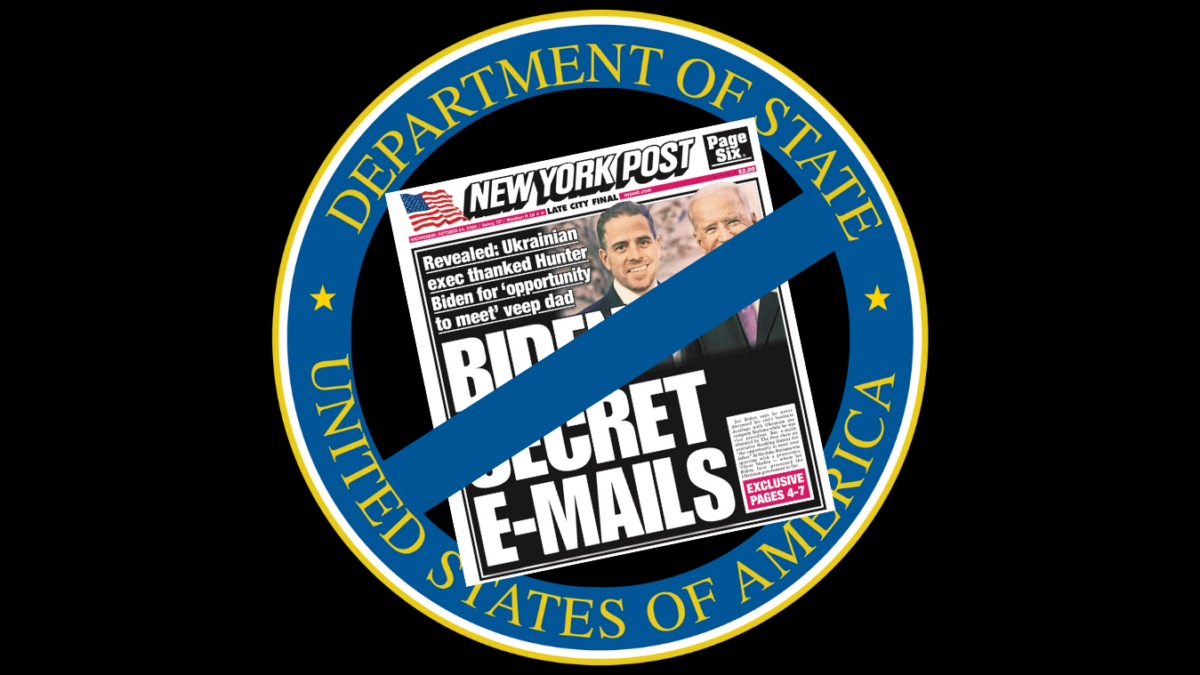
The Federalist’s Mollie Hemingway and Sean Davis were among several prominent conservatives targeted by a federal censorship operation carried out during the 2020 election, according to a new bombshell congressional report.
Released by the House Select Subcommittee on the Weaponization of the Federal Government on Monday, the interim report documents how the Cybersecurity & Infrastructure Security Agency (CISA) and Global Engagement Center (GEC), which fall within the Department of Homeland Security and the State Department, respectively, colluded with Stanford University to pressure Big Tech companies into censoring what they claimed to be “disinformation” during the 2020 election.
According to the analysis, this operation aimed to censor “true information, jokes and satire, and political opinions,” with prominent conservatives such as Hemingway and Davis being among the prime targets. Other notable targets include the social media accounts of former President Donald Trump, Newsmax, Sen. Thom Tillis of North Carolina, Harmeet Dhillon, and Charlie Kirk, to name a few.
As The Federalist previously reported, CISA, which is often called the “nerve center” of the federal government’s censorship operation, “facilitated meetings between Big Tech companies, and national security and law enforcement agencies to address ‘mis-, dis-, and mal-information’ on social media platforms.” Ahead of the 2020 contest, the agency ramped up its censorship efforts by flagging posts for Big Tech companies it claimed were worthy of being censored, some of which called into question the security of voting practices such as mass, unsupervised mail-in voting.
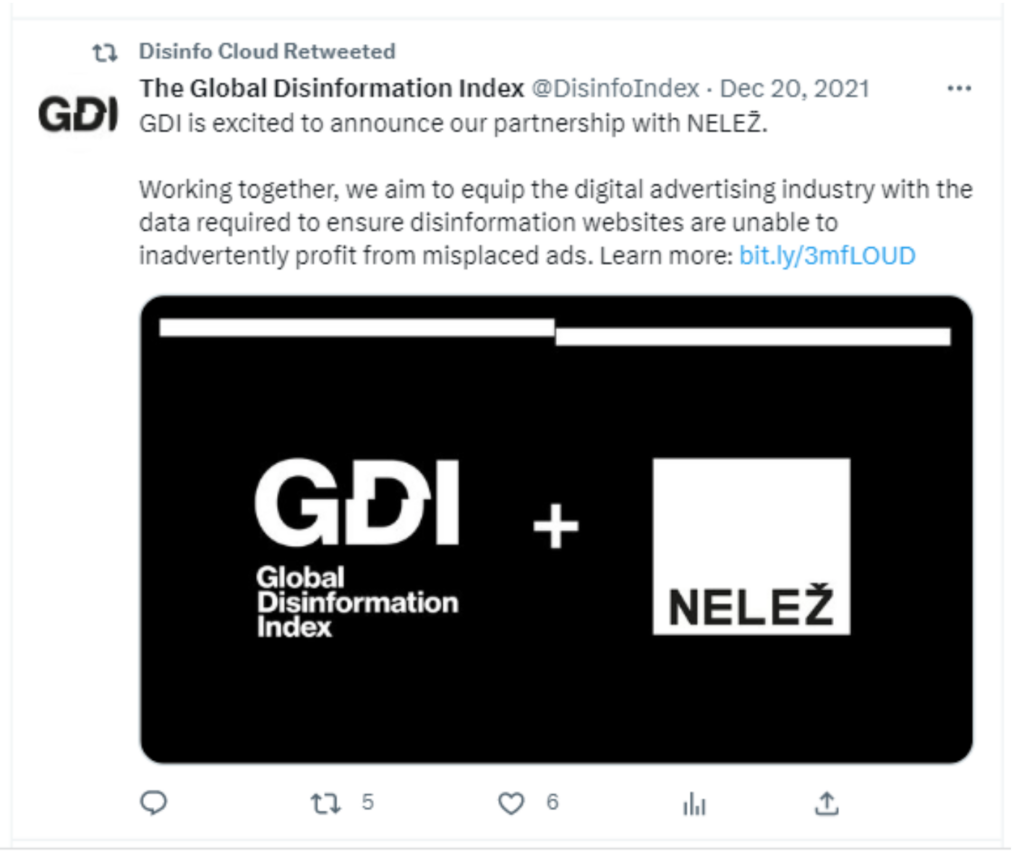
Meanwhile, as The Federalist’s Margot Cleveland reported, GEC “funded the development of censorship tools and used ‘government employees to act as sales reps pitching the censorship products to Big Tech.’” One of these GEC-funded nongovernmental entities is the Global Disinformation Index, a so-called “disinformation” tracking organization “working to blacklist and defund conservative news sites,” including The Federalist.
At the heart of the federal government’s censorship apparatus, however, was the Election Integrity Partnership (EIP), “a consortium of ‘disinformation’ academics led by Stanford University’s Stanford Internet Observatory” that coordinated with DHS and GEC “to monitor and censor Americans’ online speech in advance of the 2020 presidential election.” According to House Republicans’ Monday report, the initiative was developed “at the request” of CISA during the summer of 2020 and effectively allowed federal officials to “launder [their] censorship activities in hopes of bypassing both the First Amendment and public scrutiny.”
During the 2020 election, federal agencies and government-funded entities submitted so-called “misinformation reports” to EIP. Once acquired, EIP misinformation “analysts” would take posts flagged by the aforementioned entities, find similar examples on other Big Tech platforms, compile them into reports, and forward them to these same platforms “with specific recommendations on how [they] should censor the posts.” These EIP reports, which were known as “Jira tickets,” were hidden from the public and “accessible only to select parties, including federal agencies, universities, and Big Tech,” according to the report.
Among the posts flagged by EIP is a Nov. 4, 2020, tweet from Hemingway, in which The Federalist editor-in-chief reported claims from Georgia insiders who said it was “ridiculous [the] media are refusing to admit Trump has won the state.” The tweet also included a link to an Insider Advantage article calling Georgia for Trump. Another Hemingway post classified as “misinformation” by EIP is a Nov. 8, 2020, tweet linking to a Federalist article titled, “America Won’t Trust Elections Until The Voter Fraud Is Investigated.”
Meanwhile, EIP flagged a Nov. 4, 2020, tweet thread by Davis reporting how Pennsylvania’s Democrat-controlled Supreme Court “gave Pennsylvania Democrats a license to print post-election ballots, fill them out for Biden over the next three days, and record them without a postmark.” The censors also flagged another Nov. 4, 2020, tweet, in which Davis claimed “The absolute best evidence right now that Democrats, media, and Big Tech are conspiring to steal the election is Big Tech censoring anyone and everyone who observes that Big Tech is using corrupt censorship to steal the election for Democrats.”
But it’s not just reporting and claims about the 2020 election that EIP censors were flagging as so-called “misinformation.” Several examples highlighted in House Republicans’ report demonstrate the willingness of federal officials to censor users posting other truthful or satirical information.
In one instance, EIP analysts requested that Twitter, which has since been rebranded as X, censor a Nov. 4, 2020, tweet from Tillis thanking his supporters for propelling him to victory because EIP “deemed his declaration of victory to be premature” despite Tillis winning reelection. In another case, EIP censors flagged an Oct. 24, 2020, tweet from former Arkansas Gov. Mike Huckabee, who jokingly claimed he filled out and submitted mail-in ballots on behalf of his deceased relatives.
“The suppression of conservative politicians and media resulting from this censorship operation deprived countless American voters from exposure to a range of perspectives on the most important political issues in the days and weeks surrounding a general election,” the report reads. “Critically, the EIP conducted its censorship operation at the direction of, in collaboration with CISA, a federal government agency actively seeking to undermine free expression and the sitting President. The significance of these facts cannot be overstated.”
Shawn Fleetwood is a staff writer for The Federalist and a graduate of the University of Mary Washington. He previously served as a state content writer for Convention of States Action and his work has been featured in numerous outlets, including RealClearPolitics, RealClearHealth, and Conservative Review. Follow him on Twitter @ShawnFleetwood
The federal government peddled technology to Big Tech companies to assist them in censoring Americans’ speech on social media in the run-up to the 2020 election, according to emails Missouri and Louisiana uncovered in their First Amendment lawsuit against the Biden administration. Specifically, the State Department marketed this censorship technology through its Global Engagement Center. In other words, our tax dollars not only funded the development of tools to silence speech that dissented from the regime’s narrative. They also paid for government employees to act as sales reps pitching the censorship products to Big Tech.
I’ve been “tasked with building relationships with technology companies,” Samaruddin Stewart, then a senior adviser for the State Department’s Global Engagement Center or “GEC,” wrote in an early-February 2020 introductory email to LinkedIn, allegedly requesting a meeting. According to the lawsuit, his email also suggested he would be reaching out to other social media companies interested in “countering disinformation.”
On March 9, 2020, Stewart again contacted LinkedIn, referencing an earlier verbal discussion and writing:
I’ll send information [to LinkedIn representatives] about gaining access to Disinfo Cloud — which is a GEC funded platform that offers stakeholders an opportunity to discover companies, technology, and tools that can assist with identifying, understanding, and addressing disinformation.
These two emails are explosive. Yet because they were revealed in two passing paragraphs of the 164-page complaint filed by Missouri, Louisiana, and a handful of other plaintiffs against the Biden administration, they — and their enormous significance — have been overlooked.
‘Cold-Calling’ Big Tech
The Stewart emails establish that in 2020, federal government actors contacted social media giants to promote GEC’s Disinfo Cloud. GEC represented that this government platform provided “companies, technology, and tools” to “assist with identifying, understanding, and addressing disinformation.” Then it gave private tech companies access to Disinfo Cloud.
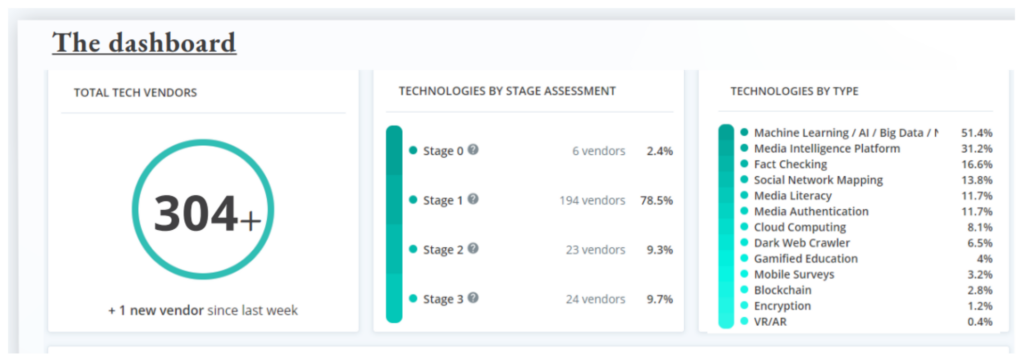
Almost identical to how GEC described Disinfo Cloud in congressional testimony, the State Department’s webpage marketed it as a “one-stop shop” to “identify and then test tools that counter propaganda and disinformation.” “Fact checking” and “media authentication” are just a couple of the types of technologies available through the dashboard.
GEC didn’t just promote Disinfo Cloud or give Big Tech access to what GEC called“the U.S. government’s online repository.” Government employees at GEC also offered to help private companies identify tools to suit their specific needs. Just “write” to the GEC’s Technology Engagement Division about “what your office needs to counter propaganda and disinformation,” the State Department instructed on its webpage, and the government will “assist” in finding “a technological solution.”
‘Testbed’
Access to Disinfo Cloud, according to the State Department’s webpage, also provides “a gateway” to the GEC’s Technology Engagement Division’s “Testbed,” allowing users to review and test the technology against their unique needs.
While Stewart’s emails don’t expressly mention the “Testbed” feature, the State Department boasts that the “private sector” uses both Disinfo Cloud and Testbed. The GEC’s webpage also invites Disinfo Cloud users to ask “for assistance in identifying a technological solution or draft a test proposal for a tool.” If Disinfo Cloud users can’t find a tool that works for them, the GEC Technology Engagement team stresses it “is open to insights and is here to help implement ideas to move the counter propaganda and disinformation mission forward.”
Infomercials
Deposition testimony by FBI Agent Elvis Chan suggests GEC’s marketing of the censorship tools went beyond making cold calls (or emails) to LinkedIn and other Big Tech companies. It also seemingly went further than providing product advice and samples on Disinfo Cloud: The GEC’s Technology Engagement Division apparently hosted infomercials to help the private vendors market their censorship software.
Chan, the assistant special agent in charge of the cyber branch at the FBI’s San Francisco field office, was “one of the primary people” communicating with social media companies about supposed “disinformation,” and thus is one of the named defendants in Missouri v. Biden. As part of that litigation, the plaintiffs deposed Chan. During questioning, Chan testified that ahead of the 2020 election, he periodically spoke with Stewart, who would meet with the social media companies separately from Chan.
According to Chan, Stewart met with policy individuals with the various social media companies about “different initiatives.” Those initiatives included various kinds of vendor-made software “that they would pilot to see if they could detect malign foreign influence on social media platforms.”
Chan further testified that Stewart and GEC “would provide webinars” from these vendors. As Chan explained, “[T]he State Department was just providing a venue where different vendors could show off their products.” The presentations were open to the general public, said Chan, but the GEC “would invite all sorts of audiences, to include researchers, employees from State Department counterparts, so typically Ministry of Foreign Affairs.” The intended audience, according to Chan, was “State Department-equivalent personnel, social media companies, and researchers.”
Chan said he attended only a couple of the webinars because the companies took only a “surface-level” look at the content, and thus he didn’t consider the technology useful to the FBI. But apparently, it was fine for the State Department to market the same tools to social media companies.
From Chan’s deposition testimony, it appears Stewart, the GEC’s then-senior adviser, made the equivalent of sales calls and hosted infomercials, all for the purpose of pushing various censorship services to social media companies.
It is unclear whether these webinars were in addition to the GEC’s “Tech Demo Series” — at which private vendors showcased their knack for fighting so-called disinformation for “U.S. government counterparts and foreign partners” — or whether, after the GEC sent a full-time representative to Silicon Valley in December of 2019 (presumably Stewart), the Tech Demo Series was opened to the public. However, given that the official Disinfo Cloud Twitter account promoted the Tech Demo Series, it seems likely that GEC expanded its target audience for the series to include the private sector and other Disinfo Cloud users.
Either way, Chan’s deposition testimony reveals our government marketed censorship technology to social media companies through “webinars.” And while Chan claimed he didn’t think GEC endorsed the products, the government expressly represented the Disinfo Cloud technology as tools to “assist” with attacking so-called disinformation.
The Tools
So what exactly were those tools?
From open-source material, it is difficult, if not impossible, to identify the entire dataset of tech companies featured on Disinfo Cloud or participating in the Tech Demo Series. That’s because Disinfo Cloud has “been retired as [a] GEC-sponsored effort,” according to the State Department. The DisinfoCloud.com webpage has also been shuttered.
But because GEC ran various “tech challenges,” giving winners State Department “sponsorship” on the government’s Disinfo Cloud Testbed — advertised as worth $25,000 — among other things, several censorship companies involved can be identified, including NewsGuard, PeakMetrics, and Omelas.
NewsGuard’s censorship technology includes “its unreliable reliability ratings database of thousands of news and information websites and a second database of purported hoaxes,” as I detailed in March. NewsGuard’s winning tech-challenge entry built upon those databases and used“AI and social listening tools to identify the initial source of the hoax,” and to find instances of the hoax being “repeated or amplified” online.
The second winner, PeakMetrics, offered a dashboard for tracking mentions of a topic across multiple media channels with social listening technology. The third winner, Omelas, developed tools to visually map online information.
The government gave these winners the ability to pilot their technology on Disinfo Cloud’s Testbed. Then it promoted Disinfo Cloud to social media giants as offering “access to companies, technology, and tools that can assist with identifying, understanding, and addressing disinformation.”
So were NewsGuard, PeakMetrics, and Omelas among the companies GEC marketed to Big Tech? Did they participate in the government-run Tech Demos and present infomercials to the private sector? Did GEC help these vendors test their products for private companies on the Testbed?
In Practice
Consider the implications, using NewsGuard to illustrate.
NewsGuard rates various media outlets on a 100-point scale and provides a red “unreliable” rating if its “experts” score the news source below 60. The company rates The Federalist “red” and claims it is one of the top-10 “most influential misinformers.” Conversely, some of the outlets that botched the biggest political stories of the century maintain a 100 percent reliability score.
The government awarded NewsGuard a $25,000 prize to develop new technology on Disinfo Cloud, using, in part, that ratings system as a backbone. NewsGuard would later receive an additional $750,000 from the government to advance the development of its censorship technology. PeakMetrics and Omelas also both scored additional government funding of $1.5 and $1 million respectively.
But think about the government’s other behind-the-scenes censorship entanglements. The government, via your tax dollars, funded both Disinfo Cloud, which provided the technology necessary to pilot the program, and the outside contractor, Park Advisors, that managed it.
The State Department’s GEC promoted the companies and technology featured on Disinfo Cloud, and a government liaison working for GEC personally contacted social media companies to encourage them to use the platform. The government also hosted Tech Demo Series for the vendors to market their products to the private sector.
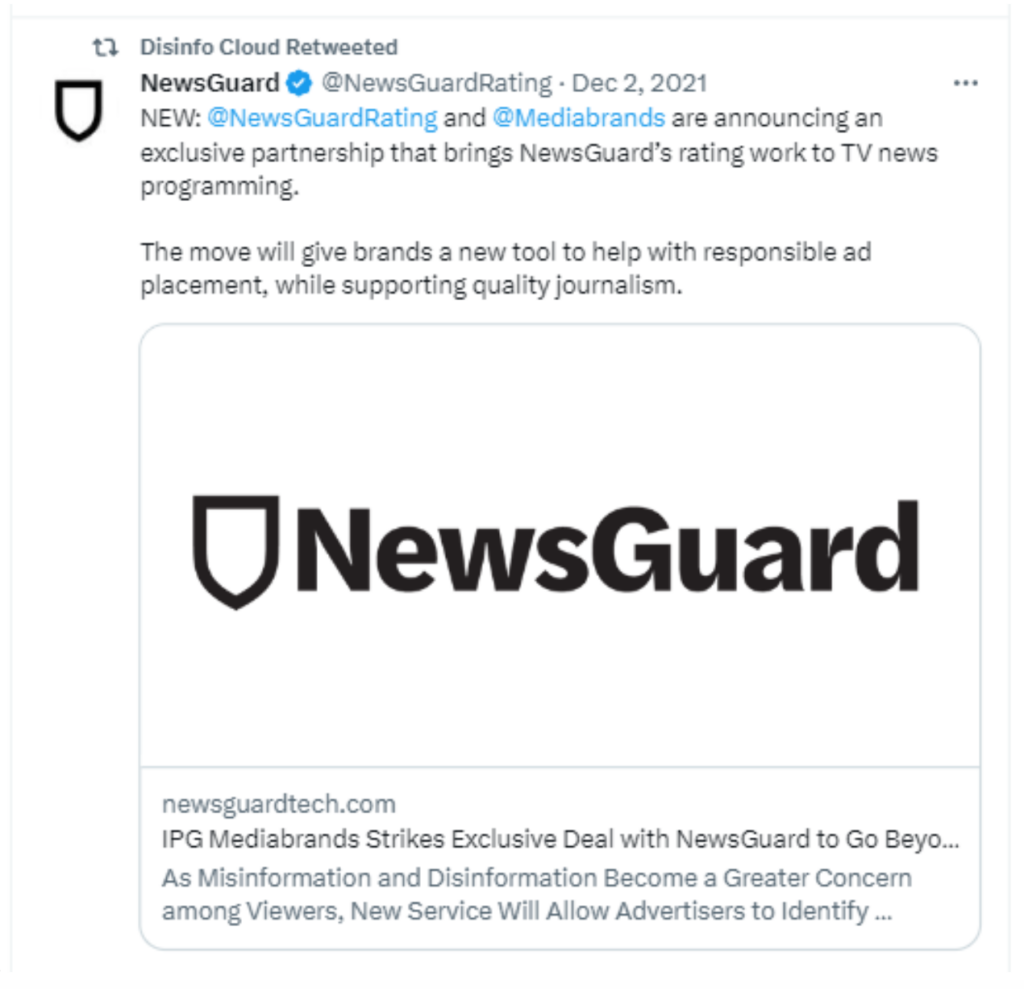
Disinfo Cloud regularly promoted private censorship technology on its official Twitter account and retweeted NewsGuard’s announcement of its partnership with Mediabrands to “bring NewsGaurd’s rating work to TV news programming.
Then beyond promoting the censorship tools, government employees working with GEC helped social media and private-sector businesses identify, test, and tweak the most “appropriate” technology for their “needs.”
And what are those “needs?” Censoring the speech of you and your fellow Americans.
A Scandal Like No Other
This scandal far surpasses the one that formerly ensnared GEC, when it was revealed the State Department awarded the Global Disinformation Index (GDI) — another “ratings” company that blacklists conservative outlets — $100,000 as part of the U.S.-Paris Tech Challenge. GDI also reportedly received money from other government-funded organizations. Those taxpayer funds helped finance GDI’s blacklist of conservative media outlets, which advertisers relied upon to defund dissenters.
But what Stewart’s emails now reveal is that the government is not merely funding censorship research. It is acting as a sales rep to market censorship technology to private companies.
The State Department isn’t skirting the First Amendment. It is driving a stake through its heart.
Margot Cleveland is The Federalist’s senior legal correspondent. She is also a contributor to National Review Online, the Washington Examiner, Aleteia, and Townhall.com, and has been published in the Wall Street Journal and USA Today. Cleveland is a lawyer and a graduate of the Notre Dame Law School, where she earned the Hoynes Prize—the law school’s highest honor. She later served for nearly 25 years as a permanent law clerk for a federal appellate judge on the Seventh Circuit Court of Appeals. Cleveland is a former full-time university faculty member and now teaches as an adjunct from time to time. As a stay-at-home homeschooling mom of a young son with cystic fibrosis, Cleveland frequently writes on cultural issues related to parenting and special-needs children. Cleveland is on Twitter at @ProfMJCleveland. The views expressed here are those of Cleveland in her private capacity.
American Family Association
American Family Association (AFA), a non-profit 501(c)(3) organization, was founded in 1977 by Donald E. Wildmon, who was the pastor of First United Methodist Church in Southaven, Mississippi, at the time. Since 1977, AFA has been on the frontlines of Ame
NEWSMAX
News, Opinion, Interviews, Research and discussion
Opinion
American Family Association
American Family Association (AFA), a non-profit 501(c)(3) organization, was founded in 1977 by Donald E. Wildmon, who was the pastor of First United Methodist Church in Southaven, Mississippi, at the time. Since 1977, AFA has been on the frontlines of Ame
American Family Association
American Family Association (AFA), a non-profit 501(c)(3) organization, was founded in 1977 by Donald E. Wildmon, who was the pastor of First United Methodist Church in Southaven, Mississippi, at the time. Since 1977, AFA has been on the frontlines of Ame
You Version
Bible Translations, Devotional Tools and Plans, BLOG, free mobile application; notes and more
Political
American Family Association
American Family Association (AFA), a non-profit 501(c)(3) organization, was founded in 1977 by Donald E. Wildmon, who was the pastor of First United Methodist Church in Southaven, Mississippi, at the time. Since 1977, AFA has been on the frontlines of Ame
NEWSMAX
News, Opinion, Interviews, Research and discussion
Spiritual
American Family Association
American Family Association (AFA), a non-profit 501(c)(3) organization, was founded in 1977 by Donald E. Wildmon, who was the pastor of First United Methodist Church in Southaven, Mississippi, at the time. Since 1977, AFA has been on the frontlines of Ame
Bible Gateway
The Bible Gateway is a tool for reading and researching scripture online — all in the language or translation of your choice! It provides advanced searching capabilities, which allow readers to find and compare particular passages in scripture based on




 What Did You Say?
You must be logged in to post a comment.