
Perspectives; Thoughts; Comments; Opinions; Discussions

Posts tagged ‘GERALD GROFF’

Op-ed: The Post Office fired me for honoring the Lord’s Day. Supreme Court must make this right


 By Gerald Groff | Fox News | Published April 13, 2023 2:00am EDT

Read more at https://www.foxnews.com/opinion/post-office-fired-me-honoring-lord-day-supreme-court-must-make-this-right

My roots in Lancaster County, Pennsylvania run deep.  Growing up here it was rare to see businesses open on Sundays.  It was the Lord’s Day.  We spent the morning in church, the afternoon with family, and honored God by resting from our regular labor—something God commanded we do in the fourth of the Ten Commandments.

I never thought I would lose my job for honoring the Lord’s Day. 

As I matured, I looked for jobs that would respect the Lord’s Day.  The United States Postal Service seemed a perfect fit.  Not only could I drive the rural routes of my boyhood, it famously did not deliver on Sundays.  I could have a good career and respect the Lord’s Day.

It was an ideal job until the Postal Service contracted with Amazon to provide Sunday delivery.  At first, we managed to find a workable solution: I would work every holiday that did not fall on the Lord’s Day and take extra route work on weekdays and Saturdays to make up for not working Sundays. 

SUPREME COURT TAKES UP RELIGIOUS FREEDOM CASE INVOLVING POSTAL WORKER WHO REFUSED TO WORK ON SUNDAY

As much as I was able to accommodate the Post Office, stepping in to help other employees when they needed it most, the Postal Service would not accommodate me.  If I were a full-time rural carrier, it would be no problem.  Full-time carriers have enough seniority to be contractually exempt from work on Sundays.  If I had been willing to compromise what I believed and worked just a few Sundays, I would have reached seniority to get a full-time route and gone on to have a long career with the U.S. Postal Service.

Authorities say a mail dropbox outside of a Pennsylvania post office has been struck dozens of times by thieves searching for money and checks. 
Authorities say a mail dropbox outside of a Pennsylvania post office has been struck dozens of times by thieves searching for money and checks.  (FOX 29 Philadelphia)

It was either I violate God’s command to me and honor the Lord’s Day by keeping it holy or honor Him and trust Him with the outcome.  On the verge of my ideal career, I surrendered all my seniority, unwilling to sacrifice my hope of becoming a full-time carrier at the prospect of refusing God’s decree—even if it meant working just one Lord’s Day.

The response by the Postal Service was brutal.  I felt targeted for almost two years.  Rather than respect my religious beliefs, the Postal Service chose to make an example out of me.  Postal management sent me for eight different “pre-disciplinary interviews” at the main post office.  Each one took about two hours out of my work day, and I still had to finish all of my routes—and without overtime pay.

My employer purposefully assigned me more work than the same carriers I had been supporting every Saturday and holiday by working so they could have time off with family.  Without explanation or justification, USPS docked my pay.  If I had just compromised what I believed about the Lord’s Day—even just a handful of times—all of it would have gone away.  Compromising what we believe is never the right choice.

Surely an employer the size of the Postal Service could have found a way to accommodate a single employee’s religious beliefs.  Instead, it disciplined me so severely, it was quit or be fired.

Gerald Groff lives in Lancaster, Pennsylvania and is a former postal employee.  The U.S. Supreme Court will hear his case on April 18, 2023. 
Gerald Groff lives in Lancaster, Pennsylvania and is a former postal employee.  The U.S. Supreme Court will hear his case on April 18, 2023.  (First Liberty Institute)

Now, the U.S. Supreme Court will decide whether religious employees like me who work extra shifts, holidays, and cover for his colleagues deserve a religious accommodation in the workplace.  Only God knows the final outcome; I still trust Him even if my decision to honor the Lord’s Day cost me my career. 

Our nation has a long history of protecting employees from being treated differently just because of their faith.  That is something woven into the fabric of our nation, including Lancaster County.  The heritage of respect and tolerance our nation has shown to the Old Order Amish and Mennonites who are my neighbors in Lancaster County is a lovely thing.  Yet the U.S. Postal Service refused to extend that religious tolerance to me.

I hope the Supreme Court reaffirms our nation’s commitment to providing equal opportunity and fair treatment in the workplace.  No employee should be forced to make the same decision the Postal Service forced upon me: faith or job.
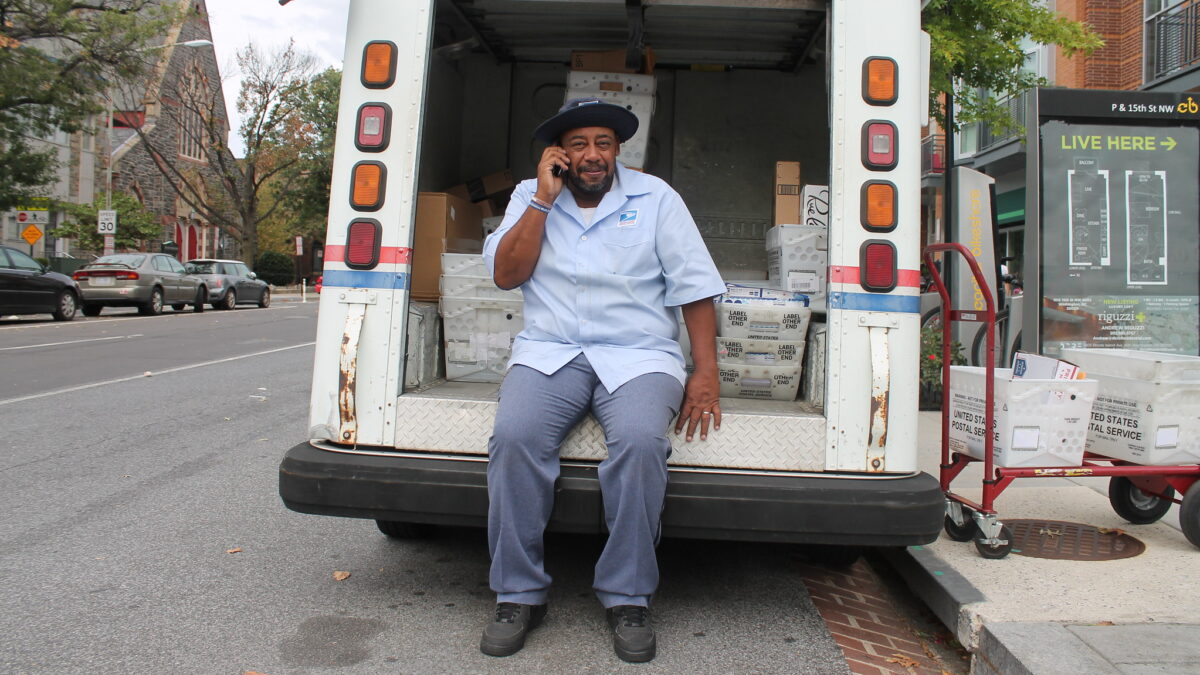

Gerald Groff lives in Lancaster, Pennsylvania and is a former postal employee.

No One Should Be Forced to Choose Between His Faith and His Paycheck


BY: RACHEL N. MORRISON | MARCH 06, 2023

Read more at https://thefederalist.com/2023/03/06/no-one-should-be-forced-to-choose-between-his-faith-and-his-paycheck/

USPS man sitting in the back of his mail truck
Without action by the Supreme Court, employers will continue to feel safe denying religious accommodation requests.

Author Rachel N. Morrison profile

RACHEL N. MORRISON

MORE ARTICLES

Should American employees be forced to choose between making a living and freely exercising their religious beliefs? That is the question the Supreme Court is considering in Groff v. DeJoy.

On Tuesday, a diverse group submitted amicus briefs urging the court to answer that question with a resounding “no.” More than 30 briefs were filed on behalf of Christians, Jews, Hindus, Mormons, Muslims, Seventh-day Adventists, Sikhs, Zionists, religious liberty and employment law scholars, medical professionals, nonprofit organizations, states, and members of Congress, among others.

Groff involves United States Postal Service (USPS) mail carrier Gerald Groff, a Christian, who holds uncontested sincere religious beliefs about resting, worshiping, and not working on his Sunday Sabbath. After he joined USPS in 2012, USPS contracted with Amazon in 2013 to provide mail deliveries on Sundays. Initially, USPS accommodated Groff’s Sunday Sabbath observance but later required him to work Sundays.

In accordance with his religious beliefs, Groff refused to work when he was scheduled on his Sunday Sabbath, resulting in progressive disciplinary actions by USPS. Realizing his termination was imminent, Groff resigned in 2019, leading to this religious discrimination lawsuit.

This case places the future of workplace religious accommodation rights in the hands of the Supreme Court.

Religious Accommodations in the Workplace

Title VII of the Civil Rights Act of 1964 prohibits discrimination in employment on the basis of race, color, religion, sex, or national origin. Recognizing that we live in a pluralistic and religiously diverse society and that it is important for employees not to have to hide or give up their religious identities in the workplace, Congress amended Title VII in 1972 to affirmatively require employers to “reasonably accommodate” an employee’s religious observances and practices unless doing so would pose an “undue hardship on the conduct of the employer’s business.”

The necessity for a religious accommodation in the workplace arises when a job duty, rule, or policy violates an employee’s sincerely held religious belief — such as working on one’s Sabbath. In practice, Title VII’s religious accommodation right has the biggest benefit for employees of minority religions and those who have less common religious practices — from a Muslim’s hijab and daily prayers, to a Jew’s yarmulke or Friday Sabbath observance, to a Seventh-day Adventist’s Saturday Sabbath observance, and a Sikh’s kirpan (small sword), metal bracelet, unshorn hair, and beard.

In 2015, the Supreme Court held that under Title VII the clothing store Abercrombie & Fitch could not refuse to hire a female Muslim applicant because she wore a hijab in violation of the store’s “no cap” policy. As the Supreme Court explained: “Title VII does not demand mere neutrality with regard to religious practices — that they be treated no worse than other practices. Rather, it gives them favored treatment,” creating an affirmative obligation on employers.

What Does ‘Undue Hardship’ Mean?

The central issue in Groff is what the phrase “undue hardship on the conduct of the employer’s business” entails. In a 1977 case called Trans World Airlines, Inc. v. Hardison, the Supreme Court, interpreting similar language from an Equal Employment Opportunity Commission guideline in effect during the events at issue, summarily stated that “undue hardship” meant merely “more than a de minimis cost.” This formulation has been adopted as the standard for Title VII by lower court judges across the country, effectively gutting the workplace religious accommodation right Congress provided employees.

Justices, judges, legal scholars, and religious leaders, among others, have criticized the Hardison court’s undue hardship formulationAs Justice Thurgood Marshall explained in his dissent in Hardison, the decision “effectively nullifie[s]” employees’ religious accommodation rights and “makes a mockery” of Title VII.

To put it simply: Hardison’s more than de minimis standard is absurd. De minimis means “very small or trifling,” and more than de minimis means merely a smidge more than “very small or trifling.” “Undue,” in contrast, means “exceeding what is appropriate or normal” or “excessive,” which is significantly more than “very small or trifling.”

Since Hardison, and to avoid application of Hardison’s non-textual standard, Congress has explicitly defined “undue hardship” in multiple statutes as “an action requiring significant difficulty or expense.” This is true for laws requiring other types of workplace accommodations, such as the Americans with Disabilities Act (1990), which provides employees accommodations for disability, and the Pregnant Workers Fairness Act (2022), which provides employees accommodations for the known limitations related to pregnancy, childbirth, or related medical conditions.

A secondary issue in Hardison is whether undue hardship on the conduct of the employer’s business can be met by merely showing a burden on the employee’s coworkers rather than on the business itself. In Groff, the court of appeals held that USPS satisfied its burden to demonstrate undue hardship because accommodating Groff would burden the employee’s coworkers. This standard would minimize Title VII’s religious accommodation protections, subjecting them to a “heckler’s veto by disgruntled employees,” as Judge Thomas Hardiman wrote in his dissent.

Poised to Protect Religious Accommodations

The Supreme Court has had several chances in recent years to revisit Hardison, but the court finally decided it should do so in Groff. This has led many to speculate that the court will reject Hardison’s more than de minimis formulation and clarify that undue means, well, just that — undue.

Indeed, this case should be a no-brainer. It is a simple exercise in statutory interpretation and textual definitions.

An interesting wrinkle in this case, however, is that since the USPS is an arm of the federal government, it is represented in court by the Department of Justice (DOJ).

In December 2019, the DOJ, joined by the Equal Employment Opportunity Commission (the federal agency tasked with enforcing Title VII), told the court that Hardison’s formulation is “incorrect.” Indeed, in USPS’s brief urging the court not to hear Groff, DOJ merely argued the case was a “poor vehicle” to revisit Hardison and that the issue of a religious accommodation’s burden on coworkers “does not merit review.” The court clearly disagreed.

It would go against DOJ custom for the United States to change its position on Hardison. But it is unclear if the Biden administration will willingly support religious liberty, especially when it involves a Christian employee. We’ll find out when USPS files its response brief.

As evidenced by the number of amicus briefs filed by different faith traditions in support of Groff, religious accommodation rights in the workplace is an issue that all Americans, regardless of religion, can and should support. No one should be forced to choose between his religion and earning a paycheck.

Without action by the Supreme Court, employers will continue to feel safe denying religious accommodation requests because they can easily demonstrate a cost that is slightly more than de minimis. It is high time the Supreme Court remedies Hardison’s error.

Oral argument in Groff is scheduled for April 18, and a decision is expected by the end of June.


Rachel N. Morrison is an attorney and fellow at the Ethics and Public Policy Center, where she works on EPPC’s HHS Accountability Project.

Tag Cloud