New York Attorney General Letitia James is suing JBS USA, the world’s largest producer of beef, over the company’s emissions and for “greenwashing” by allegedly misleading the public about its environmental impact.
In an announcement, James noted that beef production has the largest greenhouse gas footprint of any major food commodity, and that animal agriculture accounts for 14.5% of global greenhouse gas emissions. According to James, JBS USA’s various net-zero pledges for 2030 and 2040 are therefore misleading and “not feasible” given the scope of its worldwide beef production operations.
“As families continue to face the daily impacts of the climate crisis, they are willing to spend more of their hard-earned money on products from brands that are better for the environment,” James said in a statement. “When companies falsely advertise their commitment to sustainability, they are misleading consumers and endangering our planet.”
“JBS USA’s greenwashing exploits the pocketbooks of everyday Americans and the promise of a healthy planet for future generations,” she added. “My office will always ensure that companies do not abuse the environment and the trust of hardworking consumers for profit.”
New York Attorney General Letitia James speaks during a news conference in New York on Sept. 21, 2022. (AP Photo/Brittainy Newman, File)
The lawsuit was applauded by state Democrats and national climate advocacy organizations like Earthjustice, Mighty Earth, Friends of the Earth US, Citizens Campaign for the Environment and Stand.earth.
“JBS repeatedly claims that it will reach net zero by 2040. This claim was found to be misleading and yet JBS continues to assert it,” said Peter Lehner, an attorney at Earthjustice. “While it is critical for every company to reduce its climate change impact, JBS would need to implement enormous operational changes to achieve this goal. However, JBS is doing very little and is not taking anywhere close to the steps that would be required.”
In her announcement and lawsuit, James pointed to several instances in which JBS USA and its executives made pledges to reduce the company’s impact on the environment. She also stated the company — which has a market cap of more than $10 billion and whose North American beef business earns tens of billions of dollars annually — has acknowledged consumers are more interested in sustainable products.
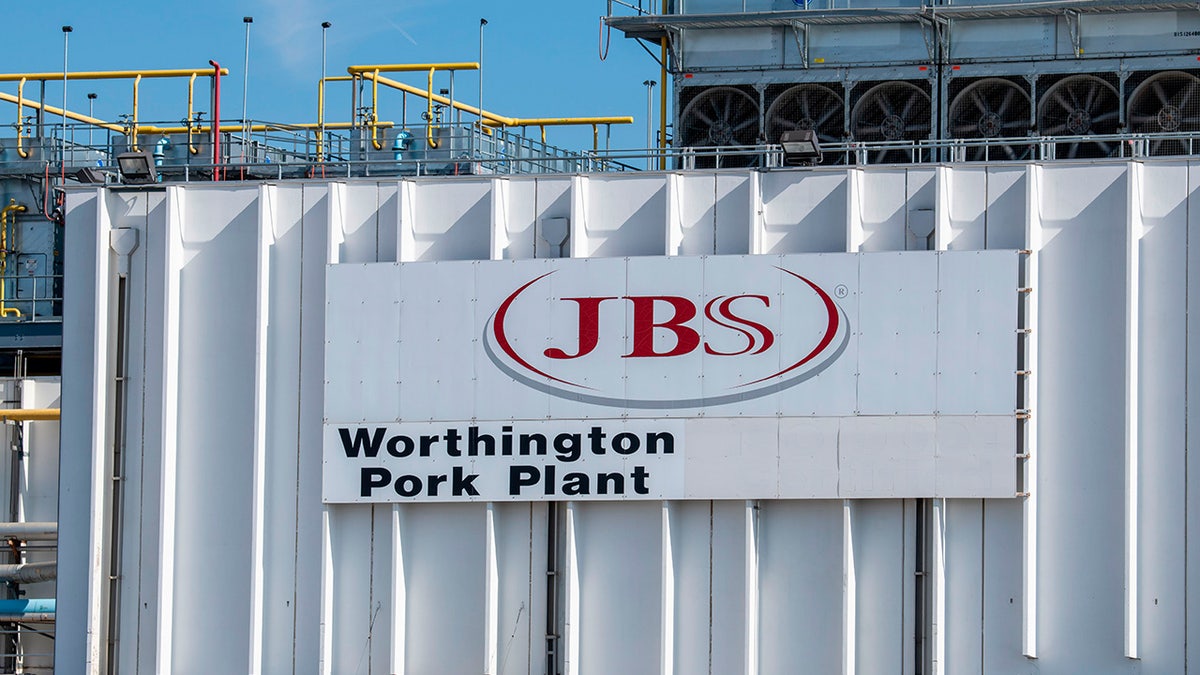
A JBS pork plant is pictured in Worthington, Minnesota. (Michael Siluk/UCG/Universal Images Group via Getty Images)
For example, in March 2021, JBS announced a pledge to achieve net-zero greenhouse gas emissions by 2040 across global operations and including indirect downstream emissions. The company then began a publicity campaign touting the pledge, running a full-page advertisement one month later in The New York Times stating “it’s possible” for meat production to be “part of the climate solution.”
Since then, JBS and its subsidiaries have continued to tout the 2040 pledge and other sustainability goals. The company even presented at the United Nations climate summit in Dubai late last year, announcing additional sustainability initiatives and investments.
“JBS takes its commitment to a more sustainable future for agriculture very seriously,” JBS USA spokesperson Nikki Richardson said in an email to Fox News Digital. “We disagree with the action taken today by the New York Attorney General’s office.”
“JBS will continue to partner with farmers, ranchers and our food system partners around the world to help feed a growing population while using fewer resources and reducing agriculture’s environmental impact,” she continued. “Our belief that American agriculture can help sustainably feed the world is undeterred.”
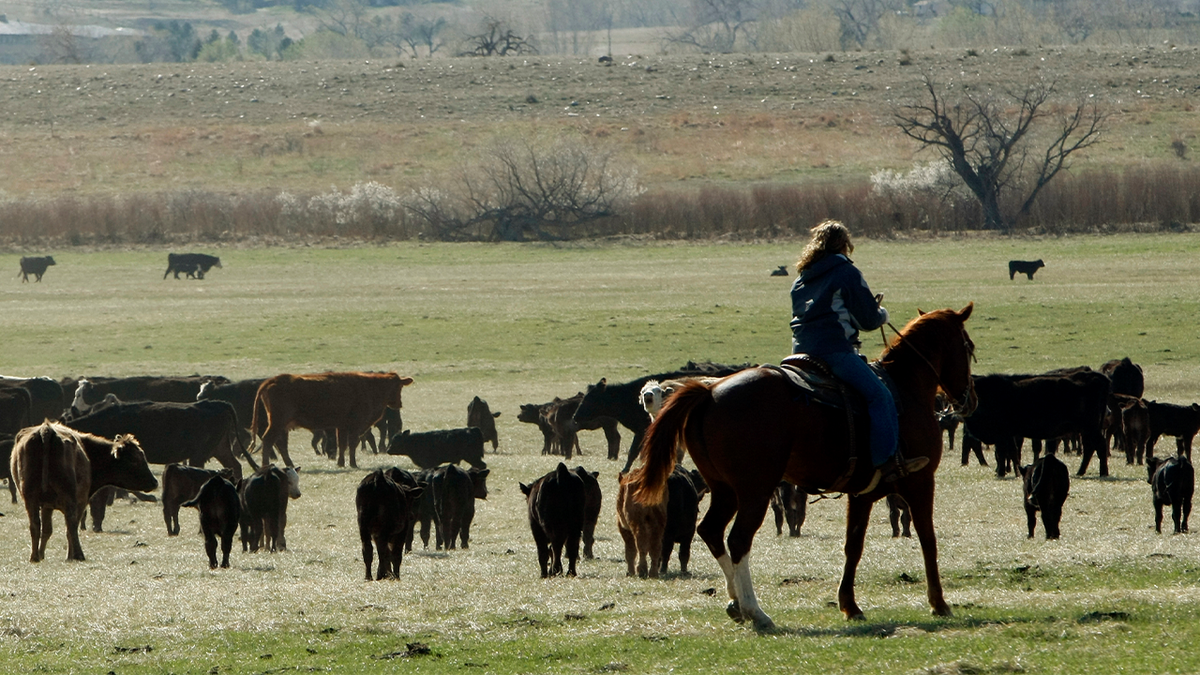
Cows and calves are herded to pasture on a ranch near Boulder, Colorado. (Reuters/Rick Wilking)
James’ lawsuit comes as environmental groups and lawmakers worldwide increasingly set their sights on the agriculture industry. The global food system — which includes land-use change, actual agricultural production, packaging and waste management — generates about 18 billion tons of carbon dioxide per year, the equivalent of 34% of total worldwide emissions, according to a 2021 study published in the Nature Food journal.
President Biden’s international climate envoy John Kerry warned last year that decarbonization would be impossible without a concerted effort from the agriculture industry to achieve green goals.
“We can’t get to net-zero, we don’t get this job done unless agriculture is front and center as part of the solution. So all of us understand here the depths of this mission,” Kerry said.
Thomas Catenacci is a politics writer for Fox News Digital.
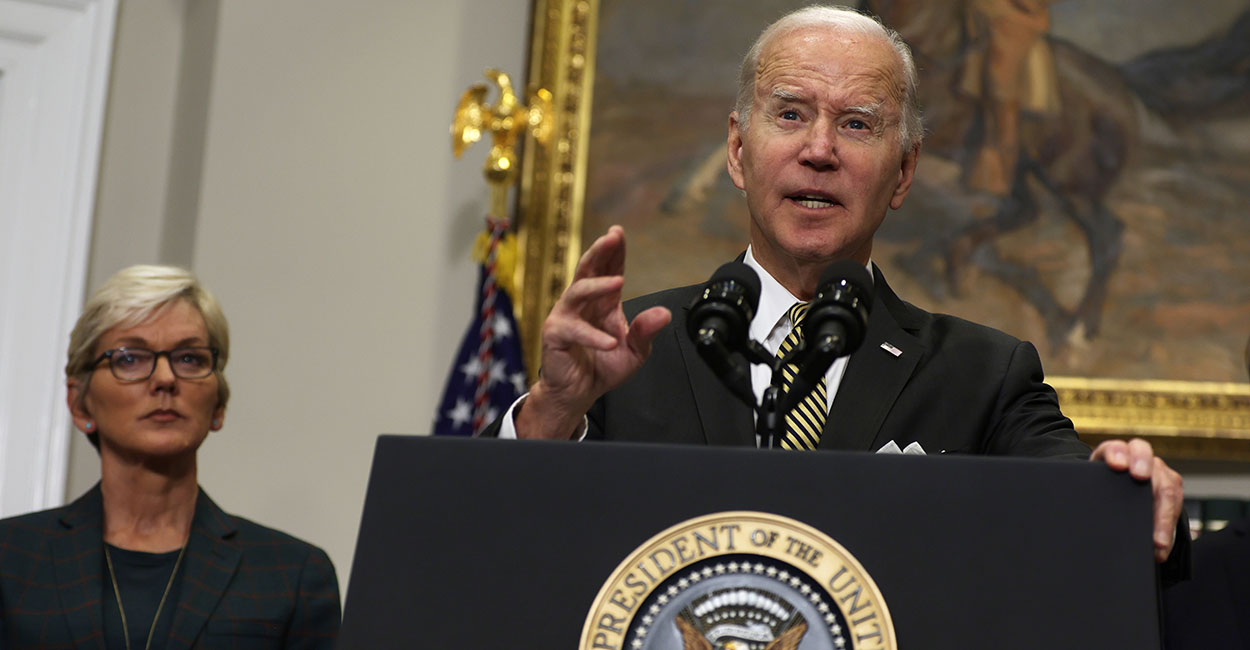
A project in North Dakota wins a $350 million Energy Department grant despite emitting three times more carbon dioxide than it captures and stores. Pictured: President Joe Biden talks about “investments” in green energy while flanked by Energy Secretary Jennifer Granholm on Oct. 19, 2022, at the White House. (Photo: Alex Wong/Getty Images)
Despite the Energy Department’s admission that the Tundra Project would emit three times more carbon dioxide than it captures, a department grant worth up to $350 million is going to this proposed carbon capture and storage endeavor. The venture is backed by two American companies, Minnkota and Kiewit, as well as Canada’s TC Energy and Japan’s Mitsubishi Heavy Industries.
But Project Tundra, planned for North Dakota’s Oliver County, presents a climate problem of its own. The project could emit more greenhouse gases than it stores because of the energy it takes to transport the carbon dioxide.
Once the coal is used to produce energy, Project Tundra would employ the Fluor Corp.’s Econamine PG Plus system, which captures CO2 and sulfur hexafluoride using a fluoride-amine solvent, reheats the solvent, isolates the captured gases, and pumps the gases for storage one mile below ground.
However, according to the Institute for Energy Economic and Financial Analysis, Fluor’s system was tested on a slipstream 10 times smaller than the retrofitted North Dakotan plant. Upscaling the technology often leads to unanticipated problems, as previous tests of such facilities have shown.
Project Tundra would emit more greenhouse gases than it saves, but some carbon capture and storage facilities both have reduced emissions and provided marginal economic benefits.
For example, Petra Nova in Texas received $190 million in Energy Department grants to reinject captured carbon into oil reserves to store the gases and flush out the hydrocarbons. From 2017 to 2020, Petra Nova exchanged 3.9 million short tons of captured CO2 with 4.2 million barrels of oil while reducing total emissions by 33%.
Although carbon capture and storage facilities such as Petra Nova provide some natural resources to offset the retrofitting cost, Project Tundra would rely solely on government grants and federal “45Q” tax credits, which provide $85 per ton of CO2 permanently stored underground.
The initial estimated cost in 2022 of $1 billion for Project Tundra has risen to $1.9 billion. Despite the increased cost, it received authorization for a $150 million loan from the North Dakota Industrial Commission last July through the state’s Clean Sustainable Energy Authority. In December, Project Tundra secured the additional $350 million from the Energy Department.
Even with the infusion of more taxpayer funds, there is substantial worry that Minnkota customers also would have to finance this new carbon capture and storage facility. In some states, climate initiatives force citizens to pay almost 20% more for green energy projects at a time of unprecedented inflation.
Despite these increased costs, Project Tundra’s carbon capture goals actually have decreased. Originally, it was supposed to reduce carbon emissions by 95%. Today, the goals have decreased to a 74% reduction, a drop of 21 percentage points before construction of the facility has begun.
This decline relates to a troubling trend that appears when examining major carbon capture and storage projects. According to the National Energy Technology Library, 175 such CCS facilities are planned or operational in the U.S.
Among 13 flagship CCS facilities capturing roughly 55% of total carbon captured worldwide, only a few have been sustainable even with carbon taxes or subsidies. Others either failed or are performing 20% to 50% below original target rates due to unscalable capture technology.
Investors in Project Tundra will decide whether to move forward a little later in the year. Foreign and domestic firms are certainly free to invest in Project Tundra and other such pilot technology.
However, distributing more than half a billion in taxpayer dollars to a carbon capture and storage venture that emits three times the amount of carbon it sequesters is completely unwarranted anytime—especially when Americans are suffering through a period of unprecedented inflation caused by government spending.
American Family Association
American Family Association (AFA), a non-profit 501(c)(3) organization, was founded in 1977 by Donald E. Wildmon, who was the pastor of First United Methodist Church in Southaven, Mississippi, at the time. Since 1977, AFA has been on the frontlines of Ame
NEWSMAX
News, Opinion, Interviews, Research and discussion
Opinion
American Family Association
American Family Association (AFA), a non-profit 501(c)(3) organization, was founded in 1977 by Donald E. Wildmon, who was the pastor of First United Methodist Church in Southaven, Mississippi, at the time. Since 1977, AFA has been on the frontlines of Ame
American Family Association
American Family Association (AFA), a non-profit 501(c)(3) organization, was founded in 1977 by Donald E. Wildmon, who was the pastor of First United Methodist Church in Southaven, Mississippi, at the time. Since 1977, AFA has been on the frontlines of Ame
You Version
Bible Translations, Devotional Tools and Plans, BLOG, free mobile application; notes and more
Political
American Family Association
American Family Association (AFA), a non-profit 501(c)(3) organization, was founded in 1977 by Donald E. Wildmon, who was the pastor of First United Methodist Church in Southaven, Mississippi, at the time. Since 1977, AFA has been on the frontlines of Ame
NEWSMAX
News, Opinion, Interviews, Research and discussion
Spiritual
American Family Association
American Family Association (AFA), a non-profit 501(c)(3) organization, was founded in 1977 by Donald E. Wildmon, who was the pastor of First United Methodist Church in Southaven, Mississippi, at the time. Since 1977, AFA has been on the frontlines of Ame
Bible Gateway
The Bible Gateway is a tool for reading and researching scripture online — all in the language or translation of your choice! It provides advanced searching capabilities, which allow readers to find and compare particular passages in scripture based on

 By Thomas Catenacci Fox News | Published February 29, 2024 10:47am EST



 What Did You Say?
You must be logged in to post a comment.