Meet NewsGuard: The Government-Backed Censorship Tool Billed As An Arbiter Of Truth
BY: LEE FANG | NOVEMBER 15, 2023


LEE FANG
In May 2021, L. Gordon Crovitz, a media executive turned start-up investor, pitched Twitter executives on a powerful censorship tool.
In an exchange that came to light in the “Twitter Files” revelations about media censorship, Crovitz, former publisher of the Wall Street Journal, touted his product, NewsGuard, as a “Vaccine Against Misinformation.” His written pitch highlighted a “separate product” — beyond an extension already on the Microsoft Edge browser — “for internal use by content-moderation teams.” Crovitz promised an out-of-the-box tool that would use artificial intelligence powered by NewsGuard algorithms to rapidly screen content based on hashtags and search terms the company associated with dangerous content.
Read NewsGuard’s email and RealClearInvestigations’ response about RCI’s reporting here.
How would the company determine the truth? For issues such as Covid-19, NewsGuard would steer readers to official government sources only, like the federal Centers for Disease Control. Other content-moderation allies, Crovitz’s pitch noted, include “intelligence and national security officials,” “reputation management providers,” and “government agencies,” which contract with the firm to identify misinformation trends. Instead of only fact-checking individual forms of incorrect information, NewsGuard, in its proposal, touted the ability to rate the “overall reliability of websites” and “’prebunk’ COVID-19 misinformation from hundreds of popular websites.”
NewsGuard’s ultimately unsuccessful pitch sheds light on one aspect of a growing effort by governments around the world to police speech ranging from genuine disinformation to dissent from officially sanctioned narratives. In the United States, as the “Twitter Files” revealed, the effort often takes the form of direct government appeals to social media platforms and news outlets. More commonly the government works through seemingly benign non-governmental organizations — such as the Stanford Internet Observatory — to quell speech it disapproves of.
Or it pays to coerce speech through government contracts with outfits such as NewsGuard, a for-profit company of especially wide influence. Founded in 2018 by Crovitz and his co-CEO Steven Brill, a lawyer, journalist, and entrepreneur, NewsGuard seeks to monetize the work of reshaping the internet. The potential market for such speech policing, NewsGuard’s pitch to Twitter noted, was $1.74 billion, an industry it hoped to capture.
Instead of merely suggesting rebuttals to untrustworthy information, as many other existing anti-misinformation groups provide, NewsGuard has built a business model out of broad labels that classify entire news sites as safe or untrustworthy, using an individual grading system producing what it calls “nutrition labels.” The ratings — which appear next to a website’s name on the Microsoft Edge browser and other systems that deploy the plug-in — use a scale of zero to 100 based on what NewsGuard calls “nine apolitical criteria,” including “gathers and presents information responsibly” (worth 18 points), “avoids deceptive headlines” (10 points), and “does not repeatedly publish false or egregiously misleading content” (22 points), etc.
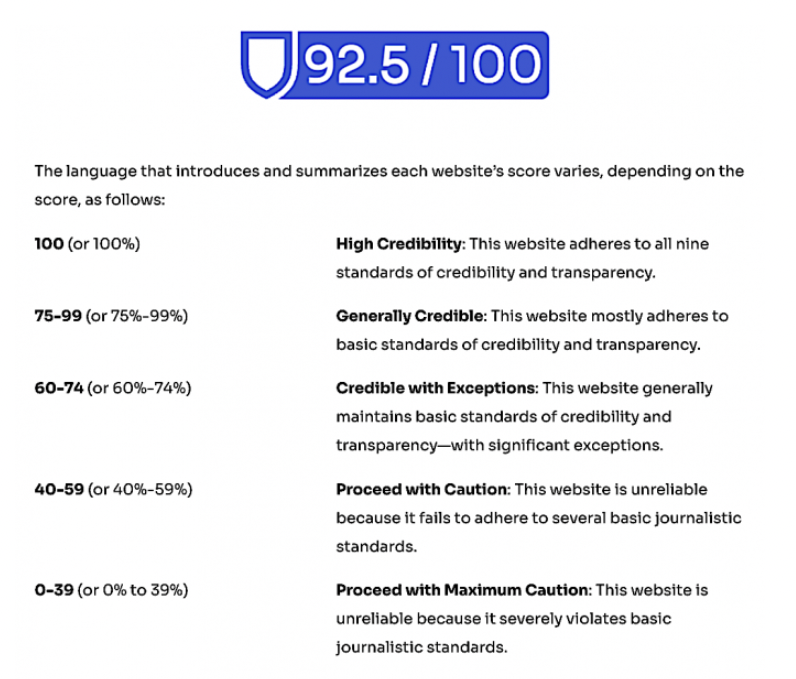
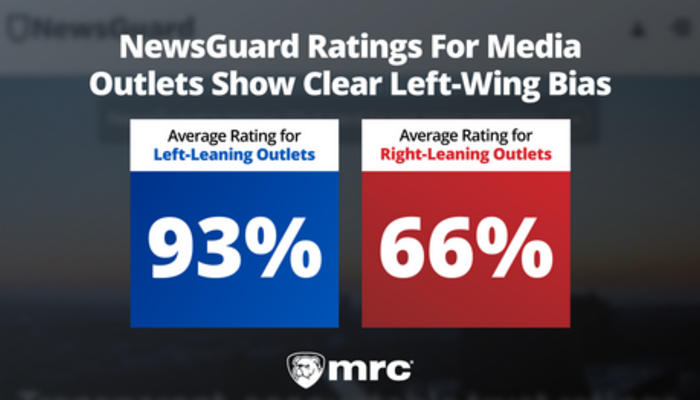
Critics note that such ratings are entirely subjective — The New York Times, for example, which repeatedly carried false and partisan information from anonymous sources during the Russiagate hoax, gets a 100 percent rating. RealClearInvestigations, which took heat in 2019 for unmasking the “whistleblower” of the first Trump impeachment (while many other outlets including the Times still have not), has an 80 percent rating. (Verbatim: the NewsGuard-RCI exchange over the whistleblower.) Independent news outlets with an anti-establishment bent receive particularly low ratings from NewsGuard, such as the libertarian news site Antiwar.com, with a 49.5 percent rating, and conservative site The Federalist, with a 12.5 percent rating.
As it stakes a claim to being the internet’s arbiter of trust, the company’s site says it has conducted reviews of some 95 percent of news sources across the English, French, German, and Italian web. It has also published reports about disinformation involving China and the Ukraine-Russia and Israel-Hamas wars. The model has received glowing profiles in CNN and The New York Times, among other outlets, as a viable solution for fighting fake news.

NewsGuard is pushing to apply its browser screening process to libraries, academic centers, news aggregation portals, and internet service providers. Its reach, however, is far greater because of other products it aims to sell to social media and other content moderation firms and advertisers. “An advertiser’s worst nightmare is having an ad placement damage even one customer’s trust in a brand,” said Crovitz in a press release touting NewsGuard’s “BrandGuard” service for advertisers. “We’re asking them to pay a fraction of what they pay their P.R. people and their lobbyists to talk about the problem,” Crovitz told reporters.
How NewsGuard Starves Disfavored Sites Of Ad Clients
NewsGuard’s BrandGuard tool provides an “exclusion list” that deters advertisers from buying space on sites NewsGuard deems problematic. But that warning service creates inherent conflicts of interest with NewsGuard’s financial model: The buyers of the service can be problematic entities too, with an interest in protecting and buffing their image.
A case in point: Publicis Groupe, NewsGuard’s largest investor and the biggest conglomerate of marketing agencies in the world, which has integrated NewsGuard’s technology into its fleet of subsidiaries that place online advertising. The question of conflicts arises because Publicis represents a range of corporate and government clients, including Pfizer — whose Covid vaccine has been questioned by some news outlets that have received low scores. Other investors include Bruce Mehlman, a D.C. lobbyist with a lengthy list of clients, including United Airlines and ByteDance, the parent company of much-criticized Chinese-owned social media platform TikTok.
NewsGuard has faced mounting criticism that rather than serving as a neutral public service against online propaganda, it instead acts as an opaque proxy for its government and corporate clients to stifle views that simply run counter to their own interests. The criticism finds support in internal documents, such as the NewsGuard proposal to Twitter, which this reporter obtained during “Twitter Files” reporting last year, as well as in government records and discussions with independent media sites targeted by the startup.
And although its pitch to Twitter (now Elon Musk’s X) “never went anywhere,” according to Matt Skibinski, the general manager of NewsGuard, his company remains “happy to license our data to Twitter or any platform that might benefit.” Coincidentally (or not), X comes in for criticism in NewsGuard’s latest “misinformation monitor” headlined: “Blue-Checked, ‘Verified’ Users on X Produce 74 Percent of the Platform’s Most Viral False or Unsubstantiated Claims Relating to the Israel-Hamas War.”

Bullying Consortium News After Foreign Policy Critiques
Meanwhile, one of the sites targeted by NewsGuard earlier, Consortium News, has filed a lawsuit against it claiming “First Amendment violations and defamation.”
Beginning last year, users scanning the headlines on certain browsers that include NewsGuard were warned against visiting Consortium News. A scarlet-red NewsGuard warning pop-up said, “Proceed With Caution” and claimed that the investigative news site “has published false claims about the Ukraine-Russia war.” The warning also notifies a network of advertisers, news aggregation portals, and social media platforms that Consortium News cannot be trusted.
But Consortium News, founded by late Pulitzer Prize-winning investigative journalist Robert Parry and known for its strident criticism of U.S. foreign policy, is far from a fake news publisher. And NewsGuard, the entity attempting to suppress it, Consortium claims, is hardly a disinterested fact-checker because of federal influence over it. NewsGuard attached the label after pressing Consortium for retractions or corrections to six articles published on the site. Those news articles dealt with widely reported claims about neo-Nazi elements in the Ukrainian military and U.S. influence over the country — issues substantiated by other credible media outlets. After Consortium editors refused to remove the reporting and offered a detailed rebuttal, the entire site received a misinformation label, encompassing over 20,000 articles and videos published by the outlet since it was founded in 1995.
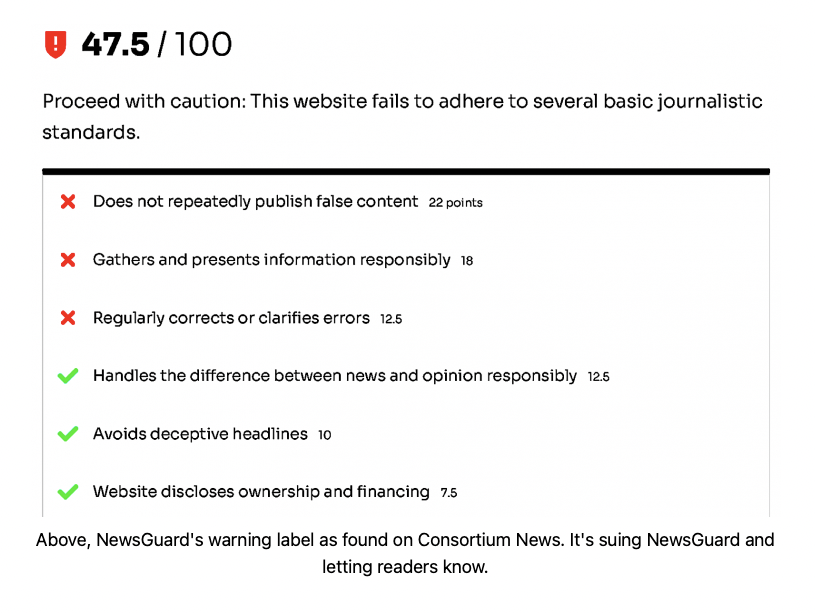
The left-wing news site believes the label was part of a pay-for-censorship scheme. It notes that Consortium News was targeted after NewsGuard received a $749,387 Defense Department contract in 2021 to identify “false narratives” relating to the war between Ukraine and Russia, as well as other forms of foreign influence.
Bruce Afran, an attorney for Consortium News, disagrees. “What’s really happening here is that NewsGuard is trying to target those who take a different view from the government line,” said Afran. He filed an amended complaint last month claiming that NewsGuard not only defamed his client, but also acts as a front for the military to suppress critical reporting.
“There’s a great danger in being maligned this way,” Afran continued. “The government cannot evade the Constitution by hiring a private party.”
Joe Lauria, the editor-in-chief of Consortium News, observed that in previous years, anonymous social media accounts had also targeted his site, falsely claiming a connection to the Russian government in a bid to discredit his outlet.
“NewsGuard has got to be the worst,” said Lauria. “They’re labeling us in a way that stays with us. Every news article we publish is defamed with that label of misinformation.”
Both Lauria and Afran said that they worry that NewsGuard is continuing to collaborate with the government or with intelligence services. In previous years, NewsGuard had worked with the State Department’s Global Engagement Center. It’s not clear to what extent NewsGuard is still working with the Pentagon. But earlier this year, Crovitz wrote an email to journalist Matt Taibbi, defending its work with the government, describing it in the present tense, suggesting that it is ongoing:
For example, as is public, our work for the Pentagon’s Cyber Command is focused on the identification and analysis of information operations targeting the U.S. and its allies conducted by hostile governments, including Russia and China. Our analysts alert officials in the U.S. and in other democracies, including Ukraine, about new false narratives targeting America and its allies, and we provide an understanding of how this disinformation spreads online. We are proud of our work countering Russian and Chinese disinformation on behalf of Western democracies.
The company has not yet responded to the Consortium News lawsuit, filed in the New York federal court. In May of this year, the Air Force Research Lab responded to a records request from journalist Erin Marie Miller about the NewsGuard contract. The contents of the work proposal were entirely redacted.

Asked about the company’s continued work with the intelligence sector, Skibinski replied, “We license our data about false claims made by state media sources and state-sponsored disinformation efforts from China, Russia and Iran to the defense and intelligence sector, as we describe on our website.”
Punishing An Outlet That Criticized A NewsGuard Backer’s Pharma Clients
Other websites that have sought to challenge their NewsGuard rating say it has shown little interest in a back-and-forth exchange regarding unsettled matters. Take the case of The Daily Sceptic, a small publication founded and edited by conservative English commentator Toby Young. As a forum for journalists and academics to challenge a variety of strongly held public-policy orthodoxies, even those on Covid-19 vaccines and climate change, The Daily Sceptic is a genuine dissenter. Last year, Young reached out to NewsGuard, hoping to improve his site’s 74.5 rating.
In a series of emails from 2022 and 2023 that were later forwarded to RealClearInvestigations, NewsGuard responded to Young by listing articles that it claimed represent forms of misinformation, such as reports that Pfizer’s vaccine carried potential side effects. The site, notably, has been a strident critic of Covid-19 policies, such as coercive mandates. Anicka Slachta, an analyst with NewsGuard, highlighted articles that questioned the efficacy of the vaccines and lockdowns. The Daily Sceptic, for example, reported a piece casting Covid-19 lockdowns as “unnecessary, ineffective and harmful,” citing academic literature from Johns Hopkins University.
Rather than refute this claim, Slachta simply offered an opposing view from another academic, who criticized the arguments put forth by lockdown critics. And the Hopkins study, Slachta noted, was not peer-reviewed. The topic is still, of course, under serious debate. Sweden rejected the draconian lockdowns on schools and businesses implemented by most countries in North American and Europe, yet had one of the lowest “all-cause excess mortality” rates in either region.
Young and others said that the issue highlighted by NewsGuard is not an instance of misinformation, but rather an ongoing debate, with scientists and public health experts continuing to explore the moral, economic, and health-related questions raised by such policies. In its response to NewsGuard’s questions about the lockdown piece, Young further added that his site made no claim that the Hopkins paper was peer-reviewed and added that its findings had been backed up by a paper from the National Bureau of Economic Research.
Yet to NewsGuard, Young’s site evidently posed a misinformation danger by simply reporting on the subject and refusing to back down. Emails between NewsGuard and the Daily Sceptic show Young patiently responding to the company’s questions; he also added postscripts to the articles flagged by NewsGuard with a link to the fact checks of them and rebuttals of those fact checks. Young also took the extra step of adding updates to other articles challenged by fact-checking non-governmental organizations. “I have also added postscripts to other articles not flagged by you but which have been fact checked by other organisations, such as Full Fact and Reuters,” Young wrote to Slachta.
That wasn’t enough. After a series of back-and-forth emails, NewsGuard said it would be satisfied only with a retraction of the articles, many of which, like the lockdown piece, contained no falsehoods. After the interaction, NewsGuard lowered The Daily Sceptic’s rating to 37.5/100.
“I’m afraid you left me no choice but to conclude that NewsGuard is a partisan site that is trying to demonetise news publishing sites whose politics it disapproves of under the guise of supposedly protecting potential advertisers from being associated with ‘mis-’ and ‘disinformation,’” wrote Young in response. “Why bother to keep up the pretence of fair-mindedness John? Just half my rating again, which you’re going to do whatever I say.”
NewsGuard’s Skibinski, in a response to a query about The Daily Sceptic’s downgrade, denied that his company makes any “demands” of publishers. “We simply call them for comment and ask questions about their editorial practices,” he wrote. “This is known as journalism.”
The experience mirrored that of Consortium. Afran, the attorney for the site, noted that NewsGuard uses an arbitrary process to punish opponents, citing the recent study from the company on misinformation on the Israel-Hamas war. “They cherry-picked 250 posts among tweets they knew were incorrect, and they attempt to create the impression that all of X is unreliable,” the lawyer noted. “And so, what they’re doing, and this is picked up by mainstream media, that’s actually causing X, formerly Twitter, to now lose ad revenue, based literally on 250 posts out of the billions of posts on Twitter.”
The push to demonize and delist The Daily Sceptic, a journalist critic of pharmaceutical products and policies, reflects an inherent conflict with the biggest backer of NewsGuard: Publicis Groupe.
Publicis client Pfizer awarded Publicis a major deal to help manage its global media and advertising operations, a small reflection of which is the $2.3 billion the pharmaceutical giant spent on advertising last year.
The NewsGuard-Publicis relationship extends to the Paris-based marketing conglomerate’s full client list, including LVHM, PepsiCo, Glaxo Smith Kline, Burger King, ConAgra, Kellogg Company, General Mills, and McDonalds. “NewsGuard will be able to publish and license ‘white lists’ of news sites our clients can use to support legitimate publishers while still protecting their brand reputations,” said Maurice Lévy, chairman of the Publicis Groupe, upon its launch of NewsGuard.
Put another way, when corporate watchdogs like The Daily Sceptic or Consortium News are penalized by NewsGuard, the ranking system amounts to a blacklist to guide advertisers where not to spend their money.
“NewsGuard is clearly in the business of censoring the truth,” noted Dr. Joseph Mercola, a gadfly voice whose website was ranked as misinformation by NewsGuard after it published reports about Covid-19’s potential origin from a lab in Wuhan, China.
“Seeing how Publicis represents most of the major pharmaceutical companies in the world and funded the creation of NewsGuard, it’s not far-fetched to assume Publicis might influence NewsGuard’s ratings of drug industry competitors,” Mercola added, in a statement online.
This article was originally published by RealClearInvestigations.



 What Did You Say?
You must be logged in to post a comment.