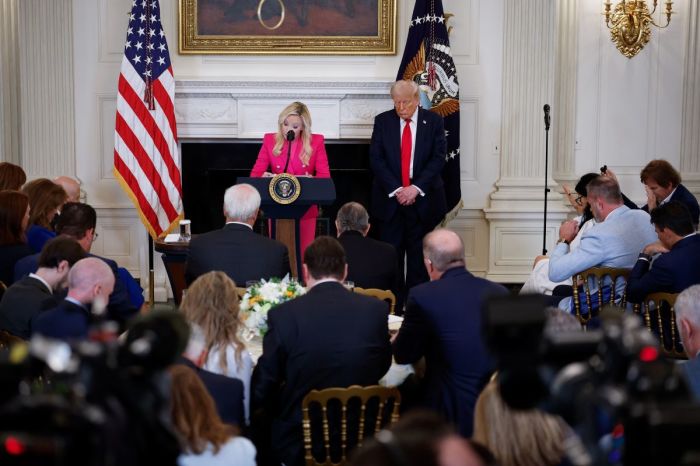
U.S. President Donald Trump and Pastor Paula White-Cain, the head of the White House Faith Office, bow their heads in prayer during a White House Faith Office luncheon in the State Dining Room at the White House on July 14, 2025 in Washington, DC. White-Cain hosted the luncheon with members of government and faith-based and community organizations. | Kevin Dietsch/Getty Images
President Donald Trump and the White House Faith Office hosted the inaugural Summit of Faith and Business Leaders on Monday to celebrate what he calls “core values that built this country,” which include “freedom, hard work, risk-taking, and above all, trust in Almighty God.”
Held in the State Dining Room, the event was attended by dozens of CEOs and business leaders, honoring those who have donated to faith-based charities.
In addition to remarks from Trump, Paula White-Cain, senior advisor to the White House Faith Office and a Charismatic televangelist, also addressed the gathering.
While Trump touched upon multiple topics during the discussion, encompassing both foreign and domestic policy, the importance of the Christian faith loomed large.
Here are four highlights from the meeting.
1. Trump highlights faith of notable entrepreneurs
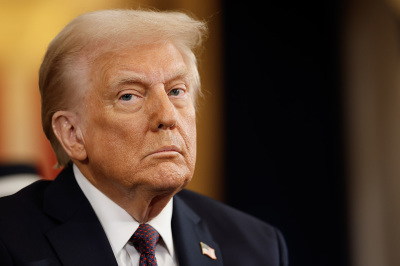
U.S. President Donald Trump attends inauguration ceremonies in the Rotunda of the U.S. Capitol on Jan. 20, 2025, in Washington, D.C. Donald Trump takes office for his second term as the 47th president of the United States. | Chip Somodevilla/Getty Images
The president began his remarks by naming notable entrepreneurs throughout American history who strongly embraced the Christian faith. He repeatedly asserted that Christianity has had a positive influence on American society.
“From the earliest days of our republic, the steady compass of faith has guided the strong hands of American workers, builders and entrepreneurs like really no other,” he said. “Our country was founded by pilgrims and believers. And every generation since, Americans of faith have built our communities and forged new industries and enriched our country by millions and millions of people and ways.”
Trump listed John D. Rockefeller of Standard Oil, clothing entrepreneur J.C. Penney, inventor Charles Goodyear, and Chick-fil-A founder Truett Cathy as examples of business leaders “inspired by their love of God.” He insisted that there were people he could name in the room whose “names are every bit as big as that,” adding that “the proud tradition continues with all of you.”
“This group reminds us [that] a nation that prays is a nation that prospers,” he added. “I think one of the reasons we went so bad is they really wanted to take God and religion out of your lives, and there was nobody to … look up to.”
“We have to bring religion back into the country, and we’re starting to do that, I think, at a very high level.”
WASHINGTON, DC – APRIL 05: People use IRS Direct File at the Internal Revenue Service Building on April 05, 2024 in Washington, D.C. | Tasos Katopodis/Getty Images for Economic Security Project
2. Trump touts new policy allowing pastors to endorse political candidates
Much of Trump’s remarks at the event consisted of highlighting what he viewed as the major accomplishments of his administration so far.
“As president, I’ve ended the radical left war on faith, and we’re once again protecting religious freedom like never before in our country,” he said.
Trump touted “getting rid of the Johnson Amendment that didn’t let the pastors and ministers and everybody speak about politics.” He contended that in the absence of the Johnson Amendment, which was passed in 1954 to prevent nonprofits from endorsing political candidates, pastors now have the ability to say, “I don’t like that guy.”
In a legal filing last week, the IRS confirmed that religious leaders who endorse political candidates from the pulpit or through their church communications will not lose their tax-exempt status, drawing praise from conservative and progressive Christian leaders and criticism from secular legal groups.
The president recalled how many religious leaders supported him in his first presidential bid in 2016. But he claims they declined to endorse him because of concerns of losing their tax-exempt status under the Johnson Amendment. He described how, during “a meeting with 50 faith leaders” in 2015, then-candidate Trump informed them that “I’d love to have your endorsement.”
Trump expressed concern that the religious leaders “didn’t say anything” due to their concerns about the Johnson Amendment, maintaining that he was unaware of the longstanding provision because he was new to politics.
In a subsequent meeting with religious leaders ahead of the 2016 presidential election, Trump vowed to get rid of the Johnson Amendment. In 2017, Trump instructed the IRS to relax enforcement of the Johnson Amendment on churches.
Republican presidential candidate former President Donald Trump is rushed offstage after an assassination attempt on his life during a rally on July 13, 2024, in Butler, Pennsylvania. Butler County district attorney Richard Goldinger said the shooter is dead after injuring former U.S. President Donald Trump, killing one audience member and injuring another in the shooting. | Anna Moneymaker/Getty Image
3. Trump says his life was ‘saved by God to make America great again’
As Trump continued to talk about what has transpired during his administration, he noted that the White House gathering took place one day after the first anniversary of the Butler, Pennsylvania, campaign rally, where an assassin’s bullet nearly ended his life.
“It’s remarkable to think that it was only one year ago this week that my time on earth nearly ended,” Trump asserted. “And if you look at that, God was with me because that’s something,” he added. “In theory, I should not be with you today.”
After the attendees erupted into applause, Trump insisted that “my life was saved by God to really make America great again.” The president echoed what he has articulated in previous remarks about his assassination attempt, noting how his sons, who are avid shooters, informed him that “at that distance with that gun, you didn’t have a chance.”
“Some people say it was lucky, and some people say something else. I say something else. I think God helped us,” he concluded.
Paula White-Cain, senior advisor of the White House Faith Office, delivers remarks at a White House Faith Office luncheon, July 14, 2025. | Screenshot: Paula White Ministries
4. Paula White calls America’s business leaders ‘stewards on divine assignment’
The Rev. Paula White-Cain, a Florida-based pastor who has served as Trump’s spiritual advisor, called Trump “the greatest champion of faith of any president that the United States of America has ever had.”
She told the attendees that the Trump administration “understands that people who are of faith who are entrusted with wealth and influence, as you are, are essential to building a stronger, freer, and more compassionate nation.”
“You’re more than just CEOs and business leaders and entrepreneurs,” she said. “You’re stewards on divine assignment, builders of legacy and vessels of impact. You’ve been called by God to His kingdom for such a time as this.”
White-Cain claimed that “America’s spiritual and moral foundations have been restored.”
“And it’s only the beginning,” she continued. “Today’s not just a luncheon. It is a moment of divine alignment, a commissioning. And we believe that God is raising up business leaders who don’t separate faith from enterprise but who see their platforms and their pulpits as their businesses and instruments for eternal impact.”
American Family Association
American Family Association (AFA), a non-profit 501(c)(3) organization, was founded in 1977 by Donald E. Wildmon, who was the pastor of First United Methodist Church in Southaven, Mississippi, at the time. Since 1977, AFA has been on the frontlines of Ame
NEWSMAX
News, Opinion, Interviews, Research and discussion
Opinion
American Family Association
American Family Association (AFA), a non-profit 501(c)(3) organization, was founded in 1977 by Donald E. Wildmon, who was the pastor of First United Methodist Church in Southaven, Mississippi, at the time. Since 1977, AFA has been on the frontlines of Ame
American Family Association
American Family Association (AFA), a non-profit 501(c)(3) organization, was founded in 1977 by Donald E. Wildmon, who was the pastor of First United Methodist Church in Southaven, Mississippi, at the time. Since 1977, AFA has been on the frontlines of Ame
You Version
Bible Translations, Devotional Tools and Plans, BLOG, free mobile application; notes and more
Political
American Family Association
American Family Association (AFA), a non-profit 501(c)(3) organization, was founded in 1977 by Donald E. Wildmon, who was the pastor of First United Methodist Church in Southaven, Mississippi, at the time. Since 1977, AFA has been on the frontlines of Ame
NEWSMAX
News, Opinion, Interviews, Research and discussion
Spiritual
American Family Association
American Family Association (AFA), a non-profit 501(c)(3) organization, was founded in 1977 by Donald E. Wildmon, who was the pastor of First United Methodist Church in Southaven, Mississippi, at the time. Since 1977, AFA has been on the frontlines of Ame
Bible Gateway
The Bible Gateway is a tool for reading and researching scripture online — all in the language or translation of your choice! It provides advanced searching capabilities, which allow readers to find and compare particular passages in scripture based on



 What Did You Say?
You must be logged in to post a comment.