
Perspectives; Thoughts; Comments; Opinions; Discussions

Posts tagged ‘war games’

Democrats’ ‘War Game’ for Election Includes West Coast Secession, Possible Civil War


Reported by JOEL B. POLLAK | 

URL of the originating web site: https://www.breitbart.com/2020-election/2020/08/02/democrats-war-game-for-election-includes-west-coast-secession-possible-civil-war-john-podesta/
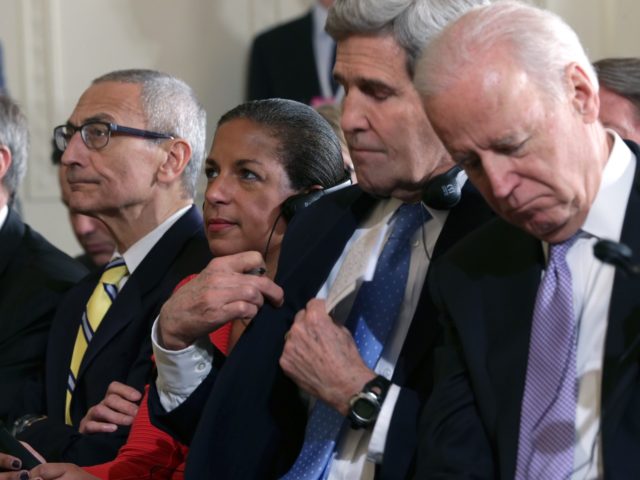
Podesta and Biden (Alex Wong / Getty)

However, buried near the end of Smith’s column is a report that Democrats have participated in a “war game” in which they considered several possible outcomes of the election. In one scenario, John Podesta — the former chair of Hillary Clinton’s presidential campaign, and a leading figure in party circles — played former Vice President Joe Biden, and refused to concede the election.

The result: the threat of secession by the entire West Coast, followed by the possible intervention of the U.S. armed forces:

But conveniently, a group of former top government officials called the Transition Integrity Project actually gamed four possible scenarios, including one that doesn’t look that different from 2016: a big popular win for Mr. Biden, and a narrow electoral defeat, presumably reached after weeks of counting the votes in Pennsylvania. For their war game, they cast John Podesta, who was Hillary Clinton’s campaign chairman, in the role of Mr. Biden. They expected him, when the votes came in, to concede, just as Mrs. Clinton had.

But Mr. Podesta, playing Mr. Biden, shocked the organizers by saying he felt his party wouldn’t let him concede. Alleging voter suppression, he persuaded the governors of Wisconsin and Michigan to send pro-Biden electors to the Electoral College.

In that scenario, California, Oregon, and Washington then threatened to secede from the United States if Mr. Trump took office as planned. The House named Mr. Biden president; the Senate and White House stuck with Mr. Trump. At that point in the scenario, the nation stopped looking to the media for cues, and waited to see what the military would do.

Notably, on Election Night in 2016, Podesta publicly refused to concede the election to President Donald Trump.

Joel B. Pollak is Senior Editor-at-Large at Breitbart News and the host of Breitbart News Sunday on Sirius XM Patriot on Sunday evenings from 7 p.m. to 10 p.m. ET (4 p.m. to 7 p.m. PT). His new book, RED NOVEMBER, tells the story of the 2020 Democratic presidential primary from a conservative perspective. He is a winner of the 2018 Robert Novak Journalism Alumni Fellowship. Follow him on Twitter at @joelpollak.

Pendleton Marines train for large-scale deployment


By Jennifer Hlad, Stars and Stripes, Published: February 26, 2015

URL of the Original Posting Site: http://www.stripes.com/news/pendleton-marines-train-for-large-scale-deployment-1.331728

Marines in the combat operations center plan an attack on an enemy force occupying a partner nation during a training exercise at Camp Pendleton, Calif. The exercise, which simulates the deployment of 50,000 troops, is the first of its scale in 12 years. Jennifer Hlad/Stars and Stripes

Gen. Joseph Dunford expects all Marine units to be “physically and mentally ready” to deploy anywhere, at any time, he said in planning guidance released last month. But instead of having every platoon, company and battalion involved in constant training for everything, he has outlined broad responsibilities for each of the three Marine Expeditionary Forces. Commanders and Marines can now focus on core competencies related to specific operations they might be involved in. This rebalance will help address shortfalls in personnel, equipment and training in nondeployed units, he said.

It’s also the first exercise of its size in more than a decade. More than 1,800 Marines and sailors were involved in the training, which simulated the deployment of more than 50,000 U.S. troops. The countries in the exercise are fictional, and no one mentioned a specific threat, even though talk of “anti-access area denial” conjures images of Russia and China.

Inside the sprawling combat operations center — a maze of tents serving as the nerve center for the enormous operation — members of I Marine Expeditionary Force monitored communication lines, pored over intelligence and studied computer screens, planning an enormous battle designed to push invading troops back into their own country and restore international borders.

“We don’t know what’s coming,” said Lt. Col. Doug “Lucky” Luccio, deputy current operations officer for I MEF, as he walked through the command center, pointing out an Army Ranger, civil affairs officers, logistics Marines and intelligence troops. Marine aviation units participated from an operations center at Miramar, 32 miles south. “We have to make sure [the training scenario] is big enough,” he said, so that everyone and every process is tested.

The last time an entire MEF deployed was the march to Baghdad in 2003. Since then, the Marine Corps has deployed smaller forces to Iraq and Afghanistan and other spots around the world. Now, Luccio said, Marines must return to what they call their “core competencies,” instead of focusing solely on counterinsurgency.

Under the new guidance, the California I MEF, which encompasses virtually all of the troops stationed at Camp Pendleton and Twentynine Palms as well as the Marine Corps air stations in Miramar and Yuma, Ariz., is charged with maintaining proficiency in “major operations and campaigns.”

North Carolina-based II MEF will focus on maintaining proficiency for smaller unit crisis response, in the 12,000 to 20,000-troop range, while the Okinawa-based III MEF will focus on “the full range of military operations” in the Pacific, according to the guidance.

The MEF-level exercise, dubbed MEFEX, means I MEF “is well on [its] way to meeting the commandant’s intent,” said Brig. Gen. Joaquin Malavet, deputy commander of I MEF. A Marine Corps training group of about 60 service members and contractors drove the exercise, acting as the enemy and as the higher headquarters – a sort of “boss” command that pushed information down to the MEF and approved battle plans created by the MEF.

On Wednesday, the I MEF staff began a simulated air and ground attack on the occupying force, which involved not just enveloping the enemy and calling in air strikes, but also keeping the simulated troops supplied and warding off cyberattacks and attacks on the base at Camp Pendleton. The exercise built on training last year that focused on getting Marines from sea to shore, touching on another piece of Dunford’s guidance: naval integration.

Malavet said it just makes sense, because in a real-world situation, the Navy and Marine Corps work together to cover all domains — space, cyber, sea, undersea and ground. 

“You have to put in place a series of training exercises that methodically gets at the kind of capabilities and refines and strengthens those capabilities for interoperability that we would need across those domains,” he said. “And the way that you bring that together is with exercises like this MEFEX.”

Athletes know there is a difference between studying game tape and getting out on the field, he said.

“This is about mental memory, muscle memory, unit cohesion,” Malavet said. “The key is to always be prepared, across the full range of military operations.”.

The training wasn’t just for Marines inside the command center. Col. James Herrera’s units were tasked with building, sustaining and protecting the expeditionary base. That included food, generators, communications, mail, sleeping quarters, restroom and shower facilities, chaplain services and base security, said Herrera, commander of I MEF Headquarters Group.

It’s a lot of work, but he said it’s critical for building relationships, improving communication and learning to get things up and running quickly.

“It’s very hard to do that on PowerPoint,” he said.Tree of Liberty 03

hlad.jennifer@stripes.com
Twitter: @jhladFreedom with Prayer

Our “Community-Organizer-in-Chief” is Trying to Act Tough


‘Provocative’ Putin reacts to U.S. presence

Puts U.S. warship on notice as Washington moves troops

http://www.wnd.com/2014/04/provocative-putin-reacts-to-u-s-presence/#VhD0dbKbTvwFWKH1.99

Published: 21 hours ago

author-image
F. Michael Maloof, staff writer for WND and G2Bulletin, is a former senior security policy analyst in the office of the secretary of defense.

Vladimir Putin

WASHINGTON – Russian President Vladimir Putin has begun to react to subtle U.S. military deployments in the periphery of Russia.

The U.S. has sailed an Aegis anti-ballistic warship into the Black Sea, and the Pentagon announced Tuesday that U.S. troops would be sent for exercises in Eastern Europe to reassure allies on Russia’s border.

In an act deemed by the Pentagon as “provocative,” a Russian Sukhoi-24 fighter jet repeatedly buzzed the U.S.S. Donald Cook as low as 500 feet over a 90-minute period April 12 as the U.S. warship trolled the Black Sea in international waters near Crimea.

With enhanced Russian military presence in Crimea, the prospect of further provocations against ships and military aircraft from the U.S. and its partners of the North Atlantic Treaty Organization is expected to increase, sources say.

In turn, such an episode would only increase Russian surveillance of Western military assets, possibly affecting their ability to conduct normal reconnaissance and intelligence-gathering operations.

Meanwhile, the Pentagon is considering the deployment of up to 10,000 ground troops to Poland to show U.S. commitment to allied security in the area.

After a meeting with Polish Defense Minister Tomasz Siemoniak last week, U.S. Defense Secretary Chuck Hagel said Poland would play a major role in the NATO buildup of troops in Eastern Europe “under U.S. patronage.”

“All Show and No GO?”

Signaling a change in overall strategic defense policy, Hagel said the U.S. needs to “re-pivot back to Europe from Asia to confront “Russian aggression” in Ukraine.

One of the options for the U.S. is to move a 4,500-member combat brigade from Fort Hood, Texas, to Europe.

A forward contingent already is on the ground in Poland to oversee what may become a series of military exercises with NATO allies in the region. It’s a response to Putin’s apparent intention of taking over all of Ukraine and possibly other areas of Eastern Europe where there is a concentration of ethnic Russians.

The prospect has prompted concern among NATO countries in the region, which have assessed that the Russian military is stronger than all of their militaries combined. Consequently, the NATO members are hoping the U.S. will increase its presence to confront what they consider “Russian aggression.”

Regional sources have told WND that Putin’s motive is to set up buffer zones against the eastern encroachment of NATO, as Ukraine, Moldova and Georgia seek to join the Western alliance.

Putin, however, has reacted forcibly, in 2008 with the Russian invasion of Georgia and now the movement of Russian special forces into Crimea. The annexation of the peninsula came after a disputed referendum of its citizens, which are predominantly ethnic Russian.

The sources believe Putin will remain assertive in his determination to set up buffers while keeping out elements of NATO. For that reason, the Russian president last week reacted forcibly against the deployment of NATO anti-missile defenses, including the U.S.S. Cole, an Aegis-equipped missile warship, near Crimea.

Putin views the moves as a threat to the nuclear defenses of southwestern Russia, which include Crimea for the first time in Russia’s strategic doctrine.

The Cole actually was to head to the Ukrainian city of Odessa for a port call but canceled due to demonstrations and after Putin referred to the U.S. deployment as a threat.

The U.S. warship reportedly then pulled out of the area and headed toward Turkey and Georgia.

Russia expert John Helmer said that the use of the ships in the Black Sea is of particular concern to Putin.

A U.S. warship, the U.S.S. Mount Whitney, was in the Black Sea during the Winter Olympics in Sochi, Russia, to assist Putin in counter-terrorism activities. But it also secretly monitored Russian reaction to demonstrations in Ukraine at the time that led to the ouster of its pro-Russian president.

The Mount Whitney is described as a floating headquarters for NATO strike forces aimed at Russia. It was present in the Black Sea during the 2008 Russian invasion of Georgia.

The ship has the capability of intercepting signals intelligence and listening in on Russian command communications.

According to Helmer, who said he was quoting European military observers, the actual purpose of the Mount Whitney during the Olympic Games was to monitor how far Putin’s attention was distracted by the Olympics “while the U.S. worked to transform the situation in Kiev, overthrowing the government of (Ukrainian) President Viktor Yanukovych, if it could.”

Putin was distracted by the Olympics, the Europeans believe, and so he was taken by surprise by the Feb. 21 coup in Kiev, prompting him to act first in Crimea to create the buffer against NATO.

Tag Cloud