
Perspectives; Thoughts; Comments; Opinions; Discussions

Posts tagged ‘THE SENATE’

This Bold Move by the Senate Has Shocked Democrats


By: Kevin Jackson | September 17, 2025

Read more at https://theblacksphere.net/2025/09/move-by-the-senate-is-breathtaking/

In a plot twist scarier than a switchblade at a balloon party, the U.S. Senate just rewrote its own script. On September 11, 2025, Senate Republicans, the perennial guardians of decorum who’d rather filibuster their own lunch order than rock the boat, dropped a tactical nuke. With a unanimous 53-45 vote, they slashed the confirmation threshold for President Trump’s nominees from a stately 60 to a sassy 51, leaving Chuck Schumer and his Democratic posse clutching their filibuster like a toddler’s comfort blankie. NBC News captured the detonation:

No more endless debates, just batch votes for Trump’s picks—48 at a time, like a Costco run for cabinet secretaries. The hypocrisy? Oh, it’s richer than a K Street steak dinner, and the fallout signals something bigger: Trump hasn’t just returned; he’s repo’d the Republican Party from its RINO squatters.

Let’s savor the irony before we dissect the corpse.

These are the same Republicans who, back in 2013, wailed like banshees when Harry Reid pulled a similar stunt to fast-track Obama’s judges. Mitch McConnell, the Senate’s resident Yoda of obstruction, called it a “dark day for democracy” and warned of a Senate “run like a banana republic” CNN archives the meltdown.

Fast-forward to 2017, and McConnell’s singing a different tune, extending Reid’s nuclear precedent to ram Neil Gorsuch onto the Supreme Court. Now, in 2025, the GOP’s back at it, torching Senate tradition to grease Trump’s agenda.

The “nuclear option” is a relatively new beast in the Senate’s menagerie.

The phrase was coined in 2005 when Trent Lott, exasperated by Democratic filibusters on Bush’s judges, mused about blowing up the rules. But the filibuster itself? It’s a relic older than the Capitol’s creaky elevators.

Born in the 19th century, the filibuster allowed senators talk a bill to death—think Jimmy Stewart in Mr. Smith Goes to Washington. By 1917, the Senate adopted Rule XXII, requiring a two-thirds vote (later 60) to end debate, per Senate.gov’s history lesson. It was a compromise to keep the chamber from devolving into a verbal Thunderdome.

The nuclear option’s DNA, though, traces to a 1957 memo by then-VP Richard Nixon, who argued the Senate could reinterpret its rules by simple majority—a procedural middle finger to tradition. It sat dormant until Reid’s 2013 gambit, which dropped the cloture threshold for non-Supreme Court nominees to 51.

Republicans screamed bloody murder, but when Trump took the White House, they happily borrowed Reid’s playbook. In April 2017, McConnell nuked the filibuster for SCOTUS, landing Gorsuch and later Brett Kavanaugh and Amy Coney Barrett. Democrats cried foul, conveniently forgetting their own trigger finger.

As TIME’s 2025 analysis notes, this latest move “further erodes the Senate’s deliberative role.” Clearly, that rule has been on life support since cable news became a food group.

So why this 2025 encore? Because Trump’s 2024 comeback wasn’t just a win—it was a hostile takeover.

Rewind to 2020: The GOP’s RINO wing—think Liz Cheney’s sanctimonious pressers or Mitt Romney’s furrowed-brow op-eds—played footsie with Democrats to kneecap Trump’s re-election. They didn’t rig the ballots (leave that to the tinfoil-hat crowd), but their lukewarm “support” and post-January 6 kumbaya with crooked Democrats fueled the Uniparty narrative: a cozy D.C. club where Republicans and Democrats swap talking points over martinis.

Trump’s base smelled the betrayal. And by 2024, they roared back, delivering him a popular-vote landslide and an Electoral College rout. The RINOs? Caught flat-footed, like deer staring into an orange-tinted semi.

Post-inauguration, the GOP establishment tried to play nice with Democrats, co-signing bipartisan bills on infrastructure and Ukraine aid like it was 2019. Trump, ever the disruptor, wasn’t having it. I’m sure he made overtures to Thune, and then the drastic happened. Charlie Kirk was assassinated.

Democrats showed their asses, as my grandmother would say, and Republican felt the winds in their direction go from smooth sailing to gale force.

By September, as Axios detailed, Majority Leader John Thune bundled 48 nominees into one vote, a procedural middle finger to Schumer’s stalling. The nuclear option wasn’t courage; it was the RINOs waving a white flag before Trump’s MAGA juggernaut.

The hypocrisy parade is a sight to behold. McConnell’s 2016 blockade of Merrick Garland was “letting the people decide,” but Barrett’s 2020 confirmation, weeks before Election Day, was “elections have consequences.” Now, with Trump’s second term, Republicans cheer the nuclear option like it’s the Fourth of July, while Democrats clutch their gavels and moan about “norms.” Schumer’s floor speeches about “Senate tradition” are peak performance art, considering his party’s 2013 precedent. Oh, and let’s not forget his poll numbers.

Everyone’s a constitutional purist until their guy’s in charge. As The Hill pointed out, this move “signals a new era of Senate power dynamics.” But this latest decision by the Senate is less about power and more about survival. The RINOs know Trump’s base is the GOP’s new oxygen.

Now, let’s peer into the crystal ball—polished with the gritty residue of 2025’s news cycle, where #NuclearOption and #TrumpNominees trend harder than a Kanye outburst.

The 2026 midterms are shaping up as a Democratic bloodbath.

Urban chaos, fueled by unchecked migration and gang turf wars, has voters itching for pitchforks. Trump’s border crackdowns, amplified by X’s raw footage, make GOP challengers look like sheriffs in a zombie flick. Democrats’ counter? More sanctuary cities and DEI buzzwords, which play about as well as a kazoo solo at a funeral. By 2028, the presidential race looks even bleaker for the blue team.

Trump’s out, but his successors—JD Vance’s Rust Belt grit or “I’m not Little” Marco Rubio have the edge.

Democrats’ bench? Gavin Newsom, California’s nanny-state czar, or Kamala Harris, still lost in her own syntax. Their coffers? Drained by Trump’s donor purge and FEC reforms that choke dark money. Election fraud? Neutered by voter ID laws and blockchain audits. Ideas? Just recycled climate platitudes while red states grill steaks during blackouts.

This isn’t just a GOP win; it’s a middle finger to the Uniparty cabal that’s held D.C. hostage for decades.

As The New York Times noted, the nuclear option “breaks the confirmation logjam,” but it’s more than that—it’s a signal to the deep state: Your lease is up. America’s back, and so’s the world, with a U.S. that doesn’t beg permission from Brussels or Beijing. Yet here’s the sardonic kicker: The GOP, once the party of limited government, now bulldozes Senate rules to pack the executive branch with Trump’s pit bulls. “Drain the swamp”? More like restocking America with loyal gators.

So, what’s the takeaway for us, the X-scrolling, coffee-swilling masses?

Screw party loyalty—it’s as useful as a paper straw in a hurricane. We picked Trump in 2016 and resurrected him in 2024 because the suits wouldn’t. His rallies outdrew Coachella; our memes buried their manifestos.

This nuclear vote? It’s our Molotov cocktail chucked through the Uniparty’s stained-glass window. Messy, loud, and oh-so-satisfying. The midterms loom, the cabal’s crumbling, and America’s got its swagger back—orange glow and all.

Leftists Want Direct Democracy Because It’s Easy to Manipulate the Masses


BY: CASEY CHALK | JANUARY 03, 2024

Read more at https://thefederalist.com/2024/01/03/leftists-want-direct-democracy-because-its-easy-to-manipulate-the-masses/

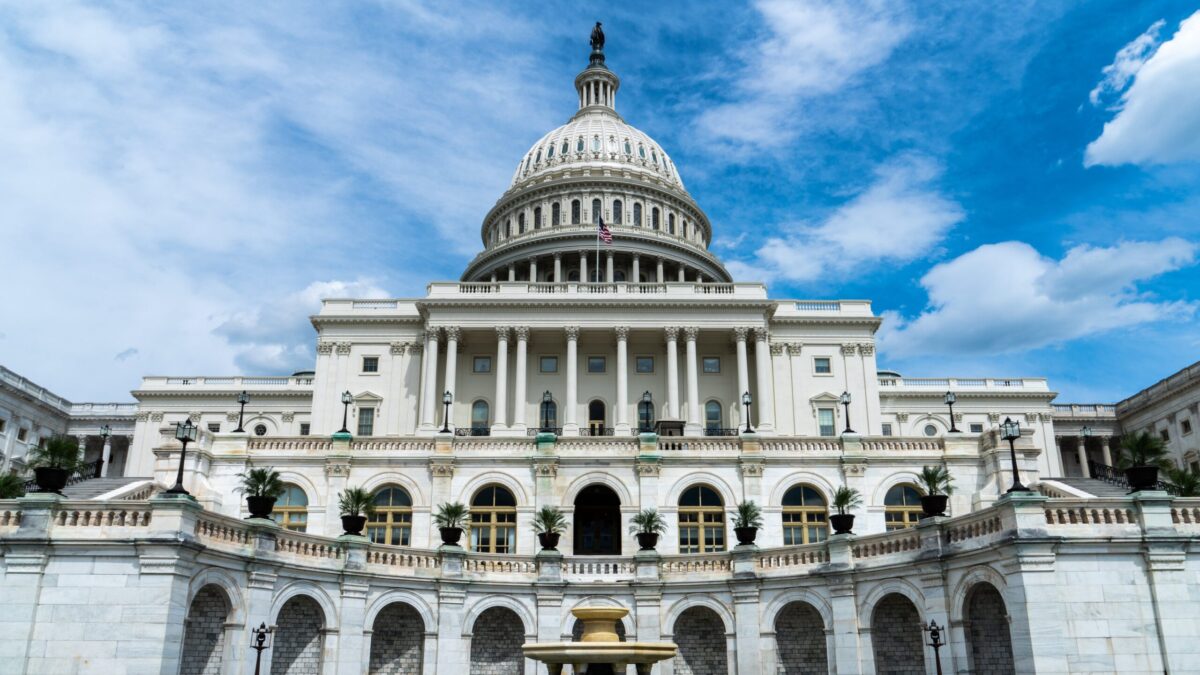
US Capitol Building

Author Casey Chalk profile

CASEY CHALK

MORE ARTICLES

“American democracy is cracking,” warns Washington Post Chief Correspondent Dan Balz in a recent column that presents some ideas to repair it. His suggestions include, among other things, proportional representation, diminishing the power of the Senate, and eliminating the Electoral College. What these three suggestions have in common is a desire to remove any intermediary institutions between the will of the people and government action — otherwise known as “direct” democracy. 

These proposals are not new. Indeed, even the framers of the Constitution were familiar with them. But the reasons why such suggestions would significantly erode the republican government envisioned by our Founding Fathers are not new either. 

Given Biden’s low approval ratings — especially in important swing states with critical Electoral College votes — as well as broader Democrat fears of a Republican takeover of the Senate, we will likely hear a renewed chorus of voices calling for direct democracy. After all, masses of individuals are much easier to manipulate than smaller families, communities, or even states. Conservatives would do well to arm themselves with the best arguments against such initiatives.

Founders Worked to Curb Direct Democracy

The framers of our Constitution felt quite strongly that direct democracy was something to avoid. In Federalist 10, for example, the Father of the Constitution James Madison warned of “the superior force of an interested and overbearing majority” on a government, or what has come to be called the “tyranny of the majority,” in which a majority of the population exerts great coercive power over minority factions.

Again in Federalist 51, Madison wrote: “[I]n the federal republic of the United States … all authority in it will be derived from and dependent on the society, the society itself will be broken into so many parts, interests, and classes of citizens, that the rights of individuals, or of the minority, will be in little danger from interested combinations of the majority.” 

Our second president, John Adams, called a unicameral legislative body — in which each member is accountable to his constituents — a “tyranny of the majority.” Adams, reflecting the opinion of that founding generation, argued for “a mixed government, consisting of three branches.” The framers took various steps to disburse power among the federal government, dividing it into three competing branches: executive, legislative, and judicial. 

But the founders’ dispersion of governing power also goes beyond the three branches. The 10th Amendment reads: “The powers not delegated to the United States by the Constitution, nor prohibited by it to the States, are reserved to the States respectively, or to the people.” In other words, unless the Constitution expressly grants certain powers to the federal government, those powers exist in the states or, even more decentralized, in local communities of Americans. 

Later Generations Understood the Threat

A generation after that founding generation, visiting French aristocrat Alexis de Tocqueville authored an extended survey of American politics and culture, Democracy in America. Tocqueville perceived that the American political system was created to resist the tyranny of the majority, “which bases its claim to rule upon numbers, not upon rightness or excellence.” Thus, Tocqueville writes:

When a man or a party suffers from an injustice in the United States, to whom do you want them to appeal? To public opinion? That is what forms the majority. To the legislative body? It represents the majority and blindly obeys it. To the executive power? It is named by the majority and serves it as a passive instrument. 

In other words, the executive branch, even with its disbursed powers, can be influenced by this tyrannical tendency to reflect the opinions of the majority of the people against minority interests at the state or community level. It was thus only through the states and local bases of power and voluntary associations that this tyrannical tendency could be avoided. 

A century after Tocqueville’s warnings, Supreme Court Justice Louis Brandeis discussed another way to understand our nation’s default desire to resist direct democracy. Brandeis was one of the first to describe the states as “laboratories of democracy.” In his New State Ice Co. v. Liebmann opinion, he explained how “a single courageous State may, if its citizens choose, serve as a laboratory; and try novel social and economic experiments without risk to the rest of the country.”  

State and local autonomy served as a means of testing laws and policies to evaluate their effectiveness before implementing across a diverse nation of states, localities, and subcultures. If something works at the micro level, other localities or states — and even potentially the federal government — can appreciate and adopt it. 

Constant Temptation of Direct Democracy

Yet such a deliberative process of testing is slow and uneven. And we Americans are often eager for speedy solutions. Political theorists, journalists, and ordinary citizens throughout American history have been frustrated by the Constitution’s manifold methods of distributing power to deter the tyranny of the majority. If a majority of the nation’s populace wants something, they posit, why shouldn’t they be able to get it? After all, as the journalist H.L. Mencken wryly commented, “Democracy is the theory that the common people know what they want, and deserve to get it good and hard.” 

Such demands especially increase at times of heightened political gridlock in which the country obviously has a particular problem or set of problems but constitutionally mandated laws and procedures thwart attempts to resolve them. When we are all vexed with our politicians for failing to act in what we believe to be the interests of the nation (and its voters), it’s easy to be sympathetic to that line of thinking. 

Yet we must beware of this temptation, which reflects what conservative political theorist Russell Kirk calls a manifestation of vox populi, vox dei — the voice of the people is the voice of God. In other words, as long as they constitute a majority, whatever the people want becomes the law of the land. 

Direct democracy thus not only represents a threat to freedom, but it is a political order that rejects hierarchies both natural and spiritual. Although these hierarchies are sometimes abused, they serve as a cautionary brake upon the whims of the masses, which — as many revolutions have demonstrated — can be quite violent and destructive. Just look at the French or Russian Revolutions, which ended up terrorizing those they claimed to represent. Millions of dead across the world reveal the problem with direct democracy.

This is the reason for state representation rather than proportional representation in the lower House, a Senate consisting of equal representation by state, the filibuster, the Electoral College, and powers relegated to the states vis-a-vis the 10th Amendment. All of it is an attempt to slow the destructive force of vox populi, vox dei

As that great French observer of American politics Alexis de Tocqueville observed: “If ever freedom is lost in America, that will be due to the … majority driving minorities to desperation…” 

Let’s do everything we can to avoid that scenario.


Casey Chalk is a senior contributor at The Federalist and an editor and columnist at The New Oxford Review. He has a bachelor’s in history and master’s in teaching from the University of Virginia and a master’s in theology from Christendom College. He is the author of The Persecuted: True Stories of Courageous Christians Living Their Faith in Muslim Lands.

Tag Cloud