Below is my column in the Hill on the termination of funding for National Public Radio. Now that we have ended government-sponsored media, the question is whether the media will cease acting like a state media. The good news is that the market could force a correction that the media has largely refused to make.
Here is the column:
With the final elimination of public funding for National Public Radio as part of a $9 billion savings package, the era of the American state media will technically come to an end. However, what makes for state media is not state support alone.
So, the state media is dead — long live the state media.
That variation of the traditional mourning cry of the British monarchy will be heard more in whispers than proclamations this week in Washington. The government subsidy for NPR has long been a subject of controversy. Many opposed NPR for its open bias in reporting news, a record that thrilled the left and outraged many on the right. Just before the final vote, NPR CEO Katherine Maher gave another interview that left many agape. She denied any such bias and asked whether anyone could point to a single story that showed a political or ideological slant.
Ignoring a myriad of such examples, Maher then went from defiant to delusional, insisting that NPR was trying hard to “understand those criticisms.”
It was a bit late for Maher to feign surprise or confusion, particularly as a CEO whose selection to take over the struggling NPR many of us opposed. Her glaring and overt bias did not seem like the antidote to NPR’s shrinking audience and revenue. In 2024, NPR had a window to actually “understand” the criticism and make adjustments. Instead, it treated the government subsidy as an entitlement, backed by Democratic members in Congress. The board would have done better to select a neutral journalist. Instead, it doubled down, hiring a candidate with a long record of far-left public statements against Republicans, Trump, and others.
This is the same CEO who attacked respected senior editor Uri Berliner when he tried to get NPR to address its bias and restore greater balance on the staff. Berliner noted that NPR’s Washington headquarters has 87 registered Democrats among its editors and zero Republicans.
Maher slammed the award-winning Berliner for his “affront to the individual journalists who work incredibly hard.” She called his criticism “profoundly disrespectful, hurtful, and demeaning.” Berliner resigned after noting how Maher’s “divisive views confirm the very problems at NPR” that he had been pointing out.
But I have argued that NPR’s well-established bias and publication of baseless conspiracy theories are not the real reasons for taking away its federal funding. The truth is, NPR represented an embrace of a state media model used in other countries that Americans thoroughly reject.
Maher bizarrely tried to rally support for government funding by insisting that we must “keep the government out” of the media. Congress just did precisely that by clawing back NPR’s funding.
The government has occasionally supported the media, but generally to benefit all media outlets. For example, in 1791, Madison declared that Congress had an obligation to improve the “circulation of newspapers through the entire body of the people” and sponsored the Post Office Act of 1791, giving newspapers reduced postage rates.
Notably, those same Democrats in Congress who decried the reduction of funding for NPR would have revolted over funding for more successful radio outlets, such as Fox Radio. Indeed, some of the same members had previously pushed cable carriers to consider dropping Fox News, the most popular cable news channel.
What Congress did with prior funding of a single preferred media outlet was wrong. Liberals and Democrats fought to protect the funding even though NPR’s shrinking audience is now overwhelmingly white, affluent, and liberal.
However, the end of government subsidies will not necessarily mean the end of an effective state media. As I noted in my book “The Indispensable Right,” we have seen how the media can create the same effect as state media by consent rather than coercion. For years, media outlets have echoed the same party line, including burying negative stories and repeating debunked stories. Actual readers and listeners abandoned the mainstream media in droves. “Let’s Go Brandon” became a national mantra mocking journalists for their inability even to see and hear if the sights and sounds don’t fit their preconceived narratives.
Just as Maher has expressed utter confusion on how anyone could view NPR as biased, these editors and journalists will cling to the same advocacy journalism, rejecting the principles of objectivity and neutrality. However, there is still one hope for restoring traditional journalism: the market.
Now that NPR is off the public dole, it will have to compete fairly with other radio outlets for audiences and revenue. It is free to alienate most listeners who have center-right viewpoints, but it will have to sustain itself on a smaller share of the market.
Other outlets are facing the same dire choice. Recently, the Post encouraged writers and editors to leave if they were unwilling to get on board with a new direction at the newspaper. Previously, Washington Post publisher and CEO Will Lewis had told his writers that the newspaper was experiencing massive losses in readers and revenues because “no one is reading your stuff.” It triggered a revolt on the staff, which would have rather run the paper into insolvency than return to objectivity and neutrality.
The same preference was seen with the cancellation of Stephen Colbert’s late-night show. What had been David Letterman’s formidable program had become a shrill echo chamber for the far left as Colbert engaged in nightly and mostly unfunny diatribes against Trump and Republicans. As its ratings and revenues fell, Colbert was unmoved. At the same time, Fox’s Greg Gutfeld continued to crush the competition as viewers abandoned CBS and other broadcast networks.
The year’s second-quarter ratings showed Fox News’s “Gutfeld!” drawing an average of three million viewers. Gutfeld’s more conservative takes on news remain unique among these late-night shows. In comparison, “The Late Show” with Stephen Colbert came in second last quarter with an average 2.42 million viewers, despite being a far more costly program.
As liberals expressed outrage over the cancellation and alleged that CBS’s owner, Paramount, was seeking to garner favor with the Trump Administration, even CNN admitted that the show under Colbert had become “unfortunately unprofitable.” Colbert’s show was reportedly losing $40 million a year with a bloated staff and declining audience.
Paramount issued a statement insisting that Colbert’s cancelation was “not related in any way to the show’s performance.” Perhaps, but media companies are hardly in the habit of cancelling profitable, high-performing programming.
Ultimately, the market is correcting what the media would not. Roughly half of this country is center-right, and 77 million people voted for Trump. They are turning to social media and new media rather than remain a captive audience to a biased legacy media committed to advocacy journalism.
As media outlets fail, there may also be more pressure on journalism schools to return to core principles rather than crank out social justice warriors no one wants to read or hear from.
In the meantime, Maher and NPR can continue to stay the course and try to make up in pledge drives what they lost in public subsidies. However, the whole thing will now have to pay for itself without passing along costs to the rest of the non-listening country.
The opinions expressed by columnists are their own and do not necessarily represent the views of Townhall.com.
Source: AP Photo/Julio Cortez
Why can’t liberals ever just let Trump hang himself? Isn’t what he’s actually done bad enough? No, the media always have to punch up the story, layering lie upon lie, until normal people are forced to say, I don’t want to defend the guy, but that didn’t happen.
This was the whole point of my book “Resistance Is Futile,” written at the outset of the Trump administration:
“[M]y advice to the Resistance is: Get Trump on the worst thing he’s actually done, and stop running off with Wouldn’t it be great if he raped and murdered a nun? You’re right: If Trump had done that, he would be finished, done, put a fork in him. Unfortunately, he hasn’t committed that particular crime.”
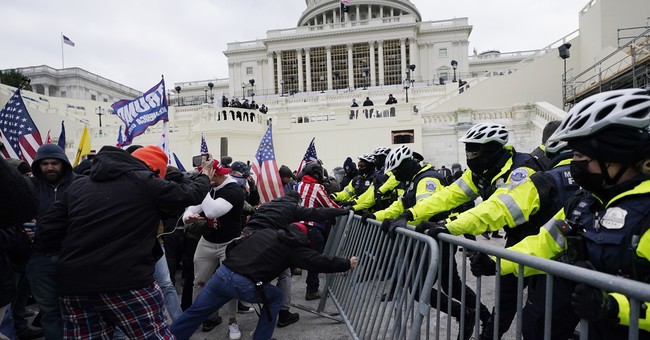
Even after a mob of Trump supporters stormed the Capitol on Jan. 6, the media felt the need to pile up the false accusations.
Their first order of business was to turn it into a story about race.
The Trump riot has as little to do with race as any story in 21st-century America. COVID, immigration, tax cuts, the stimulus — I could come up with a racial angle for any of those.
Your assignment: Make the siege at the Capitol a story primarily about race relations.
You, a normal person, one week later: I’m stumped.
But to our media, the main point to be made about the riot was: Can you imagine what would have happened if black people had done that?
An unarmed Trump supporter crawling through a window at the Capitol was shot dead. Please name the black protester killed by the police throughout 2020’s incessant BLM riots, lootings and arsons. He’d already be on a postage stamp.
During the 2015 BLM riots in Baltimore after a heroin dealer, Freddie Gray, died in the back of a police van, the mayor announced that she was giving “those who wished to destroy space to do that as well.”
If you look at a mob storming the Capitol to protest Biden’s certification as president and immediately think, This is a story about black people!, you’ve got racism on the brain.
— Renee Zellweger Wins Oscar for Best Actress
Oh like she would have gotten if it she were black. I don’t think so!
— Nobel Prize for Physics Awarded to Reinhard Genzel and Andrea Ghez for “Discovery of a Supermassive Compact Object at the Center Of Our Galaxy”
Does anyone seriously believe that the prize would have been awarded if the discovery had been made by Black Lives Matter?
— Denver beat the Knicks 114-89
Can you imagine Denver intentionally running up the score like that on a white team?
I’m beginning to suspect that conservatives are the only people who were genuinely appalled by Trump supporters storming the Capitol. The left’s consistent reaction has been: OK, what do we have to do to make it look bad?
It must be awkward to have to work up a high dudgeon about the Capitol protest after spending half of 2020 saying “mostly peaceful” protests were OK, even if beyond the “mostly” there was a lot of arson and looting.
SOLUTION: A riot is not bad unless it can be denounced as “racist.”
Liberals were indignant with Sen. Tom Cotton for saying Trump should send in troops to restore order during the George Floyd riots. His New York Times op-ed making this point was slapped with a disclaimer from the editors that’s nearly as long as the original column.
Today, there are more troops on patrol in D.C. than in actual war zones.
But, this time, instead of calling the militarization of our nation’s capital “fascist” — as the Times’ Michelle Goldberg dubbed Cotton’s proposal — the very presence of troops is cited as proof of how awful the Jan. 6 riot was.
Liberals have got to learn that their neuroses are not proof of their opponents’ perfidy. The hysterical deployment of more than 20,000 troops to Biden’s inauguration says something about them, not the rioters.
Similarly, cable news has been featuring Democrats giving long, emotional TV interviews describing their fears during the storming of the Capitol. I was afraid they’d kill us all! What if they’d started lynching senators? They could have taken hostages! I fully expected a mass shooting. I thought the building would collapse on top of us! What if they’d had a nuke?
Oh my gosh! What did they actually do?
They broke four windows, took selfies and threw papers on the ground.
The “Your Neurosis Proves My Malfeasance” argument is a specialty of the feminists. If I wasn’t sexually harassed, then please explain why I gained 30 pounds? You want proof that Trump is a monster? I can’t sleep at night! Do you want to see my psychiatrist’s bill?
No, no! We believe you! But it’s not evidence that anyone did something bad to you. Your mental anguish comes in during the penalty phase, not during the guilt-finding phase.
The raid was disgusting, appalling, sickening, but it’s not a license for concocting imaginary accusations. Trump is bad. The thugs who stormed the Capitol are bad. You don’t need to manufacture evidence against them, media.
American Family Association
American Family Association (AFA), a non-profit 501(c)(3) organization, was founded in 1977 by Donald E. Wildmon, who was the pastor of First United Methodist Church in Southaven, Mississippi, at the time. Since 1977, AFA has been on the frontlines of Ame
NEWSMAX
News, Opinion, Interviews, Research and discussion
Opinion
American Family Association
American Family Association (AFA), a non-profit 501(c)(3) organization, was founded in 1977 by Donald E. Wildmon, who was the pastor of First United Methodist Church in Southaven, Mississippi, at the time. Since 1977, AFA has been on the frontlines of Ame
American Family Association
American Family Association (AFA), a non-profit 501(c)(3) organization, was founded in 1977 by Donald E. Wildmon, who was the pastor of First United Methodist Church in Southaven, Mississippi, at the time. Since 1977, AFA has been on the frontlines of Ame
You Version
Bible Translations, Devotional Tools and Plans, BLOG, free mobile application; notes and more
Political
American Family Association
American Family Association (AFA), a non-profit 501(c)(3) organization, was founded in 1977 by Donald E. Wildmon, who was the pastor of First United Methodist Church in Southaven, Mississippi, at the time. Since 1977, AFA has been on the frontlines of Ame
NEWSMAX
News, Opinion, Interviews, Research and discussion
Spiritual
American Family Association
American Family Association (AFA), a non-profit 501(c)(3) organization, was founded in 1977 by Donald E. Wildmon, who was the pastor of First United Methodist Church in Southaven, Mississippi, at the time. Since 1977, AFA has been on the frontlines of Ame
Bible Gateway
The Bible Gateway is a tool for reading and researching scripture online — all in the language or translation of your choice! It provides advanced searching capabilities, which allow readers to find and compare particular passages in scripture based on




 What Did You Say?
You must be logged in to post a comment.