
Perspectives; Thoughts; Comments; Opinions; Discussions

Posts tagged ‘Originalism’

Wisconsin’s Supreme Court Race Is the Left’s Opening to Reverse Years of Conservative Victories


BY: DAVE CRAIG AND JAKE CURTIS | APRIL 03, 2023

Read more at https://thefederalist.com/2023/04/03/wisconsins-supreme-court-race-is-the-lefts-chance-to-reverse-years-of-conservative-victories/

split screen of two candidates
Wisconsin’s growing leftist base sees an opportunity to overturn all of the hard-fought reforms by flipping the state’s high court.

Author Dave Craig and Jake Curtis profile

DAVE CRAIG AND JAKE CURTIS

MORE ARTICLES

On Tuesday, Wisconsinites will once again head to the polls in a race that has garnered national attention and set national spending records for a judicial race. According to the most recent Wispolitics.com tally, the two Wisconsin Supreme Court candidates and outside groups have combined for over $45 million in spending. What’s at stake? All of the reforms of the Gov. Scott Walker era, and more.

Home to Walker, former Speaker Paul Ryan, former RNC Chairman and White House Chief of Staff Reince Priebus, and conservative star Sen. Ron Johnson, Wisconsin has enjoyed an outsized role in national politics since 2010. Instead of cautiously governing like so many administrations in purple states, Walker and his allies advanced some of the boldest reforms in the nation. Starting with the historic Act 10 that resulted in a siege of the Capitol (and over $15 billion in taxpayer savings), conservatives advanced bold reforms like Right to Work, voter ID, concealed carry, castle doctrine, and a dramatic expansion of school choice.

Now, Wisconsin’s growing leftist base sees an opportunity to overturn all of the hard-fought reforms by flipping the state’s high court. Politico recently proclaimed the race “could be the beginning of the end for GOP dominance.” This would obviously be bad news for conservatives nationally since Wisconsin will undoubtedly play a huge role in who is president in 2025.

The two candidates running to replace the former conservative Chief Justice on the current 4-3 conservative court could not be any more different, and whoever wins will determine the ideological control of the court for years. Running as the progressive is Milwaukee County Circuit Court Judge Janet Protasiewicz. Instead of articulating a coherent judicial philosophy, she has consistently emphasized her “values” and how they will influence her decisions. She has also troublingly declared that Wisconsin’s legislative maps are rigged –  announcing her thoughts on an issue that is likely to come before the court if liberals gain the majority. She has stated that she disagrees with the U.S. Supreme Court’s Dobbs decision that returned abortion law to the states. She is also the candidate that the left apparently sees as showing they “are done pretending that judges are merely legal umpires.”

Contrast Protasiewicz’s activism with the originalist approach of former Justice Dan Kelly, appointed to the court by Gov. Scott Walker, who authored historic decisions during his four years on the court and consistently quotes from the Federalist Papers on the campaign trail. His lead opinion in Tetra Tech upended decades of deference to administrative agencies.

While Kelly has been supported by the Republicans and Protasiewicz by the Democrats, it is clear that Protasiewicz views the job of a judge as a super partisan legislator, supplanting the legislature’s authority with that of her own. Forecasting what a liberal majority would do Wisconsin’s duly-enacted reform regime, liberal Justice Jill Karofsky herself has declared specifically that “everything that Wisconsinites care about is on the line in this election, from abortion rights to fair maps to the 2024 election to democracy itself, all of those things are going to be on the ballot on April 4th…” These are all issues that have been settled by the democratically elected legislature but are apparently all on the table for a liberal majority of the court.

While abortion, crime, and redistricting have been the main focus of the media and outside groups during the campaign, several other cases could be brought which would fundamentally transform the landscape in Wisconsin. Even cases that have already been addressed by the U.S. Supreme Court are at risk of novel interpretations under the Wisconsin constitution by a new progressive majority.

An issue impacting tens of thousands of Wisconsin families that could be dramatically affected by the balance of the state Supreme Court is school choice. In 1998, the Wisconsin Supreme Court upheld the choice program for religious schools in Jackson v. Benson. There, the court reversed the lower court, holding that the Milwaukee Parental Choice Program was valid under both the Establishment Clause and Article I, Section 18 of the Wisconsin Constitution, which prohibits the use of money from the public treasury to be used for the benefit of religious societies, religious schools, or seminaries. The holding was based in large part on the fact that students in the program were not compelled to attend sectarian schools nor forced to participate in religious activities. The Court further held that public funds may be given to third parties as long as the program on its face is neutral between sectarian and nonsectarian alternatives and that the transmission of funds is guided by the decisions of independent third parties.

While the decision in Jackson has been in place for a generation, a court viewing itself as a super-legislature could undo the decision in part, or in whole, based on a narrowed view of the constitutional provisions reviewed in that case, particularly relative to monies “drawn from the treasury” that are used in the choice program. A court decision holding a strict view of the provision could decimate a program that provides alternatives to families desperately looking for an alternative to failing public schools.

Another issue likely to surface in the event the ideological makeup of the court shifts, as it has recently in other states, is the constitutionality of Wisconsin’s voter ID law. In League of Women Voters v. Walker and Milwaukee Branch of NAACP v. Walker, leftist groups challenged Wisconsin’s 2011 voter ID law, claiming the legislature lacked authority to enact a voting qualification under the Wisconsin constitution and that the law was an undue burden on the right to vote. Upholding the law, the Court noted that requiring an ID was within the legislature’s authority to provide for laws relating to elector registration under Article III, Section 2, that the law was a reasonable regulation that “could improve and modernize election procedures, safeguard voter confidence in the outcome of elections and deter voter fraud,” and that the burdens of gathering the required documents, traveling, and obtaining a photograph ID were not a substantial burden.

In a challenge to the voter ID law under the state constitution’s right to vote, an activist court could hold that a record demonstrating that numerous individuals claiming to have been deterred from voting because of the burden of obtaining an ID is evidence of a “substantial burden” that outweighs the threat of voter fraud and could strike down the law. The left will undoubtedly come after this important law ahead of the 2024 election as it has recently in other states. In a state with razor-thin margins of victory for conservative super-stars like Sen. Ron Johnson, opening the gate to fraudulent votes in the absence of a voter ID law could have major consequences in 2024 and beyond.

Finally, and least covered by the media, are the ramifications the court race might have on the shift of power back to the deep state. In the 2018 case Tetra Tech EC, Inc. v. Wis. Dep’t of Revenue, the court departed from its practice of “deferring to administrative agencies’ conclusions of law.” In a case where a citizen may be challenging an agency’s interpretation of law or administrative rule, the court would no longer review the agency’s action with a “bias” toward the agency’s own interpretation. Agency interpretation is an issue that arises in courts every day across the country, measuring the amount of authority an agency wields on virtually any issue, ranging from taxation to education to election administration – many times involving an agency seizing authority the legislature never gave it. A restoration of agency deference by an activist court could result in an immediate shift of authority from the legislative branch to the unelected officials in the executive branch.

During the final days of the race, former Justice Dan Kelly is sprinting across to the state with a final closing message: saving the court. But the race is about more than just the court. It could impact policies duly enacted by the legislature that conservatives have worked for a generation to obtain. It will make a difference in securing elections and electing strong conservatives like Ron Johnson, who has demanded Covid transparency and has taken on the deep state, or electing central planners like Tammy Baldwin who want to strip us of our freedoms. The election on Tuesday presents a fundamental choice to voters.

Do they want Wisconsin to lurch backward with a progressive court that will undo so many of the reforms the legislature and Gov. Walker worked to implement over the last decade, or are they going to vote to save the court by elevating a former justice that will ensure a conservative majority that respects the law as written by the legislature? The choice is obvious. Save the court and save the state.

Dave Craig is a Waukesha attorney and served in the Wisconsin Legislature from 2011 to 2021. Prior to his election, he worked as an aide to Congressman Paul Ryan. Jake Curtis is an Ozaukee attorney who previously served as an agency Chief Legal Counsel in the Walker Administration.

Leftists Regurgitate ‘Uncle Tom’ Smear to Dim Clarence Thomas’ Legacy, But It Won’t Work


BY: SHAWN FLEETWOOD | FEBRUARY 16, 2023

Read more at https://thefederalist.com/2023/02/16/leftists-regurgitate-uncle-tom-smear-to-dim-clarence-thomas-legacy-but-it-wont-work/

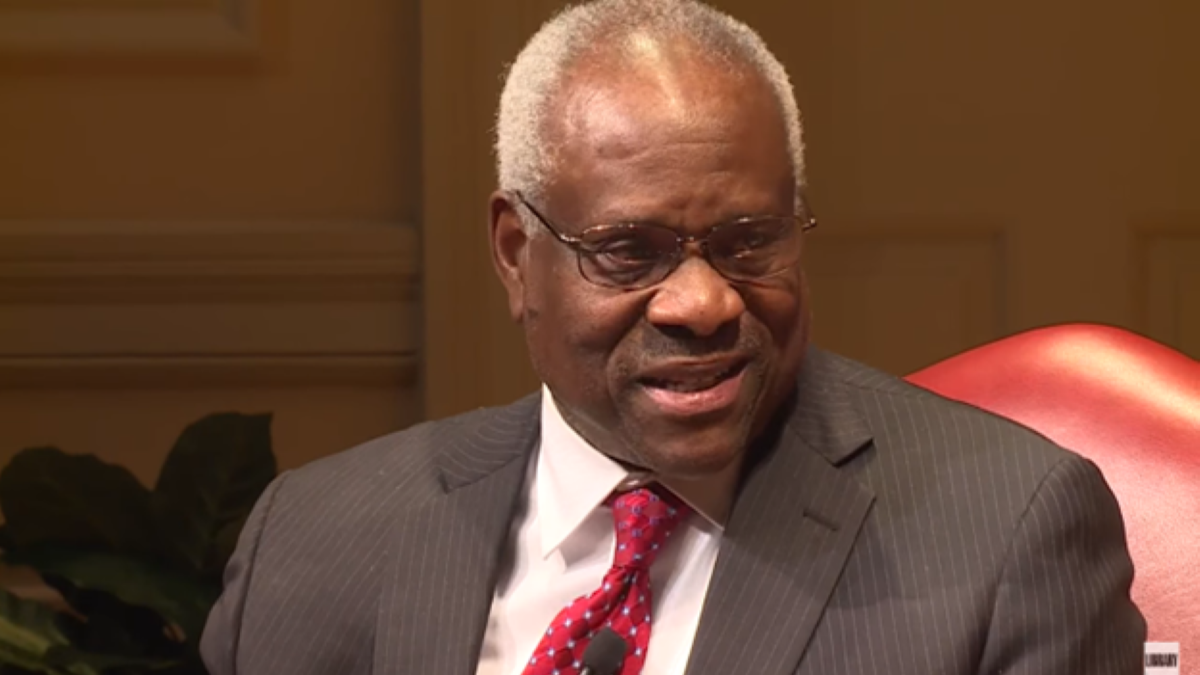
Justice Clarence Thomas doing an interview at the Library of Congress
No matter what the left throws at him, Clarence Thomas will be remembered as one of the greatest Supreme Court justices in U.S. history.

Author Shawn Fleetwood profile

SHAWN FLEETWOOD

VISIT ON TWITTER@SHAWNFLEETWOOD

MORE ARTICLES

Supreme Court Justice Clarence Thomas is routinely the target of deranged smears from American leftists, and sadly, this week has been no exception with the return of the “Uncle Tom” attack.

On Tuesday, the Georgia Senate successfully passed SB 69, which, if approved by the state House and Republican Gov. Brian Kemp, would allow for the placement of a monument of Thomas on the grounds of the state capitol. In remarks to his colleagues, bill sponsor and GOP Sen. Ben Watson spoke to Thomas’ character and praised the justice for living a life “marked by tremendous achievement,” saying:

This native son of Georgia deserves a place of honor and recognition on our Capitol grounds, a place where future generations of Georgians can learn valuable lessons from his legacy and gain inspiration and belief that their lofty dreams are obtainable too in America, regardless of the circumstances into which they are born.

Meanwhile, the upper chamber’s Democrat members couldn’t have been less enthused. Not only did every single Democrat senator vote against the bill, but several of them used the opportunity to slander the Supreme Court’s most senior justice.

While some Democrats such as Sen. Nan Orrock went after Thomas’ judicial career by calling his service on the nation’s highest court “problematic,” the comments from leftist hacks like Sen. Emanuel Jones were much more vitriolic. During his unhinged diatribe, Jones referred to Thomas, the second black American to serve on the Supreme Court, as an “Uncle Tom,” and said he betrayed “his own community.”

“I’m just trying to tell you what we have in the African American community when we talk about a person of color that goes back historically to the days of slavery and that person betraying his own community — we have a term in the black community,” Jones said. “That term that we use is called ‘Uncle Tom.’ An Uncle Tom … talks about a person who back during the days of slavery sold his soul to the slave masters.”

A Pattern of Racist Attacks

Unfortunately, Jones’ Tuesday rant is just the tip of the iceberg. Through the years, so-called “progressive” Democrats have hurled a barrage of racist and degrading attacks at Thomas for the crime of daring to think for himself.

During a 2014 interview, for instance, Democrat Rep. Bennie Thompson of Mississippi didn’t just call Thomas an “Uncle Tom”; he also claimed the justice “doesn’t like black people” and “doesn’t like being black.”

But it’s not just Democrat politicians lobbing racist insults at Thomas. Prominent legacy media members such as MSNBC host Joy Reid have also joined in on the smear campaign in recent years. After then-President Donald Trump forecasted plans to take his 2020 election challenges to the Supreme Court shortly after the Nov. 3 contest, Reid openly questioned the legitimacy of the court and invoked the “Uncle Tom” slur by referring to Thomas as “Uncle Clarence.”

“So, I think what scares people is that if [Trump] decides to do something that legally makes no sense … but if they somehow manage to stumble into the Supreme Court, do any of you guys trust Uncle Clarence and Amy Coney Barrett and those guys to actually follow the letter of the law?” Reid asked her colleagues. “No! I mean, it’s a completely politicized Supreme Court that you can’t just trust that they’re going to do the right thing.”

In addition to Reid, actor Samuel L. Jackson is among those who has levied the “Uncle Clarence” slur against Thomas.

[READ: Why The Racist Left Smears Clarence Thomas As An ‘Angry Black Man’]

Thomas Is a National Hero

Unlike many of today’s social justice warriors who love to feign “oppression,” Thomas grew up in an era of real oppression. Born into abject poverty in Pin Point, Georgia, Thomas was raised by his grandparents in Savannah during the height of segregation. With his biological father missing from his life, Thomas’ grandfather assumed the role, providing his grandson with a foundation for hard work and discipline.

Despite the harsh circumstances of his beginnings, Thomas would go on to excel in academics, attending the College of the Holy Cross and Yale Law School. After spending years working in the legal profession, Thomas was nominated by President George H.W. Bush to serve as a judge on the U.S. Court of Appeals for the D.C. Circuit in 1989. Not long after in 1991, he was nominated and confirmed to the U.S. Supreme Court (no thanks to Democrat partisans like then-Sen. Joe Biden), where he has faithfully served for the past 31 years.

If we lived in a world where Democrats earnestly stood by their professed belief in championing the success of non-white people, Thomas wouldn’t be getting one statue, but a hundred. His journey to success is something that shouldn’t just be celebrated but shared to inspire others to overcome adversity and chase their dreams with hard work and strong principles. Then again, leftists’ racial pandering isn’t about helping people.

For Democrats, Thomas’ devotion to the Constitution and willingness to do right by the American people stands in the way of their conquest to centralize government power in the hands of a few elites. His originalist jurisprudence is a roadblock to that goal, therefore making it perfectly acceptable in their eyes to use any tactic, no matter how grotesque, to undermine him.

Despite their best efforts, the left’s bid to slander the legacy of this great man will fail. No matter what kind of rhetorical garbage they throw at him, Clarence Thomas will be remembered as one of the greatest Supreme Court justices and public servants in U.S. history. His understanding of what it means to be a judge and adherence to the Constitution have rightly garnered him adoration from millions of Americans. And that is something the left will never be able to change.


Shawn Fleetwood is a Staff Writer for The Federalist and a graduate of the University of Mary Washington. He also serves as a state content writer for Convention of States Action and his work has been featured in numerous outlets, including RealClearPolitics, RealClearHealth, and Conservative Review. Follow him on Twitter @ShawnFleetwood

For Lack Of Public Confidence In The Supreme Court, John Roberts Has Only Himself To Blame


BY: SHAWN FLEETWOOD | SEPTEMBER 14, 2022

Read more at https://thefederalist.com/2022/09/14/for-lack-of-public-confidence-in-the-supreme-court-john-roberts-has-only-himself-to-blame/

John Roberts speaking at a conference
U.S. Supreme Court Chief Justice John Roberts

Author Shawn Fleetwood profile

SHAWN FLEETWOOD

VISIT ON TWITTER@SHAWNFLEETWOOD

MORE ARTICLES

U.S. Supreme Court Chief Justice John Roberts is back in the public spotlight and his latest remarks on judicial integrity are turning heads. Appearing at the 10th Circuit Bench and Bar Conference in Colorado Springs, Colorado on Friday, the chief justice spoke about the perceived credibility of the Supreme Court among the American public and how disagreeing with its opinions “is not a basis for questioning [its] legitimacy.”

“The court has always decided controversial cases and decisions have always been subject to intense criticism, and that is entirely appropriate,” Roberts said. “But I don’t understand the connection between the opinions people disagree with and the legitimacy of the Supreme Court.”

Following the Supreme Court’s rulings on several hot-button issues this past session, such as the striking down of Roe v. Wade and upholding of Second Amendment rights, Democrats and their sycophants in legacy media have been quick to vilify the high court and call into question its ability to operate as an independent body simply because a majority of justices didn’t give them the outcomes they wanted. While it’s fair for Roberts to push back against such logic and distinguish the legitimacy of the high court from its judicial decisions, his next comments were impossible to take seriously.

“If the court doesn’t retain its legitimate function of interpreting the Constitution, I’m not sure who would take up that mantle,” the chief justice said. “You don’t want the political branches telling you what the law is, and you don’t want public opinion to be the guide about what the appropriate decision is.”

For someone who holds the rank of chief justice, the lack of self-awareness from Roberts is stunning. Throughout his tenure on the Supreme Court, Roberts’s judicial decision-making on various high-profile cases has been guided by “public opinion.”

When the court was considering the constitutionality of Obamacare in the 2012 NFIB v. Sebelius case, for instance, Roberts reportedly took extensive actions behind the scenes to alter the Supreme Court’s final decision on the matter, even though Obamacare is obviously unconstitutional. After initially siding with his Republican-appointed colleagues in striking down the individual mandate of the Affordable Care Act (ACA) “on the grounds that it went beyond Congress’s power to regulate interstate commerce,” Roberts got cold feet over fears of potential public blowback over the high court’s impending decision and worked with his Democrat-appointed colleagues to change it.

As reported by SCOTUS biographer Joan Biskupic in her book, “The Chief,” Roberts’s bid to play politics led him to form a deal with leftist Justices Stephen Breyer and Elena Kagan that upheld and struck down certain portions of the ACA.

“After trying unsuccessfully to find a middle way with [Justice Anthony] Kennedy, who was ‘unusually firm’ and even ‘put off’ by the courtship, Roberts turned to the Court’s two moderate liberals, Stephen Breyer and Elena Kagan,” a review of “The Chief” published in The Atlantic reads. “The threesome negotiated a compromise decision that upheld the ACA’s individual mandate under Congress’s taxing power, while striking down the Medicaid expansion.”

Biskupic’s reporting echoes findings released by CBS News’ Jan Crawford. She in 2012 reported that “Roberts pays attention to media coverage” and that “[a]s chief justice, he is keenly aware of his leadership role on the court” and “is sensitive to how the court is perceived by the public.”

In spite of his efforts to maintain the court’s favorability as measured by often-biased poll results, Roberts’s games in the NFIB v. Sebelius case did the exact opposite. As detailed in their bestselling book, “Justice on Trial: The Kavanaugh Confirmation and the Future of the Supreme Court,” Federalist Editor-in-Chief Mollie Hemingway and President of the Judicial Crisis Network Carrie Severino detail how “Pew [Research] reported that after the decision the Court remained at its all-time-low 52 percent approval.”

“The accepted narrative, even among those who welcomed the chief’s decision, was that he changed his legal position not on principle but in response to public pressure,” Hemingway and Severino write. “The right lost respect for him, and the decision won him no friends on the left, which still portrays him as unforgivably conservative and a craven political operative. It was a regrettable outcome for anyone concerned about the legitimacy of the Court.”

Roberts’s deference to the consistently changing and poll-manipulated opinions of the American public at the expense of upholding the Constitution didn’t stop at the Obamacare ruling, either. Over the years, Roberts has routinely abandoned originalism for political activism, with the court’s 2022 Dobbs v. Jackson Women’s Health Organization decision striking down Roe‘s made-up “constitutional right” to an abortion serving as a more recent example.

Despite Justices Clarence Thomas, Samuel Alito, Neil Gorsuch, Brett Kavanaugh, and Amy Coney Barrett all correctly maintaining that the precedent established in Roe was unconstitutional garbage, Roberts attempted — yet again — to play politician and convince one of his Republican-appointed colleagues to change his or her vote before the opinion was released. Originally reported by The Washington Post and later Biskupic, Roberts directed his lobbying to save Roe toward justices including Brett Kavanaugh, which “continued through the final weeks of the [2021-2022] session.”

“Multiple sources told CNN that Roberts’ overtures this spring, particularly to Kavanaugh, raised fears among conservatives and hope among liberals that the chief could change the outcome in the most closely watched case in decades,” Biskupic writes. “Once the draft was published by Politico, conservatives pressed their colleagues to try to hasten release of the final decision, lest anything suddenly threaten their majority.”

The report went on to detail how the abrupt May leak of the Supreme Court’s majority draft opinion in Dobbs “thwarted” Roberts’ efforts, with Biskupic noting how the chief justice “can usually work in private, seeking and offering concessions, without anyone beyond the court knowing how he or other individual justices have voted or what they may be writing.”

In the final opinion, Roberts ultimately sided with the leftist justices of the court in upholding Roe, while also voting with his Republican-appointed colleagues to uphold the Mississippi 15-week abortion law as constitutional.

Whether he wants to admit it to himself or not, a decline in public confidence in the Supreme Court isn’t due to any originalist rulings, but to Roberts’s political activism. The role of a judge is — and always has been — to apply the Constitution as it was originally written by the Founders; not manipulate the law to satisfy some personal desire for public approval.

In abdicating his responsibility as a justice, Roberts has given the country every reason to be skeptical of the court’s ability to operate freely from the politics that plague America’s societal discourse. If the chief justice had any interest in ensuring the future of the Supreme Court’s legitimacy, he would quit acting like Mitch McConnell in a robe and start behaving like the judge he was appointed to be.


Shawn Fleetwood is a Staff Writer for The Federalist and a graduate of the University of Mary Washington. He also serves as a state content writer for Convention of States Action and his work has been featured in numerous outlets, including RealClearPolitics, RealClearHealth, and Conservative Review. Follow him on Twitter @ShawnFleetwood

    Justice Scalia: ‘Constitution is not a living organism’


    FOXNEWS Banner

    http://www.foxnews.com/politics/2014/03/15/justice-scalia-constitution-is-not-living-organism/?utm_source=feedburner&utm_medium=feed&utm_campaign=Feed%3A+foxnews%2Fpolitics+%28Internal+-+Politics+-+Text%29

    Published March 15, 2014

    Associated Press

    371af5b8003e9127430f6a7067008f8b.jpg

    Supreme Court Justice Antonin Scalia administers the oath of allegiance to new citizens, during a ceremony commemorating the 150th anniversary of the dedication of the Soldiers’ National Cemetery and President Abraham Lincoln’s Gettysburg Address, Tuesday, Nov. 19, 2013, in Gettysburg, Pa. Lincoln’s speech was first delivered in Gettysburg nearly five months after the major battle that left tens of thousands of men wounded, dead or missing. (AP Photo/Matt Rourke)The Associated Press

    ATLANTA –  During a speech in Atlanta Friday, U.S. Supreme Court Justice Antonin Scalia on Friday defended interpreting the Constitution as it was originally written and intended.

    Scalia delivered a speech titled “Interpreting the Constitution: A View From the High Court,” as part of a constitutional symposium hosted by the State Bar of Georgia. Originalism and trying to figure out precisely what the ratified document means is the only option, otherwise you’re just telling judges to govern, Scalia argued.

    “The Constitution is not a living organism,” he said. “It’s a legal document, and it says what it says and doesn’t say what it doesn’t say.”

    But an originalist interpretation still provides for a flexible legal system, he said.

    “You want the death penalty? Persuade your fellow citizens it’s a good idea and enact it. You think it’s a bad idea? Persuade them the other way and repeal it. And you can change your mind. If you repeal it and find there are a lot more murders, you can put it back in,” he argued. “That’s flexibility.”

    Scalia also took anonymous questions that had been collected by event organizers in advance.

    Asked if more regional, geographic and educational diversity on the court would make a big difference in opinions, Scalia said he didn’t think trying to have a court that is representative of the population is necessary, using geography as an example.

    “As far as I’m concerned, you can find bad judges in every region of the country … and good ones as well,” he said.

    Scalia was appointed to the nation’s highest court in 1986, making him the longest-serving justice.

    Tag Cloud