Perspectives; Thoughts; Comments; Opinions; Discussions

Posts tagged ‘NEW RIGHT’

Between The Old Right And New Right, There’s One Fault Line That Matters


BY: EMILY JASHINSKY | OCTOBER 05, 2023

Read more at https://thefederalist.com/2023/10/05/between-the-old-right-and-new-right-theres-one-fault-line-that-matters/


Republican elephant

Author Emily Jashinsky profile

EMILY JASHINSKY

VISIT ON TWITTER@EMILYJASHINSKY

MORE ARTICLES

The following is a transcript of remarks I delivered at the American Political Science Association’s annual meeting on Sept. 1. Panelists were asked to review the “National Conservatism” and “Freedom Conservatism” statements of principles.

It’s true that both the National Conservative Statement of Principles — which I signed — and the Freedom Conservative Statement of Principles are useful distillations of the so-called New Right and the Old Right. I say that as someone with a foot in both camps, working for the organization founded by the Sharon Statement and a group founded by its author Stan Evans. FreeCons cite the statement as their inspiration. I’ve spoken at NatCon as well. Like Michael Brendan Dougherty, as a NatCon signer, I have quibbles with both statements but could basically sign both of them as well. 

That sentiment is certainly not shared by everyone on the right, new and old, but it reveals an essential point: The primary disagreement between NatCons and FreeCons is their priorities. This is not to minimize that disagreement. It is significant. With certain old conservative institutions run by stalwart defenders of the old agenda, it will be unworkable. But with Republican voters and average Americans, it will not. 

Take, for example, the tax bill Donald Trump signed in 2017. Here was a standard bearer of the New Right expending immense political capital behind fiscal conservatism. It became the legislative highlight of his entire presidency, and not merely because Democrats after 2018 declined to cooperate with his administration, but also because the president and people who staffed his administration genuinely wanted to do tax reform and pushed the reconciliation effort hard. 

Today, virtually no person in the national conservative camp will argue that was the right move. Importantly, though, virtually no person in the national conservative camp would in theory argue against a more competitive corporate tax rate that helps onshore jobs, or tax relief for overburdened American families increasingly getting less for their money.

Again, this is not true of everyone in the national conservative camp, because it includes a handful of integralist thinkers and heterodox voices who offer provocative dissents. Generally, though, national conservatism believes in free markets, just with the prioritization of families and communities as their moral end. Freedom Conservatives don’t disagree with that, perhaps with the exception of some hardcore libertarians. 

But this conflict over priorities amounts to a major gulf in policy and tone: When the market fails to provide a living wage for single moms, is the priority to go after government barriers that may burden businesses with costs that cut into wages? Is it to create new cash benefits for parents? Is it to do both?

What about tone? Should conservatives be extolling the virtues of the business whose CEO is pushing ESG and hiking his own salary beyond previously conceivable limits? Should they be supporting the union that might score a win for the single mom? (Even Ben Shapiro has made the conservative case for collective bargaining in the private sector, though critically it’s nobody’s pet issue.) Should they be focused on that mother’s inability to send her child to a public school that successfully educates kids, and does so without pushing politically charged policies on sex and race? 

Politics aside, what is the most moral way to prioritize family and freedom and flourishing under a set of economic and cultural conditions that threaten all those ideals? Do the free markets we all support need more or less intervention? Do families and individuals need more or less freedom? 

Here’s the NatCon statement on free markets, which some of us on the New Right might balk at in another context if it came from a FreeCon: “We believe that an economy based on private property and free enterprise is best suited to promoting the prosperity of the nation and accords with traditions of individual liberty that are central to the Anglo-American political tradition. We reject the socialist principle, which supposes that the economic activity of the nation can be conducted in accordance with a rational plan dictated by the state.”

Here’s the FreeCon statement on the same: “Most individuals are happiest in loving families, and within stable and prosperous communities in which parents are free to engage in meaningful work, and to raise and educate their children according to their values. The free enterprise system is the foundation of prosperity. Americans can only prosper in an economy in which they can afford the basics of everyday life: food, shelter, health care, and energy. A corrosive combination of government intervention and private cronyism is making these basics unaffordable to many Americans.” 

Let’s turn to foreign affairs. There are few genuine doves in either the FreeCon or NatCon camp. Note most of the NatCon opposition to war policy in Ukraine is explicitly predicated on the need to prioritize China. Many, if not most, NatCons are willing to support a more militaristic approach to Mexican cartels as well. 

If we return to the issue of tax reform, most people on the New Right — myself included — would say Republicans who reeled at the cultural chaos of 2020 expended vast amounts of political capital on a lower priority (without even doing it very well), when they could have met the moment and tackled the corruption of higher education and K-12 or immigration reform, they could have dealt with cronyism in housing and health care, they could have seriously reigned in Big Tech. 

Many ostensible disagreements are rooted more in rhetoric and priority disagreements than ideology. Here’s a broad but not at all exhaustive list of basic, fundamental points of agreement:

  • Strong borders and the benefits of a sensible immigration system
  • Peace through strength 
  • Minimizing political censorship
  • Eliminating crony capitalism (explicit in both statements)
  • Free markets
  • Corruption and decline of the educational system
  • Corruption and decline of media
  • Corruption and growth of the administrative state 
  • Primacy of marriage and family
  • Federalism
  • Independent judiciary
  • The excesses of environmental extremism 
  • Nationalism (with some quibbles over the definition and application) 
  • Sanctity of unborn life
  • Importance of the Second Amendment 
  • National debt

There are some genuine divides among many members of both camps, including:

  • Free trade
  • Domestic spying
  • Public religion
  • Civil rights law (although this is unclear as the FreeCons haven’t fully reckoned with it in recent years)

This question of priorities is the biggest development to conservative political thought because it does change the calculus when decisions have to be made on policies like the tax code, labor, trade, education, and then rhetoric.

The Sharon Statement was a perfect articulation of conservative priorities for 1960. That really has not changed. If anything, contra the FreeCons, it should be used to unite these disparate factions, not as a wedge. The central threat is an ever-expanding federal bureaucracy that seeks, in cooperation with global institutions, to impose progressive ideological ends on individuals, families, schools, and employers by encroaching on personal and corporate freedoms.

These disagreements on rhetoric and priority are not to be minimized. They are significant. Still, it’s worth considering when internecine squabbles on the right boil over if the apparent divide — which often looks and feels very bitter — puts the two camps in different ballparks or different sections of the same one. The most important development in conservative thought — to continue torturing this metaphor — is that people on the right now realize where their tickets are. 

Emily Jashinsky is culture editor at The Federalist and host of Federalist Radio Hour. She previously covered politics as a commentary writer for the Washington Examiner. Prior to joining the Examiner, Emily was the spokeswoman for Young America’s Foundation. She’s interviewed leading politicians and entertainers and appeared regularly as a guest on major television news programs, including “Fox News Sunday,” “Media Buzz,” and “The McLaughlin Group.” Her work has been featured in the Wall Street Journal, the New York Post, Real Clear Politics, and more. Emily also serves as director of the National Journalism Center, co-host of the weekly news show “Counter Points: Friday” and a visiting fellow at Independent Women’s Forum. Originally from Wisconsin, she is a graduate of George Washington University.

In Opposing War with Russia, Tucker Carlson Champions the Hard-Won Truths of Putting American Interests First


REPORTED BY: SUMANTRA MAITRA | JANUARY 31, 2022

Read more at https://thefederalist.com/2022/01/31/in-opposing-war-with-russia-tucker-carlson-champions-the-hard-won-truths-of-putting-american-interests-first/

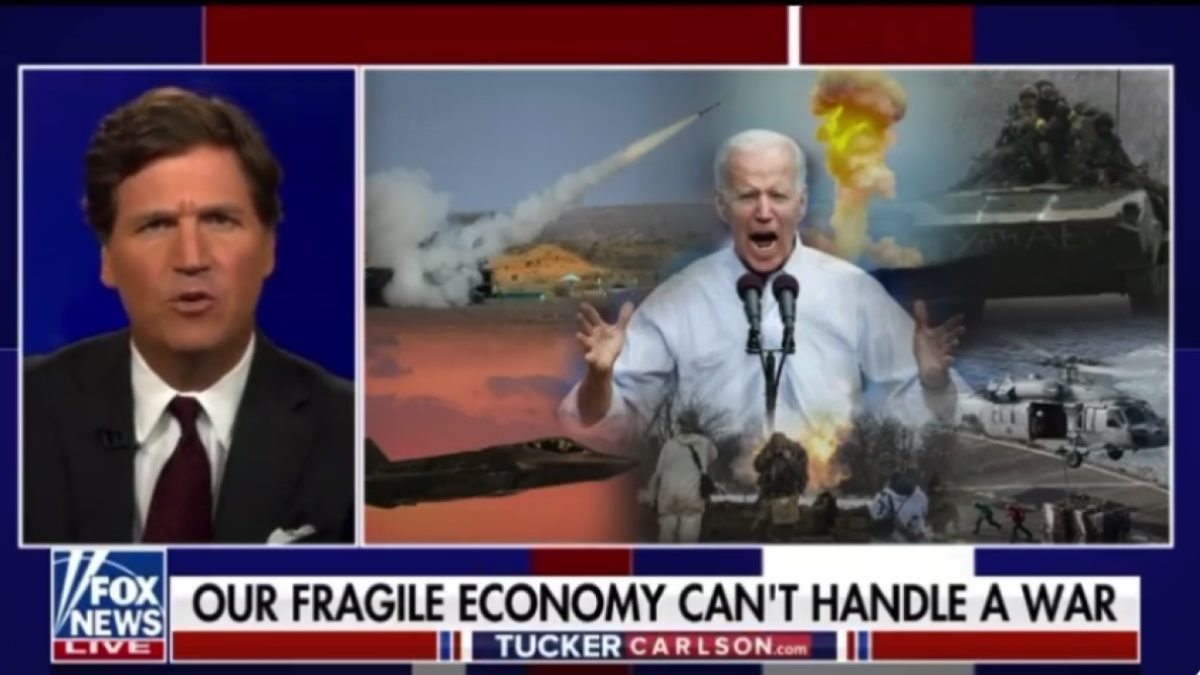
Tucker Carlson monologue on Russia

Arecent Tucker Carlson monologue questioned the relentless narrative insisting Americans must compulsively side with Ukraine against Russia in their conflict.

“We are potentially on the verge of a land war in Europe aimed at extinguishing democracy and sovereignty, and the American right wing is on the side of ethno-nationalist authoritarianism. That’s where we’re at,” tweeted President Obama’s former speechwriter Ben Rhodes, who coined the phrase “DC blob,” in reply to Carlson without a hint of irony.

Another Democrat operative, who allegedly worked with the Ukrainian embassy to dig up dirt on President Trump, tweeted that Carlson should be prosecuted as a foreign agent. To top it all, President Obama’s former Russia hand quite literally called for war against a nuclear rival to ensure the sovereignty of Ukraine, a proposition unthinkable during Cold War bipartisanship, when the first instinct was to ensure great power equilibrium and avoid mutually assured destruction.

They are not the only ones. A recent New Yorker profile makes it clearer than any:

Vladimir Putin presents himself to his citizens and to the world as the standard-bearer of a modern counter-enlightenment. He has declared liberal democracy ‘obsolete,’ a political arrangement that has ‘outlived its purpose. One of his historical role models is said to be Alexander III, a reactionary tsar in the Romanov dynasty who instituted draconian restrictions on the press, sought to ‘Russify’ his multi-ethnic empire, and mobilized against internal and external threats. Four years ago, Putin expressed his deep admiration for the tsar while visiting the Crimean Peninsula, a substantial and distinctly unthreatening parcel of Ukraine that Russia invaded in 2014 and has occupied ever since.

A Rabid Response to the New Right’s Power

There is a palpable panic at Carlson arguably driving the GOP towards a more pre-war conservatism. It’s even being hysterically termed Putinism and Russia First” by some commentators. Michael McFaul, Obama’s Russia ambassador, was vocal on Twitter arguing that opposing Russia is a moral duty of anyone who opposes “imperialism,” alongside both prominent liberal theorists and second-tier neoconservative internationalist gadflies.

There has also been relentless fearmongering about Carlson, authoritarianism, and nationalism. Some have gone so far as to bizarrely tag Carlson a “comrade,” which is absurd because Putin’s Russia is far more Christian and conservative than the increasingly secular West.

“Why is it disloyal to side with Russia but loyal to side with Ukraine?” Carlson asked, provoking commentary noting Putin murders dissidents. Yet the world is full of rulers who murderously abuse power—for example, by sending drones that kill non-combatants and children.

It cannot be a matter of American patriotism to send U.S. troops to die for evils in other nations, or United States must attempt to police the entire globe. Experience has shown that is practically impossible and deeply damaging to U.S. national interests.

Thus in recent years, the ascendant New Right has led a bipartisan push for a more restrained foreign policy, one predicated on cutting down on foreign entanglements (termed as foreign policy realism in academic circles) especially from the Middle East, pushing Europe to spend a lot more for its own defense, and focusing more on domestic issues, as well as the rise of China. Carlson is perhaps the most prominent voice of that school in the right and has consistently opposed needless foreign confrontation, especially over Iran and Russia.

Matt Walsh and Sohrab Ahmari recently also opposed further confrontation with Russia over ensuring democracy and rights in Ukraine, as this conflict does not directly threaten the American landmass or way of life. Prominent next-gen Republican lawmakers and foreign policy leaders, such as Adam Laxalt, Bernie Moreno, J. D. Vance, Blake Masters, and Peter Meijer also often voice more realist rhetoric.

Is It America’s Job to Change Other Nations’ Regimes?

This realignment has also included questioning whether the ascending conservative foreign-policy realism in America, based on a narrow definition of national interest, is compatible with progressivism. Progressivism, as John Mearsheimer noted, is by definition universalist, radical, and revolutionary.

Mearsheimer wrote, “because liberalism prizes the concept of inalienable or natural rights, committed liberals are deeply concerned about the rights of virtually every individual on the planet. This universalist logic creates a powerful incentive for liberal states to get involved in the affairs of countries that seriously violate their citizens’ rights. To take this a step further, the best way to ensure that the rights of foreigners are not trampled is for them to live in a liberal democracy. This logic leads straight to an active policy of regime change, where the goal is to topple autocrats and put liberal democracies in their place.”

Consider the relentless number of tweets by a section of the commentariat about Western support for ensuring LGBT-favoring laws in Ukraine, and Mearsheimer sounds prescient. Whatever these people are, their constant revolutionary and internationalist rhetoric would make Leon Trotsky blush.

Our Job Is to Govern Ourselves First

Foreign policy realism, on the other hand, enacts a grand strategy based on amoral narrow national interest, one formulated by early American statesmen from George Washington to James Monroe to John Quincy Adams. If it ever comes back as an administrative principle, then it will become the domain solely of the right.

The aversion against great powers and spheres of influence is an egalitarian instinct claiming all states are equal, regardless of any other variable. This instinct is by definition unnatural and revolutionary. It defies geography, aggregate power, history, and most importantly, narrow nationalism.

Believing that “History” is progressive, and therefore acting on it to liberate everyone everywhere and promote rights and democracy, then becomes part of an inflated American national interest. The side that does not believe in nation-states or nationalism cannot by definition side with a narrow interpretation of national interest.

It’s Natural to Defend Yourself

Carlson is increasingly influential because he sides with something very natural: a human urge to be a nationalist, and therefore opposed to a relentless and crusading global revolution, whether promoting a borderless Marxism or an equally borderless liberalism.

The ascendant New Right believes in peace through strength, and a very narrow Jacksonian definition of nationalism, in which Europeans pay for their own security and Americans only come at the last moment if things go wrong. In this view, China is a far bigger threat to American prosperity and its land-mass than Russia or Iran will ever be, and defending porous American borders matters a lot more to Americans than Ukrainian borders.

The other side, a duopoly of Never Trump neoconservatives and liberal-internationalists, wants to continue to allegedly ensure human rights across the globe while neglecting the way of life at home. It may be a noble goal, but ultimately it’s one that the majority of Americans and an overwhelming number of conservatives are tired of after 30 years, thousands of lost lives, and trillions of dollars in deficits.

The instinct for promoting a global revolution to promote LGBT rights, liberalism, and feminism is as radical an instinct as it can get, and that argument is increasingly opposed by a majority of Americans who simply don’t care enough to spend blood and treasure in places they cannot spot on a map.

Self-Government Means No Country Is Too Big to Fail

When Rhodes and McFaul yell about defending human rights in Ukraine, and Carlson and others on the right remind everyone of American failures in pursuing such an unlimited global policy, it’s important to rethink the priors and understand the re-alignment in foreign policy is complete. Powerful realist voices on the left such as Matthew Duss, Stephen Wertheim, Tulsi Gabbard, and Rep. Ro Khanna notwithstanding, it is becoming increasingly clear that true restrained foreign policy realism is connected to a very narrow form of nationalism, and that is fundamentally a reactionary and therefore conservative concept.

Second, as I wrote recently, “selling” such foreign policy, even to a very instinctively nationalist electorate like America, means talking in a language that most people will get. Carlson (and Donald Trump, for that matter) connected with the normal crowd, arguing about the futility of sending their sons to die for Ukraine, Afghanistan, or Libya. That has more impact than a bunch of Foreign Affairs Snapshots.

This recent debate on Ukraine, therefore, has brought forth troubling questions for those trying to sell oxymoronic “progressive” foreign policy realism, which took a hell of a beating in the last few weeks.


Dr. Sumantra Maitra is a national-security fellow at The Center for the National Interest; a non-resident fellow at the James G Martin Center; and an elected early career historian member at the Royal Historical Society. He is a senior contributor to The Federalist, and can be reached on Twitter @MrMaitra.

Tag Cloud