Republicans chose Rep. Jim Jordan as their new nominee for House speaker on Friday during internal voting, putting the gavel within reach of the staunch ally of GOP presidential front-runner Donald Trump. Jordan, of Ohio, will now try to unite colleagues from the deeply divided House GOP majority around his bid ahead of a floor vote, which could push to next week.
Frustrated House Republicans have been fighting bitterly over whom they should elect to replace the speaker they ousted, Rep. Kevin McCarthy, and the future direction of their party. The stalemate, now in its second week, has thrown the House into chaos, grinding all other business to a halt.
“I think Jordan would do a great job,” McCarthy said ahead of the vote. “We got to get this back on track.”
Attention swiftly turned to Jordan, the Judiciary Committee chairman and founder of the hard-line Freedom Caucus, as the next potential candidate after Majority Leader Steve Scalise abruptly ended his bid when it became clear holdouts would refuse to back him.
But not all Republicans want to see Jordan as speaker, second in line to the presidency. Overwhelmed and exhausted, anxious GOP lawmakers worry their House majority is being frittered away to countless rounds of infighting and some don’t want to reward Jordan’s wing, which sparked the turmoil.
“If we’re going to be the majority party, we have to act like the majority party,” said Rep. Austin Scott, R-Ga., who posed a last-ditch challenge to Jordan.
While the firebrand Jordan has a long list of detractors who started making their opposition known, Jordan’s supporters said voting against the Trump ally during a public vote on the House floor would be tougher since he is so popular and well known among more conservative GOP voters.
Heading into a morning meeting, Jordan said, “I feel real good.”
Other potential speaker choices were also being floated. Some Republicans proposed simply giving Rep. Patrick McHenry, R-N.C., who was appointed interim speaker pro tempore, greater authority to lead the House for some time.
The House, without a speaker, is essentially unable to function during a time of turmoil in the U.S. and wars overseas. The political pressure increasingly is on Republicans to reverse course, reassert majority control and govern in Congress.
With the House narrowly split 221-212, with two vacancies, any nominee can lose just a few Republicans before they fail to reach the 217 majority needed in the face of opposition from Democrats, who will most certainly back their own leader, New York Rep. Hakeem Jeffries.
Absences heading into the weekend could lower the majority threshold needed, and Republicans said they were down about a dozen lawmakers as of midday Friday. No floor votes were scheduled as attendance thinned before the weekend.
In announcing his decision to withdraw from the nomination, Scalise said late Thursday the Republican majority still has to come together and “open up the House again. But clearly not everybody is there.”
Asked if he would throw his support behind Jordan, Scalise said, “It’s got to be people that aren’t doing it for themselves and their own personal interest.”
But Jordan’s allies swung into high gear at a chance for the hard-right leader to seize the gavel.
“Make him the speaker. Do it tonight,” said Rep. Jim Banks, R-Ind. “He’s the only one who can unite our party.”
Jordan also received an important nod Friday from the Republican party’s campaign chairman, Rep. Richard Hudson, R-N.C., who made an attempt to unify the fighting factions.
“Removing Speaker Kevin McCarthy was a mistake,” Hudson wrote on social media, saying the party found itself at a crossroads also blocking Scalise. “We must unite around one leader.”
Earlier in the week, Jordan had nominally dropped out of the race he initially lost to Scalise, 113-99, during internal balloting.
Scalise had been laboring to peel off more than 100 votes, mostly from those who backed Jordan. But many hard-liners taking their cues from Trump have dug in for a prolonged fight to replace McCarthy after his historic ouster from the job.
The holdouts argued that as majority leader, Scalise was no better choice, that he should be focusing on his health as he battles cancer and that he was not the leader they would support.
Handfuls of Republicans announced they were sticking with Jordan, McCarthy or someone other than Scalise — including Trump, the former president. The position as House speaker does not need to go to a member of Congress.
Trump, the early front-runner for the 2024 GOP presidential nomination, repeatedly discussed Scalise’s health during a radio interview that aired Thursday.
Scalise has been diagnosed with a form of blood cancer known as multiple myeloma and is being treated, but he has also said he was definitely up for the speaker’s job.
On Friday, another California Republican, Rep. Tom McClintock, had introduced a motion to reinstate McCarthy during the morning meeting, but it was shelved.
“I just told them, no, let’s not do that,” McCarthy said afterward. “Let’s walk through this and have an election.”
The situation is not fully different from the start of the year, when McCarthy faced a similar backlash from a different group of far-right holdouts who ultimately gave their votes to elect him speaker, then engineered his historic downfall.
But the math this time is even more daunting, and the problematic political dynamic is only worsening.
Exasperated Democrats, who have been waiting for the Republican majority to recover from McCarthy’s ouster, urged them to figure it out.
“The House Democrats have continued to make clear that we are ready, willing and able to find a bipartisan path forward,” Jeffries said, including doing away with the rule that allows a single lawmaker to force a vote against the speaker. “But we need traditional Republicans to break from the extremists and partner with us.”
Copyright 2023 The Associated Press. All rights reserved. This material may not be published, broadcast, rewritten or redistributed without permission.
A group of nearly four dozen House Republicans is demanding a dramatic overhaul to the chamber rules after former House Speaker Kevin McCarthy’s historic ouster.
“The injustice we all witnessed cannot go unaddressed — lest we bear responsibility for the consequences that follow. Our Conference must address fundamental changes to the structure of our majority to ensure success for the American people,” 45 House GOP lawmakers said in a letter to colleagues on Thursday.
McCarthy, R-Calif., had the speaker’s gavel taken away on Tuesday after Rep. Matt Gaetz, R-Fla., called for a procedure known as a motion to vacate the chair on Monday night. Under terms McCarthy hashed out to secure the speakership in January, just one lawmaker can call for the motion to vacate, setting up a mandatory vote within 48 hours.
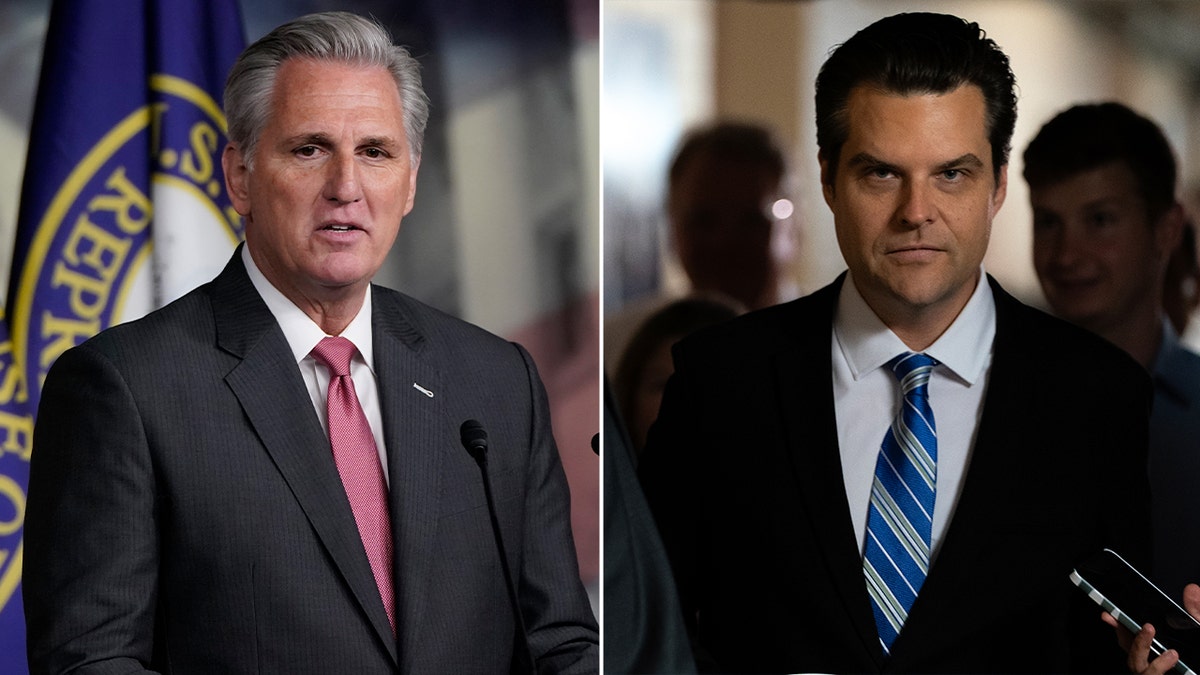
Republican Reps. Kevin McCarthy, left, and Matt Gaetz. (Win McNamee/Getty Images | Nathan Howard/Getty Images)
The lawmakers said they were “ashamed and embarrassed” by the episode, according to the letter obtained by Fox News Digital.
“Earlier this week, eight Republican members of the U.S. House of Representatives joined in an alliance with 208 Democrats to adopt a motion to vacate the Speaker of the House,” they wrote.
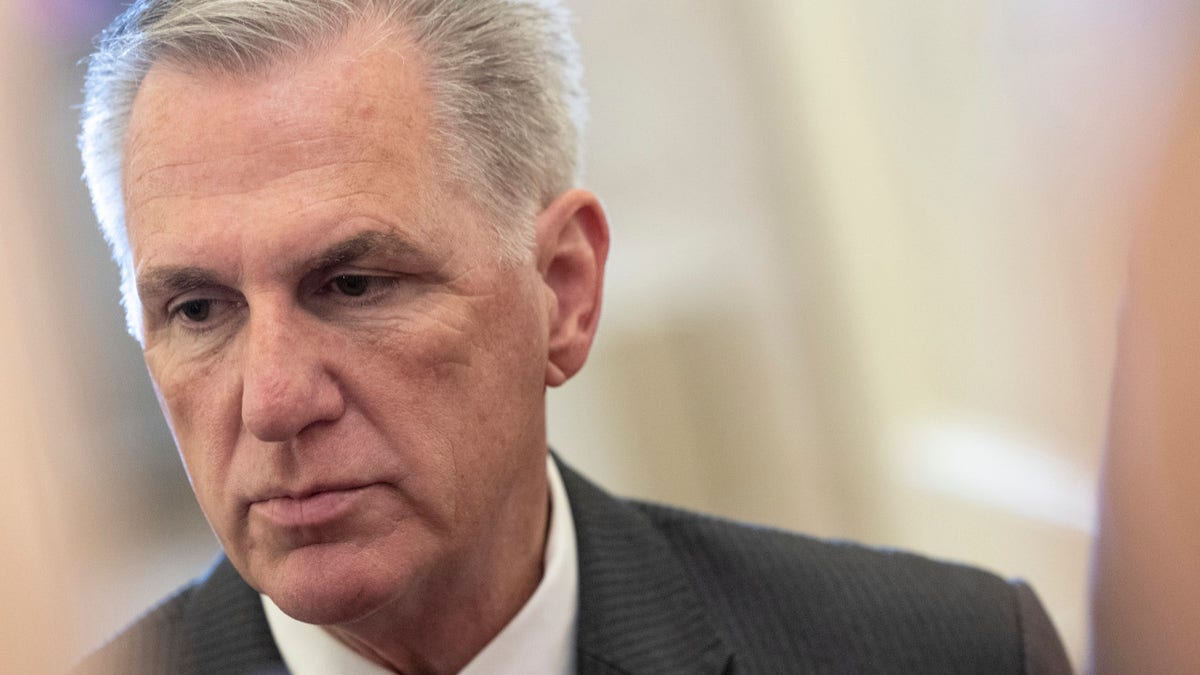
House Speaker Kevin McCarthy, R-Calif., speaks to reporters as he arrives at the U.S. Capitol in Washington, D.C., on May 25, 2023. (Kevin Dietsch/Getty Images)
“That translates to less than 4 percent of our Republican Conference joining with all Democrats to override the will of the remaining 96 percent of House Republicans on one of the most consequential votes the House has taken in over a century.”
They lauded McCarthy as “one of the most accomplished speakers in modern history.”
Rep. Matt Gaetz, R-Fla., is seen after a meeting of the House Republican Conference in the U.S. Capitol in Washington, D.C., on Tuesday. (Tom Williams/CQ-Roll Call, Inc via Getty Images)
“Ashamed and embarrassed by what happened on the Floor this week, we refuse to allow the eight members who abandoned and undermined our Conference to dictate every outcome in policy and personnel for the remainder of this Congress, including the upcoming selection of the Speaker of the House,” the letter said.
Intraparty tensions have boiled over in the wake of McCarthy’s ouster. It has made the motion to vacate rule a lightning rod in the current speakership race, with some GOP hardliners insisting it remain, while a majority of the conference have called for its threshold to be hiked above just one member — and others have floated scrapping it altogether.
“It is our responsibility to identify the right person at this moment to lead us into the future to achieve the conservative policy objectives that we and the American people all share,” the letter said.
“We cannot allow our majority to be dictated to by the alliance between the chaos caucus and the minority party that will do nothing more than guarantee the failure of our next Speaker,” it continued.
Signatories include Reps. Kelly Armstrong, R-N.D.; Jen Kiggans, R-Va.; Anthony D’Esposito, R-N.Y.; and Carlos Gimenez, R-Fla., as well as Main Street Caucus leaders Dusty Johnson, R-S.D., and Stephanie Bice, R-Okla.
Elizabeth Elkind is a reporter for Fox News Digital focused on Congress as well as the intersection of Artificial Intelligence and politics. Previous digital bylines seen at Daily Mail and CBS News.
Follow on Twitter at @liz_elkind and send tips to elizabeth.elkind@fox.com
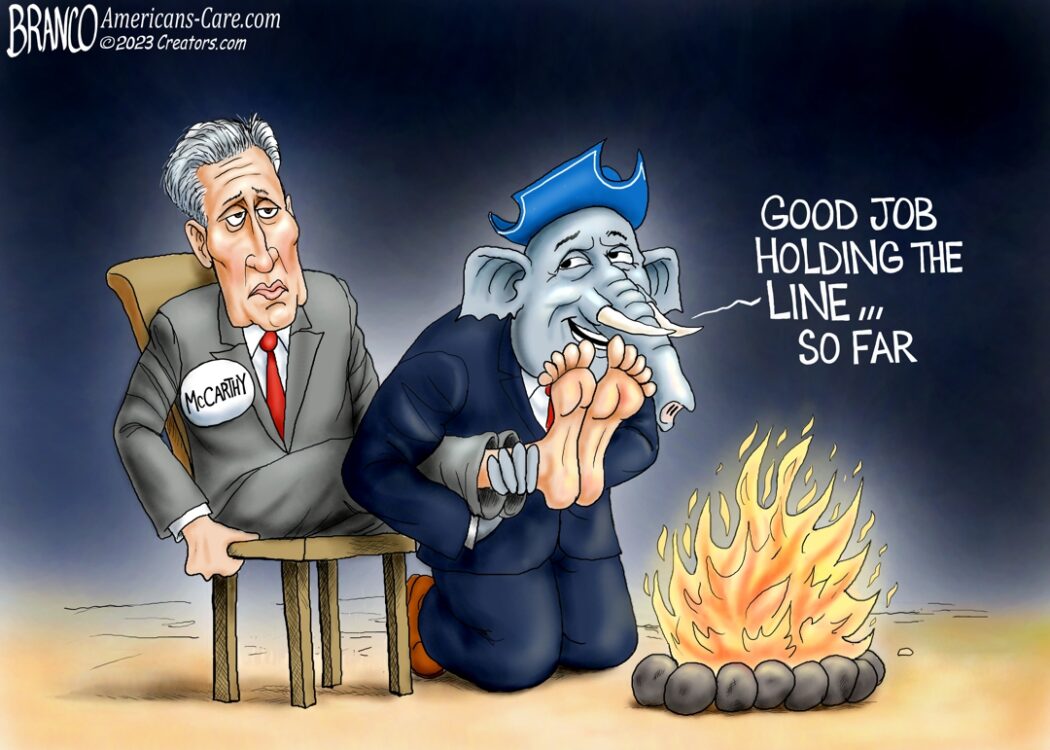
A.F. Branco has taken his two greatest passions, (art and politics) and translated them into cartoons that have been popular all over the country, in various news outlets including NewsMax, Fox News, MSNBC, CBS, ABC, and “The Washington Post.” He has been recognized by such personalities as Rep. Devin Nunes, Dinesh D’Souza, James Woods, Chris Salcedo, Sarah Palin, Larry Elder, Lars Larson, Rush Limbaugh, and President Trump
Top congressional Republican Kevin McCarthy said talks over raising the U.S. federal government’s $31.4 trillion debt ceiling were “on the right path” ahead of a meeting with Democratic President Joe Biden. The Democratic president and Republican speaker of the House of Representatives have just 10 days to reach a deal to increase the government’s self-imposed borrowing limit or trigger an unprecedented default. Biden and McCarthy will meet at 5:30 p.m. EDT (2130 GMT), the White House said, after their negotiating representatives met for more than two hours on Monday.
“I firmly believe what we’re negotiating right now, a majority of Republicans will see that it is a right place to put us on the right path,” McCarthy told reporters.
Any deal to raise the limit must pass both chambers of Congress before Biden could sign it into law. The U.S. Treasury has warned it could be unable to pay all its bills as soon as June 1.
A failure to lift the debt ceiling would trigger a default that would shake financial markets and drive interest rates higher on everything from car payments to credit cards. Ongoing uncertainty is already weighing on investors and stocks.
U.S. markets rose on Monday as investors awaited updates on the negotiations.
McCarthy’s Republicans control the House 222-213, while Biden’s Democrats hold the Senate 51-49, making it difficult to reach a bipartisan deal that would secure enough votes to pass.
It will also take several days to move legislation through Congress if and when Biden and McCarthy come to an agreement. McCarthy said that a deal must be reached this week for it to pass Congress and be signed into law by Biden in time to avoid default.
“We can get a deal tonight. We could deal tomorrow but you got to get something done this week to be able to pass it and move it to the Senate,” McCarthy told reporters.
A White House official on Monday said that Republican negotiators had proposed additional cuts to programs providing food aid to low-income Americans, adding that no deal could pass Congress without support from both parties.
CUTS AND CLAWBACKS
Republicans are pushing for discretionary spending cuts, new work requirements for some programs for low-income Americans and a clawback of COVID-19 aid approved by Congress but not yet spent in exchange for an increase, which is needed to cover the costs of lawmakers’ previously approved spending and tax cuts.
Democrats want to hold spending steady at this year’s levels, while Republicans want to return to 2022 levels. A plan passed by the House last month would cut a wide swath of government spending by 8% next year.
Biden, who has made the economy a centerpiece of his domestic agenda and is seeking re-election, has said he would consider spending cuts alongside tax adjustments but that Republicans’ latest offer was “unacceptable.”
The president tweeted that he would not back “Big Oil” subsidies and “wealthy tax cheats” while putting healthcare and food assistance at risk for millions of Americans.
Both sides must also weigh any concessions with pressure from hardline factions within their own parties.
Some far-right House Freedom Caucus members have urged a halt to talks, demanding that the Senate adopt their House-passed legislation, which has been rejected by Democrats. Former President Donald Trump, a Republican who is seeking another term after losing to Biden in the 2020 election, has urged members of his party to force a default if they do not achieve all their goals, downplaying any economic consequences.
Liberal Democrats have pushed back against any cuts that would harm families and lower-income Americans, with some urging Biden to act on his own by invoking the Constitution’s 14th Amendment — an untested move which the president said on Sunday would face constraints.
The amendment states that the “validity of the public debt of the United States … shall not be questioned,” but the clause has been largely unaddressed by the courts.
Biden is racing for a solution after refusing for months to negotiate on the debt ceiling and insisting that Republicans should pass a “clean” unconditional increase before he would agree to any spending negotiations.
In Japan on Sunday, he acknowledged the political implications, saying some far-right House Republicans “know the damage that it would do to the economy” if there was a default but hoped the blame would fall to him and thwart his re-election.
Congress three times raised the debt limit under Trump, without a similar demand from Republicans for sharp spending cuts.
Debt limit talks came to an abrupt standstill Friday after Republican House Speaker Kevin McCarthy said it’s time to “pause” negotiations, and a White House official acknowledged there are “real differences” that are making talks difficult. McCarthy said resolution to the standoff is “easy,” if only President Joe Biden would agree to some spending cuts Republicans are demanding. It is unclear when negotiations would resume.
“We’ve got to get movement by the White House and we don’t have any movement yet,” McCarthy, R-Calif., told reporters at the Capitol. “So, yeah, we’ve got to pause.”
A White House official who was granted anonymity Friday to discuss the private conversations said there are “real differences” between the parties on the budget issues and further “talks will be difficult.” The official added that the president’s team is working hard towards a “reasonable bipartisan solution” that can pass both the House and the Senate.
Biden’s administration is racing to strike a deal with Republicans led by McCarthy as the nation careens toward a potentially catastrophic debt default if the government fails to increase the borrowing limit, now at $31 trillion, to keep paying the nation’s bills.
Wall Street turned lower as the negotiations on raising the nation’s debt limit came to a sudden halt, raising worries that the country could edge closer to risking a highly damaging default on U.S. government debt.
The president who has been in Japan attending the Group of Seven summit had no immediate comment. Biden had already planned to cut short the rest of his trip and he is expected to return to Washington later Sunday.
Negotiators met for a third day behind closed doors at the Capitol with hopes of settling on an agreement this weekend before possible House votes next week. They face a looming deadline as soon as June 1 when the Treasury Department has said it will run out of cash to pay the government’s incurred debt. Republicans want to extract steep spending cuts that Biden has so far refused to accept. Any deal would need the support of both Republicans and Democrats to find approval in a divided Congress and be passed into law.
“Look, we can’t be spending more money next year,” McCarthy said at the Capitol. “We have to spend less than we spent the year before. It’s pretty easy.”
But McCarthy is facing a hard-right flank of Freedom Caucus and other Republican lawmakers that almost certain to oppose any deal with the White House. The internal political dynamics confronting the embattled McCarthy leaves the Democrats skeptical of giving away too much to the Republicans that drives away the Democrat support they will need to pass any compromise through the Congress.
Experts have warned that even the threat of a debt default would send shockwaves through the economy. Markets had been rising this week on hopes of a deal. But that shifted abruptly Friday after negotiators ended late morning an hour after they had begun.
Rep. Garret Graves, R-La., tapped by McCarthy to lead the talks, emerged from an hourlong session at the Capitol and said gaps remained between House Republicans and the Democrat administration.
“It’s time to press pause because it’s just not productive,” Graves told reporters.
He added that the negotiations have become “just unreasonable” and that it was unclear when talks would resume.
The S&P 500 went from a gain of 0.3% to a loss of 0.1% and the Dow Jones Industrial Average went from a gain of 117 points to a loss of about 90 points.
Biden departed early from a dinner with G7 leaders in Hiroshima on Friday night. White House press secretary Karine Jean-Pierre said Biden planned to be briefed on the negotiations by his team Friday evening.
As Republicans demand spending cuts and policy changes, Biden is facing increased pushback from Democrats, particularly progressives, not to give in to demands they argue will be harmful to Americans.
Another Republican negotiator, Rep. Patrick McHenry of North Carolina, said, “There is a “serious gap” between the sides.
“We’re in a tough spot,” said McHenry, the chairman of the House Financial Services Committee, as he left the meeting.
McCarthy faces pressures from his hard-right flank to cut the strongest deal possible for Republicans, and he risks a threat to his leadership as speaker if he fails to deliver.
A day earlier, the conservative House Freedom Caucus said there should be no further discussions until the Senate takes action on the House Republican bill that was approved last month to raise the debt limit into 2024 in exchange for spending caps and policy changes. Biden has said he would veto that Republican measure.
In the Senate, which is controlled by majority Democrats, the Republican leader Mitch McConnell has taken a backseat publicly, and is pushing Biden to strike a deal directly with McCarthy. McConnell blamed Biden for having “waited months before agreeing to negotiate” with the speaker.
“They are the only two who can reach an agreement,” McConnell said in a tweet. “It is past time for the White House to get serious. Time is of the essence.”
Democrats are wary of any deal with Republicans, and particularly refuse the Republican proposal to protect defense and veterans accounts from spending caps, arguing that the cuts will fall too heavily on other domestic programs. Republicans also want to impose stricter work requirements on government aid recipients. Biden has suggested he might be open to considering it, but Democrats in Congress have said is a nonstarter.
Copyright 2023 The Associated Press. All rights reserved. This material may not be published, broadcast, rewritten or redistributed without permission.
Democratic President Joe Biden and top congressional Republican Kevin McCarthy’s U.S. debt ceiling negotiations ended on Tuesday after less than an hour, as the looming fear of an unprecedented American debt default prompted Biden to cut short an upcoming Asia trip. But the meeting ended on an upbeat and unexpected note as McCarthy, coming out of the meeting with Biden and other congressional leaders, said, “It is possible to get a deal by the end of the week.”
House of Representatives Speaker McCarthy told reporters Biden is trying to reach a debt ceiling deal by June 1 to lift the threat of economic calamity
“We’ve got a lot of work to do in a short amount of time,” McCarthy told reporters, saying the less-than-an-hour session had set the stage for future conversations.
Biden and McCarthy sat down in the Oval Office with Senate Majority Leader Chuck Schumer, House Democratic leader Hakeem Jeffries and Senate Republican leader Mitch McConnell. The president leaves on Wednesday for a three-day G7 summit in Japan, but a source said Biden decided on Tuesday to skip a stop to Papau New Guinea and Australia afterward.
Ahead of the Oval Office meeting, Biden and McCarthy’s aides have discussed the requirements for two key programs that provide food and cash aid to families, in the past week’s negotiations over raising the government’s $31.4 trillion debt ceiling to avoid an economically catastrophic default. Expanding the work requirements has been a key demand of Republicans, who are also pushing for spending cuts in exchange for their votes to raise the debt limit.
Biden and McCarthy have little time to strike a deal. On Monday, the Treasury Department reiterated its warning that it could run short of money to pay all its bills as soon as June 1, triggering a default that economists say would be likely to spark a sharp economic downturn.
McCarthy on Tuesday told reporters that his party, which controls the chamber by a 222-213 margin, would only agree to a deal that cuts spending.
“We can raise the debt ceiling if we limit what we’re going to spend in the future,” McCarthy told reporters. Both parties agree on the need for urgent action.
In the past week, staffs for both sides have discussed a range of issues, including spending caps, new work requirements for some benefit programs for low-income Americans and changes to energy permitting in exchange for votes to lift the limit, according to people briefed on the talks. The sources, who spoke on condition of anonymity to reveal details about closed-door negotiations, said the work requirement discussions focus on the Supplemental Nutrition Assistance Program (SNAP), previously known as food stamps, and the Temporary Assistance for Needy Families program.
Biden alluded to the talks in public remarks over the weekend, saying he would not consider such a move for the Medicaid health program for low-income Americans.
“The president has been clear that he will not accept proposals that take away peoples’ health coverage,” said White House spokesperson Michael Kikukawa. “The president has also been clear that he will not accept policies that push Americans into poverty. He will evaluate whatever proposals Republicans bring to the table based on those principles.”
PREVIOUS DOWNGRADE
A similar 2011 standoff over the debt limit led to a historic downgrade of the U.S. credit rating, sparking a sell-off in stocks and pushing the government’s borrowing costs higher. The current deadlock has rattled investors, sending the cost of insuring exposure to U.S. government debt to record highs. A Reuters/Ipsos poll completed on Monday found that three-fourths of Americans fear a default would take a heavy toll on families like theirs.
“Nobody should use default as a hostage,” Schumer said in a Senate speech on Tuesday. “The consequences would be devastating for America.”
NICE TRY CHUCKIE BABY. You forgot we have records, videos and Congressional records where you held The Debt Ceiling hostage WITH TRUMP. LIES, LIES AND MORE LIES. Your usual conduct.
Some observers have raised concerns that the five-party talks are too unwieldy to make progress. No. 2 Senate Republican John Thune told reporters the talks appear to have “too many cooks.”
“As we’ve said all along, it is Biden and McCarthy,” Thune said. “So, whoever can actually speak on behalf of the president needs to get in the room, and get McCarthy’s best people in there, and get it done.”
McCarthy himself said he would prefer one-on-one talks with Biden.
“If the president comes to an agreement, the Democrats in the Senate will vote for it. The House will pass it, if we are all in agreement,” McCarthy said. “Why do we waste more time going around and around, not solving any of the real problems? I think you’re putting the country in jeopardy when you do that.”
House Speaker Kevin McCarthy, R-Calif., blasted President Joe Biden for being disingenuous and failing to negotiate on the House-passed debt ceiling package, saying time is running out and Biden wants debt default more than a deal.
“I still think it’s far apart,” McCarthy told a reporter Monday while walking through the Capitol Building. “It doesn’t seem to me yet they want a deal. It just seems like they want to look like they are in a meeting, but they aren’t talking anything serious.”
McCarthy cited the nonpartisan Congressional Budget Office report released recently that was forced to raise the debt estimates from the February report.
“In the meantime, we just watched the CBO come out and say we’re $100 billion further in debt,” McCarthy said. “It seems more like they want a default than a deal to me.”
Time is running out to reach a deal before the June warning of surpassing the debt limit and sending the U.S. into debt default for the first time.
“I think we’ve got to have a deal done by this weekend to have a timeline to be able to pass it in both houses,” McCarthy said.
American Family Association
American Family Association (AFA), a non-profit 501(c)(3) organization, was founded in 1977 by Donald E. Wildmon, who was the pastor of First United Methodist Church in Southaven, Mississippi, at the time. Since 1977, AFA has been on the frontlines of Ame
NEWSMAX
News, Opinion, Interviews, Research and discussion
Opinion
American Family Association
American Family Association (AFA), a non-profit 501(c)(3) organization, was founded in 1977 by Donald E. Wildmon, who was the pastor of First United Methodist Church in Southaven, Mississippi, at the time. Since 1977, AFA has been on the frontlines of Ame
American Family Association
American Family Association (AFA), a non-profit 501(c)(3) organization, was founded in 1977 by Donald E. Wildmon, who was the pastor of First United Methodist Church in Southaven, Mississippi, at the time. Since 1977, AFA has been on the frontlines of Ame
You Version
Bible Translations, Devotional Tools and Plans, BLOG, free mobile application; notes and more
Political
American Family Association
American Family Association (AFA), a non-profit 501(c)(3) organization, was founded in 1977 by Donald E. Wildmon, who was the pastor of First United Methodist Church in Southaven, Mississippi, at the time. Since 1977, AFA has been on the frontlines of Ame
NEWSMAX
News, Opinion, Interviews, Research and discussion
Spiritual
American Family Association
American Family Association (AFA), a non-profit 501(c)(3) organization, was founded in 1977 by Donald E. Wildmon, who was the pastor of First United Methodist Church in Southaven, Mississippi, at the time. Since 1977, AFA has been on the frontlines of Ame
Bible Gateway
The Bible Gateway is a tool for reading and researching scripture online — all in the language or translation of your choice! It provides advanced searching capabilities, which allow readers to find and compare particular passages in scripture based on







 What Did You Say?
You must be logged in to post a comment.