Why Trump Is Winning by Double Digits Heading into Iowa
BY: EMILY JASHINSKY | JANUARY 15, 2024
Read more at https://thefederalist.com/2024/01/15/why-trump-is-winning-by-double-digits-heading-into-iowa/
.jpg)

EMILY JASHINSKY
VISIT ON TWITTER@EMILYJASHINSKY
Nobody did it. Probably, at least.
It’s the morning of the Iowa caucus and, in the words of the Des Moines Register, “Donald Trump retains a commanding lead.” This comes according to the outlet’s latest poll, which shows Trump with a staggering 28-point advantage going into the “coldest caucus” in years.
This should chill the Beltway most of all. The Des Moines Register now puts Ron DeSantis in third place at 16 percent, down four points to Nikki Haley, a number just outside the margin of error. This is a shocking failure on the part of DeSantis, a successful populist who tapped an army of Beltway pundits to put nearly all the campaign’s eggs in the Iowa basket. But add DeSantis’ 16 points together with Haley’s 20, and Trump is still up by double digits. Consider also that many millions more ad dollars were spent touting DeSantis and Haley.
Republican voters just prefer Trump. In RealClearPolitics’ polling average, Trump is at 52.5 percent in Iowa and 61.4 percent nationally. He leads by double digits in New Hampshire. Sure, Haley and even DeSantis could over-perform the polls in Iowa, head into New Hampshire and South Carolina with momentum, over-perform there, and cruise into Super Tuesday on March 5 with an influx of cash and confidence.
The odds are low but not impossible. There’s a path if you squint. Yet it requires convincing an enormous swath of the Republican electorate — which has moved further and further into Trump’s corner over the last year — to suddenly pivot.
In 2016, Trump led Iowa by about five points in RCP’s final average. He lost by about three points to Ted Cruz. Trump was polling just under 30 percent. Nationally, he hovered around 35 percent. Well over half of the Republican primary electorate preferred a candidate other than Trump as the caucus kicked off.
DeSantis, according to RCP, was at one point about 13 points behind Trump. He’s now almost 40 points behind the former president nationally.
Democrats’ lawfare coincided with a rise in the polls for Trump. Counterintuitive as it may seem, the indictments were always going to make it difficult for another GOP candidate to poll more competitively. To her credit, Nikki Haley has been steadily eating away at DeSantis’ comfortable second-place position since the fall. (DeSantis led in New Hampshire until Haley started gaining on him in mid-September.) In Iowa, nearly half of Haley’s voters say they would vote for President Biden over Trump. She likely has a ceiling in most states that’ll make it tough to compete down the line.
Ultimately, if Iowa shakes out anywhere near the polling, it will mark the beginning of the end for DeSantis’ much-anticipated political experiment: Can Trump be defeated by a candidate with all the benefits and none of the baggage?
Perhaps the most frustrating takeaway from DeSantis’ slump is that we still don’t know the answer to that question because he allowed Beltway vest aficionados and their friends in the donor class to steer his career off course. When Trump finally attacked Vivek Ramaswamy two days before Iowa, the long-shot candidate’s response was a vision of what could have been for DeSantis.
“Yes, I saw President Trump’s Truth Social post,” Ramaswamy posted on X. “It’s an unfortunate move by his campaign advisors, I don’t think friendly fire is helpful. Donald Trump was the greatest President of the 21st century, and I’m not going to criticize him in response to this late attack.”
He added, “I’m worried for Trump. I’m worried for our country. I’ve stood up against the persecutions against Trump, and I’ve defended him at every step,” later concluding, “I want to save Trump & to save this country. Let’s do it together. You won’t hear any friendly fire from me.”
Back in September, The New York Times reported on a memo from an anti-Trump PAC helmed by Club for Growth President David McIntosh. The memo, McIntosh wrote, “shares findings from our attempts to identify an effective approach to lower President Trump’s support among Republican primary voters so we can maximize an alternative candidate’s ballot share when the field begins to consolidate.”
The takeaway from their research was perhaps the most important observation of the primary cycle, though should have been obvious from the moment every candidate entered the race.
“Broadly acceptable messages against President Trump with Republican primary voters that do not produce a meaningful backlash include sharing concerns about his ability to beat President Biden, expressions of Trump fatigue due to the distractions he creates and the polarization of the country, as well as his pattern of attacking conservative leaders for self-interested reasons,” McIntosh wrote. “It is essential to disarm the viewer at the opening of the ad by establishing that the person being interviewed on camera is a Republican who previously supported President Trump, otherwise, the viewer will automatically put their guard up, assuming the messenger is just another Trump-hater whose opinion should be summarily dismissed.”
Whatever you think of Ramaswamy (he previewed a potential Iowa surprise in an interview with The Federalist here), his response to Trump captured the lesson of that memo almost effortlessly. He’s been doing it for months.
On DeSantis, a popular and successful governor with a healthy war chest, that approach to Trump would almost certainly have improved his odds. It’s why Florida voters loved him. Politically, at least, running against Trump didn’t need to mean attacking him. The governor’s approach didn’t need to change. (I say this as someone endlessly sympathetic to the merits of DeSantis’ arguments on this particular question.)
The McIntosh memo should have been understood by DeSantis’ campaign before it ever launched. Republican voters who see Democrats relentlessly trying to put Trump in prison don’t trust GOP politicians who proactively attack him, often echoing the same critiques made by the same people who pushed the Russia-collusion hoax.
It looks like DeSantis will lose Iowa and New Hampshire. As of now, at least, it looks like Nikki Haley will too. Easily. If that’s the case, it’s remarkable how much money and effort was invested in campaigns that got the biggest question wrong from the beginning, especially the one campaign that should have known better.
 By
By 
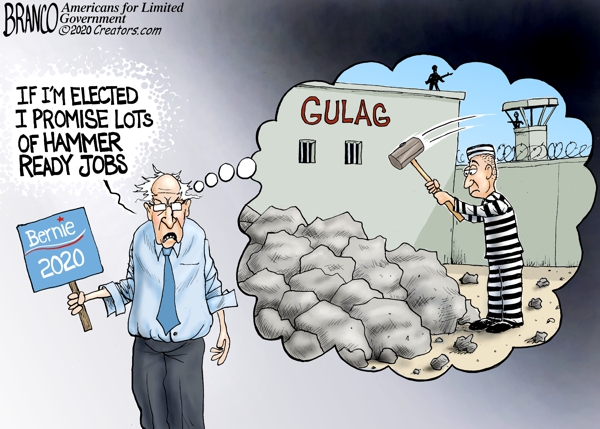 Political cartoon by A.F. Branco ©2020.
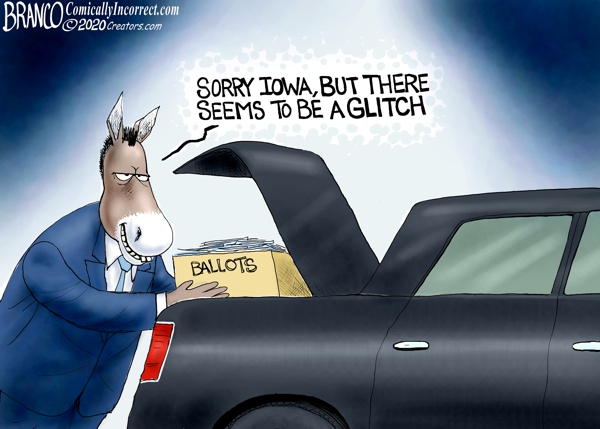 Political cartoon by A.F. Branco ©2020. debacle


 What Did You Say?
You must be logged in to post a comment.