Perspectives; Thoughts; Comments; Opinions; Discussions

Posts tagged ‘Houthis’

Biden Empowered Iran Proxies Attacking US Forces and Threatening Wider War Against Israel


By: Tyler O’Neil @Tyler2ONeil / February 16, 2024

Read more at https://www.dailysignal.com/2024/02/16/biden-empowered-iran-proxies-now-attacking-us-forces-threatening-wider-war-israel/

Houthi supporters protest in Yemen's capital, Sanaa, with one man holding a rocket and a Palestinian flag.
President Joe Biden’s policies arguably strengthened Iran’s proxies in the Middle East, including the Houthi rebels in Yemen. Pictured: Thousands of Houthi supporters, holding Yemeni and Palestinian flags, gather Feb. 9 at Sebin Square to stage a solidarity demonstration with Palestinians and protest in Sanaa, Yemen, against Israel’s efforts to eradicate the Hamas terrorist group in the Gaza Strip. (Photo: Mohammed Hamoud/Anadolu/Getty Images)

The budding regional war in the Middle East is a crisis of President Joe Biden’s own making.

Not only has the president empowered Iran by relaxing former President Donald Trump’s sanctions on the world’s top state sponsor of terrorism, but he has also empowered Iran’s proxies through various geopolitical moves that make war more likely. Biden is not alone; previous administrations have directed funds to ostensible U.S. allies in the region, funds that likely contribute to the proxies’ forces.

Biden’s relaxation of Trump-era sanctions netted Tehran at least $77 billion, some of which Iran directs to proxies across the region. Yet the president’s other policies also emboldened Iran’s proxies, who have attacked Israel, U.S. forces, and global shipping since the Oct. 7 Hamas terrorist attacks in southern Israel.

“We have enabled and fed our enemies and constricted our friends,” Rob Greenway, director of The Heritage Foundation’s Center for National Defense, told The Daily Signal. (The Daily Signal is Heritage’s news outlet.)

Greenway, who orchestrated Trump’s sanctions against Tehran, warned that Biden’s policies have “strategically appeased Iran.”

Benham Ben Taleblu, a senior fellow focused on Iran at the Foundation for the Defense of Democracies, told The Daily Signal that Iran has propped up proxies that represent “a state within a state,” exploiting instability in Iraq, Lebanon, and Yemen to “benefit from the largesse of U.S. policy.”

Taleblu notes that this poses a “philosophical problem” for America, which funds Iraq and Lebanon, even though it cannot prevent those governments from funneling that money to Iran’s proxies in their countries. Iran excels at “indigenizing the capabilities” of its allies by partnering with groups that have already arisen in another country.

Neither the White House nor the State Department provided comments for this article.

1. The Houthis

The Iran-backed Houthi movement, a Shiite militant group in Yemen, adopted the slogan “God is the greatest, death to America, death to Israel, a curse upon the Jews, victory to Islam.” The Houthis took control of Sanaa, Yemen’s capital city, in 2014, pushing the country’s then-president, Abdrabbuh Mansur Hadi, to the east. Hadi and his successor, Rashad Muhammad al-Alimi, enjoy support from the U.S. and Saudi Arabia.

During the Trump administration, the U.S. provided billions of dollars worth of arms to the Saudi-led coalition against the Houthis in Yemen. Trump vetoed a bill to block this funding in 2019. Trump’s secretary of state, Mike Pompeo, designated the Houthis a terrorist group in 2021.

Under Biden, however, Secretary of State Antony Blinken reversed the terrorist designation in a move the administration framed as intended to “alleviate or at least not worsen the suffering of the Yemeni civilians who live under Houthi control.”

In February 2021, Biden announced: “We are ending all American support for offensive operations in the war in Yemen, including relevant arms sales.”

The United Nations brokered a two-month truce on April 2, 2022, but the Houthis refused to extend that truce after it lapsed in October 2022.

The Houthis have repeatedly fired on international commercial shipping since mid-November, mostly targeting vessels with commercial ties to the U.S., Britain, or Israel. These attacks have prompted many companies to reroute ships to avoid the Red Sea, which offers a quicker, more direct route for global trade; the companies take the longer, more expensive route around Africa.

Since Jan. 11, U.S. and British planes have carried out retaliatory strikes across Yemen to respond to the Houthi attacks.

Greenway, the Heritage expert, warned that “Yemen aid is also invariably being diverted to the Houthis.”

He said the terrorists “create the humanitarian crisis, demand aid, and divert aid,” in a vicious spiral.

Last month, the Biden administration moved to redesignate the Houthis as a terrorist group, though it stopped short of the harsher designation Pompeo had used. Trump’s secretary of state had put the Houthis on the Foreign Terrorist Organization list, which bars members’ entry into the U.S. and enables the freezing of any Houthi assets in the U.S., among other things.

Blinken, by contrast, announced on Jan. 17 that the State Department would consider the Houthis a “specially designated global terrorist group” after a 30-day delay in which the U.S. would try to facilitate “humanitarian assistance” to Yemenis.

Edem Wosornu, the United Nations’ aid operations director, warned Wednesday against designating the Houthis as a terrorist group, saying the move may harm “Yemen’s already fragile economy.”

Rich Goldberg, a senior adviser at the Foundation for the Defense of Democracies who previously directed a Trump White House program to counter Iran’s development of nuclear weapons, called Blinken’s forthcoming sanctions on the Houthis “toothless,” noting that they include “five broad general exemptions.”

Goldberg mentioned Saudi Arabia’s truce with Iran last year, which he said involved the Saudis “basically buying off the Houthis and the Iranians in exchange for the Houthis stopping drone strikes.”

Goldberg told The Daily Signal that the Biden administration sent Saudi Arabia many signals that it wouldn’t back Riyadh when facing Iran’s provocations.

Saudi Crown Prince Mohammed Bin Salman “decided there is no U.S. support, the U.S. is pumping money into threats attacking Saudi Arabia, so they need to cut their own deal with the Iranians to protect themselves,” Goldberg said.

The Saudis are pouring an “unknown amount” of money into Yemen, he said.

Ben Taleblu, the other senior fellow at the Foundation for the Defense of Democracies, warned that the Houthis have “some of the most damning” missile capabilities of any Iran proxies. He noted that the Houthis launched the medium-range Burkan-3 ballistic missile for the first time in 2019.

2. UNRWA and Hamas

Biden restored funding that may have directly contributed to the Oct. 7 terrorist attacks, when Hamas terrorists brutally massacred at least 1,200 Israelis, including raping women and murdering babies, and taking hundreds hostage.

The United Nations Relief and Works Agency for Palestine Refugees in the Near East portrays itself as an aid organization, but the Israel Defense Forces provided evidence that 12 UNRWA employees took part in the Oct. 7 massacre. The U.S., Germany, Britain, and seven other countries cut off UNRWA aid after the revelations surfaced late last month.

Israel revealed Sunday that Hamas operated a tunnel right underneath UNRWA’s headquarters in Gaza City. UNRWA chief Philippe Lazzarini insisted that the U.N. agency “did not know what is under its headquarters.” He said the agency left its headquarters Oct. 12, five days after Hamas’ terrorist attacks in Israel.

In 2014, however, part of the parking lot at the UNRWA headquarters began to sink, likely because of a Hamas tunnel underneath, The Wall Street Journal reported.

“No one talked about what was causing the collapse,” a former UNRWA official said, according to the Journal. “But everyone knew.”

U.N. Watch’s Hillel Neuer revealed what he claimed to be a chat group with 3,000 UNRWA teachers celebrating the Oct. 7 attacks in Israel. Neuer testified that U.N. leaders “could not possibly have been shocked that UNRWA employees are implicated in terrorism,” because his organization sent them reports in 2015, 2017, 2019, and 2021.

In 2018, the State Department under Trump announced that the U.S. would stop contributing to UNRWA, noting that the U.S. had shouldered a “very disproportionate share” of the burden and criticizing the U.N. relief agency’s “business model and fiscal practices” as “simply unsustainable.”

In 2021, the Biden administration announced plans to provide $235 million to UNRWA, restoring part of the approximately $360 million that the U.N. agency would have expected if the U.S. had not cut off funding in 2018.

It remains unclear how much of this money went to Hamas or to UNRWA employees who may have helped Hamas on Oct. 7.

3. Hezbollah

Hezbollah, Iran’s Shiite militia in Lebanon, arguably poses a greater threat to Israel than Hamas.

“Hezbollah is a threat 10 times larger than Hamas, with long-range capabilities, precision-guided munitions, [unmanned aerial vehicles], and the ability to inflict far more damage on Israel than we’ve seen Hamas do even on Oct. 7,” Goldberg, the senior adviser at the Foundation for the Defense of Democracies, told The Daily Signal.

Hezbollah started a war on July 12, 2006, when militants captured two members of an Israel Defense Forces patrol inside Israel and killed the other three. Hezbollah launched rockets into Israel as a diversion. After Israel responded with rockets, a ground invasion, and a blockade, the United Nations negotiated a cease-fire.

The United Nations approved, and both Israel and Lebanon agreed to, U.N. Security Council Resolution 1701, which, among other things, requires Hezbollah to disarm and withdraw its forces north of the Litani River. That river is about 19 miles north of Israel’s border with Lebanon.

The U.S. has spent billions of dollars over decades funding both the Lebanese Armed Forces and the U.N. Interim Force in Lebanon, a “temporary” U.N. peacekeeping body established in 1978. Resolution 1701 states that the U.N.’s Lebanon force must disarm Hezbollah south of the Litani River, yet to this day, Hezbollah has armed forces south of that river.

“The return on investment is quite negative for the U.S. taxpayer in Lebanon these last two decades,” Goldberg said. “The threat has metastasized to such a degree that Israel is almost deterred from action in a full-scale attack on Hezbollah, and potentially deterred from action against Iran and its nuclear program.”

According to leaks following Hamas’ Oct. 7 attacks, Biden warned Israel against launching a preemptive strike against Hezbollah. “Now we see Hezbollah’s ramped up,” Goldberg noted.

Since Oct. 7, Hezbollah has attacked Israeli outposts along the Lebanese border and launched rockets into Israel. The Jewish state has evacuated tens of thousands of civilians from Israeli villages and towns near the border with Lebanon, fearing an Oct. 7-style attack from the north. Israel has demanded that Hezbollah abide by the terms of Resolution 1701.

A Biden envoy, Amos Hochstein, has been negotiating in the region. According to Axios’ Barak Ravid, earlier this month Hochstein presented a peace proposal to Israeli Prime Minister Benjamin Netanyahu. The proposal wouldn’t require Hezbollah to move its forces north of the Litani River but only 5 to 6 miles from the Israeli border, with the Lebanese Armed Forces filling in.

Hezbollah has already moved most of its elite Radwan force north of this line. Israel would have to pull forces away from the border and move its jets out of Lebanese airspace. Western powers also would send money to Lebanon to sweeten the deal for Hezbollah.

Goldberg denounced the plan as a “bag of magic beans.” He noted that the plan doesn’t explain how fighters who live in southern Lebanese towns would be forced to leave, or how Israel could verify that missiles had been moved from under schools, homes, and hospitals in southern Lebanon.

“Who would ensure Hezbollah can’t come in to attack Israel?” Goldberg asked. “It will be the LAF and UNIFIL. That’s ludicrous after 17 years of teaching us that they will not do anything to stop Hezbollah.”

He was referring to the Lebanese Armed Forces and the U.N. Interim Force in Lebanon.

Hezbollah has “taken effective political control of the country,” so the LAF does not represent any sort of check on Hezbollah, Goldberg said.

“In exchange for giving Israel no sense of security, there reportedly will also be a massive bailout of the Lebanese economy, and an Israeli commitment to negotiate giving up territory on the Lebanese border,” he said. “It’s completely insane.”

Israel needs the ability “to give residents of evacuated communities enough confidence to return to their homes” and to “prevent an Oct. 7-type invasion,” Goldberg argued, and this proposed deal doesn’t come close to meeting those goals.

The U.S. has generously funded the Lebanese army for years, with a slight, unexplained pause during the Trump administration.

“A lot of the money we give to the government of Lebanon goes to Hezbollah,” warned Greenway, director of Heritage’s Center for National Defense.

Goldberg noted that Congress knew the UNIFIL funding wasn’t deterring Hezbollah and yet continued to approve it, anyway.

“Going back to 2007, every year members of Congress wrote letters about the enforcement of [Resolution] 1701,” Goldberg said, specifying that many lawmakers demanded answers from the administrations of George W. Bush, Barack Obama, Trump, and Biden. “It has been a bipartisan failure for years.”

Goldberg noted that the Trump administration attempted to “start enforcing congressionally mandated Hezbollah sanctions” and that the U.S. Drug Enforcement Agency and the Justice Department reopened investigations into the terrorist group that were closed during the Obama administration.

“You haven’t heard anything on cracking down on Hezbollah since Joe Biden took office,” Goldberg said.

Hezbollah released videos in July 2023 showing how the terrorist group prepared for a multipoint invasion to kill and capture Israelis in Israel, Goldberg noted, adding that these videos “look like Oct. 7, only they’re set in Northern Israel, not on the Gaza border.”

“Hamas executed a plan that Hezbollah created,” he said.

4. Iran-Backed Militias in Iraq

The U.S. launched airstrikes on Feb. 2 targeting al Hashd al Shabi, an Iran-linked militia and part of Iraq’s Popular Mobilization Forces, following a Jan. 28 drone attack on the military base Tower 22 in Jordan that killed three American service members.

Heritage’s Greenway explained that the government of Iraq “owns” the Popular Mobilization Forces, but Iran effectively controls them. The U.S. has supplied $10 billion or more each year to Baghdad on semimonthly cargo flights carrying massive pallets of cash, drawn from Iraqi oil sales proceeds deposited at the Federal Reserve, The Wall Street Journal reported. It remains unclear how much of this money goes to Iran-backed militias.

Greenway warned that the Popular Mobilization Forces—an umbrella organization of about 67 diverse militias—are often “bigger than the army, and most groups are under Iran specifically and are designated terrorist groups.”

He also argued that when the U.S. allows Iraq to send money to Iran in exchange for natural gas, these electricity payments constitute a form of money laundering. (The State Department in November extended a waiver allowing Iran to sell electricity to Iraq and use the money to purchase goods overseas.)

As of 2022, Iraq was the world’s fifth-largest oil producer, producing 4.61 million barrels per day, according to the U.S. Energy Information Administration. Yet Iraq imports electricity from its eastern neighbor.

“A major oil producer importing electricity? It’s the stupidest thing in the world,” Greenway previously told The Daily Signal. “Iraq deliberately decides they need electricity and it won’t bring in countries to improve its electric grid.”

The Islamic Resistance in Iraq, an umbrella term for pro-Iran Shiite Islamist insurgents in Iraq, claimed responsibility for the Jan. 28 attack on the military base. The Islamic Resistance in Iraq is an ally of the Popular Mobilization Forces.

Taleblu, the expert at the Foundation for the Defense of Democracies, explained that the Iran-backed militias in Iraq started the Islamic Resistance in Iraq as an “umbrella group designed to further hinder attribution” for attacks.

When Islamic Resistance in Iraq takes responsibility for attacks like the one Jan. 28, it prevents the U.S. and allies from identifying which specific militia carried out the attack, Taleblu said. He described the resistance group as a “proxy for the proxies” of Iran.

For his part, Goldberg noted that the Trump administration attempted to start “squeezing Baghdad to stop financing these militias using U.S. cash.” But its efforts largely failed, he said, due to opposition from within the Defense Department, which sees the militias as allies against the Islamic State terrorist group.

Biden’s Vision for Iran

Why does Biden seem intent on helping Iran? Goldberg attributed the Biden administration’s policy to a balance-of-powers mentality that sees U.S. intervention as the major threat to Middle East peace.

“There is a worldview that in order to create an equilibrium in the Middle East that avoids conflict, you have to empower Iran to be an equal of the Sunnis and Israel,” he said. “Once they have a mutually assured destruction going on, the U.S. can pull out of the Middle East.”

“It’s a completely extremist, nonserious, ideologically fringe worldview, driven by the belief that the Islamic Republic of Iran is not an enemy but an enemy we have created,” Goldberg said.

If Biden wants to avoid a wider war in the Middle East, he needs to take action to deter Iran’s proxies. Unfortunately, the president’s policies seem to have done the opposite so far, perhaps even by design.

Survey Finds Conservatives, Independents Skeptical of Biden’s Action Against Houthis, but Liberals Confident


By: Victoria Coates @VictoriaCoates / January 16, 2024

Read more at https://www.dailysignal.com/2024/01/16/survey-finds-conservatives-independents-skeptical-of-bidens-action-against-houthis-but-liberals-confident/

Most American voters who are tracking the issue anticipate rising domestic prices for vital goods because of disruptions to commercial shipping in the Red Sea. a survey finds. Pictured: Yemenis lift rifles, Palestinian-Yemeni flags, and Houthi emblems Friday while shouting slogans to protest U.S.- and U.K.-led airstrikes against the Iran-backed Houthi rebels for disrupting maritime traffic. (Photo: Mohammed Hamoud/Getty Images)

An opinion survey taken before the recent U.S.-led military action against Iran-backed Houthi militants in Yemen found strong concern that disruptions in the Red Sea would elevate food and energy prices here at home.

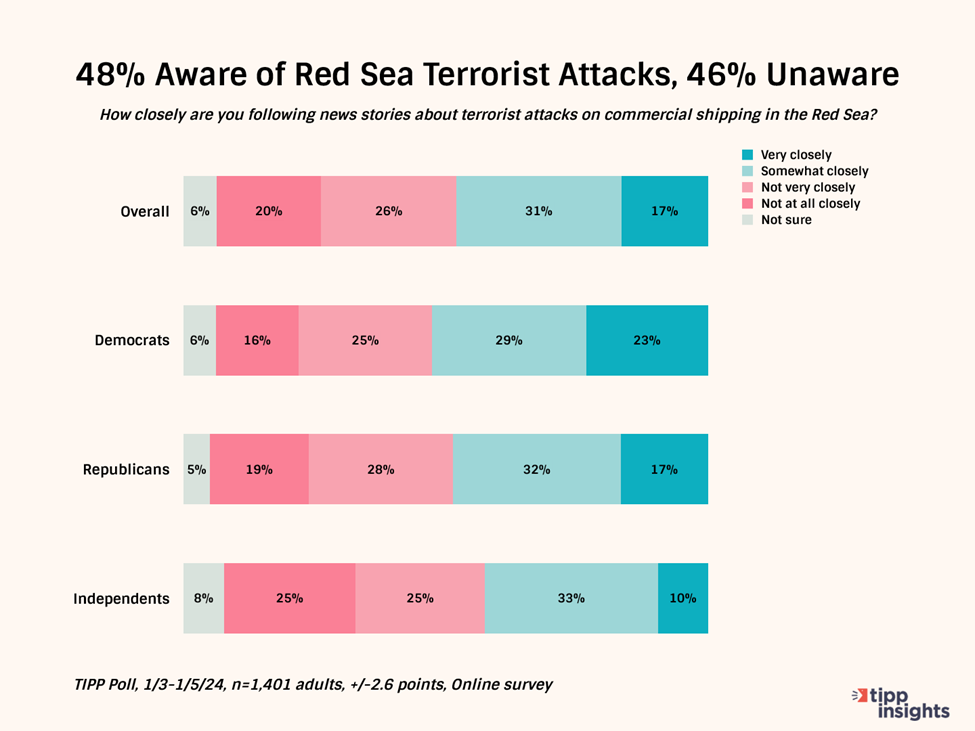
The new polling from TIPP Insights surveyed 1,401 adults about the Houthi rebels’ attacks on commercial shipping in the Red Sea.

The survey first established the extent to which respondents were tracking the issue, finding Americans closely divided: 48% said they’re following the issue very or somewhat closely, while 46% said they’re not following it very closely, or not at all. Only 6% say they were unaware of the Houthi attacks on commercial shipping. 

Broken down by party line, 52% of Democrats, 49% of Republicans, and 43% of independents said they are aware of the attacks, suggesting this generally isn’t a partisan issue.

Once this baseline was established, TIPP Insights posed three additional questions to those respondents who said they were following the Houthi attacks.

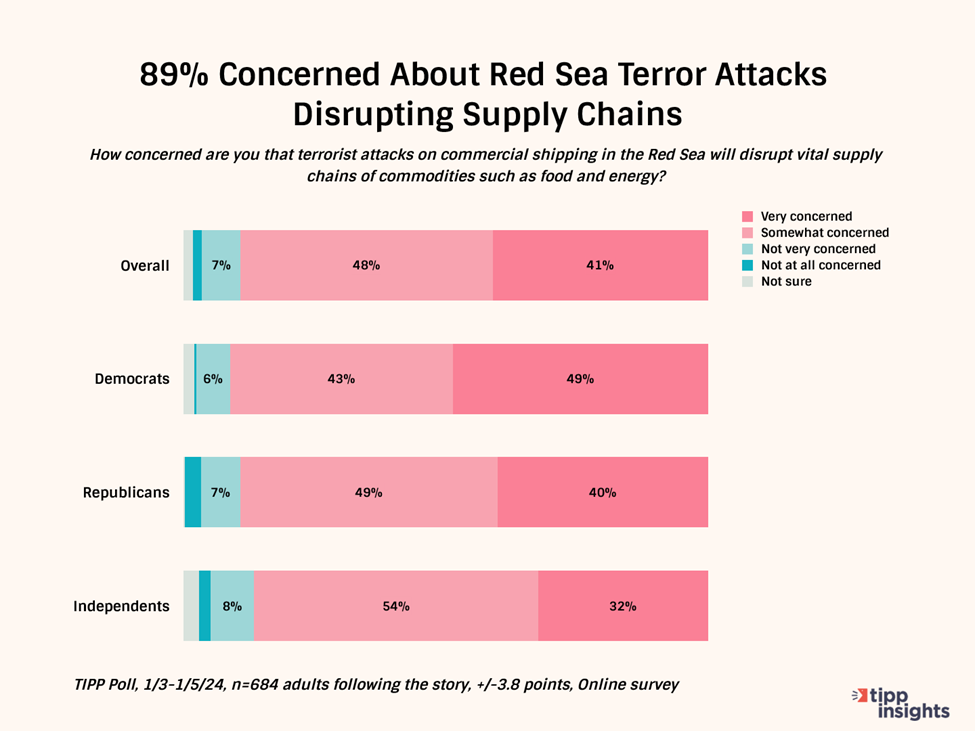
The first question, which got the most dramatic results, asked whether respondents were very, somewhat, not very, or not at all concerned that the attacks might disrupt vital supply chains of commodities such as food and energy. 

Fully 89% answered that they were very or somewhat concerned, while only 9% said they were not. The smallest group of respondents in the survey, just 2%, said they had no opinion. 

These results remained consistent across all demographics. Although younger voters were marginally less concerned than their older counterparts, the survey found that those concerned still had a significant majority that held across genders and ethnic groups.

In other words, for the roughly half of the U.S. electorate tracking the Red Sea issue, the majority anticipates a rise in domestic prices for vital goods because of the disruptions, which should get the attention of both parties at the outset of 2024.

Given that the price of Brent crude already is creeping up over $80 per barrel because of extended voyages around the Cape of Good Hope to deliver cargoes, this concern is likely to intensify in coming months.

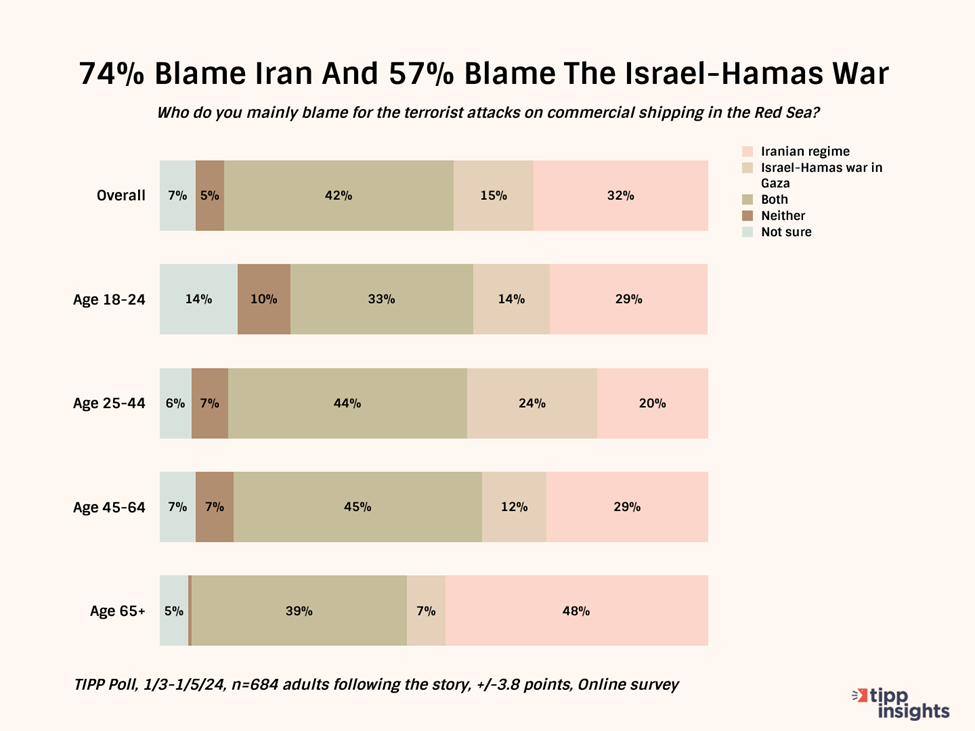
The survey’s second question asked whether respondents placed the primary blame for the attacks on Iran’s Islamist regime, the Israel-Hamas war, or both.

The largest group of respondents, 42%, said they blamed both, and the second largest, 32%, said they blamed Tehran, a result that suggests 74% of American voters consider the Iranian regime at least partially culpable for the turmoil.

Only 15% said they blamed the Israel-Hamas war and, when the response of “both” was accounted for, 57% blamed the war. 

It’s worth noting that of the 671 voters surveyed who said they were following the issue and so moved on to the additional questions, the single largest age demographic was 25 to 44, with a total of 230 respondents.

This group was considerably more likely to blame the Houthis’ attacks on the Israel-Hamas war (24%) than were those 18 to 24 (14%), 45 to 64 (12%), or 65 and older (7%), so the real percentage of Americans who blame Israel and the war may be lower.

The third question revealed the starkest partisan divide in the survey. “How confident are you,” it asked, “that President Biden’s Operation Prosperity Guardian will secure commercial shipping in the Red Sea?”

Overall, 52% of respondents said they either were very confident or somewhat confident that Biden would be successful, compared with 41% who said they weren’t confident and 8% who said they’re not sure. That should be welcome news for the president. 

Democrats were significantly more confident, with 81% responding positively and only 11% disagreeing. But the numbers for the other political groups tell a different story: Only 26% of Republicans and 41% of independents said they have a degree of confidence in Operation Prosperity Guardian, compared to 68% and 49%, respectively, who said they don’t.

So although Biden’s action has the strong support of those in his base who are following events in the Red Sea, he is underwater on the issue not only with conservatives but also with independents. These survey results could signal broader unease with Biden’s performance as commander in chief.

TIPP Insights conducted its polling as Houthi attacks on commercial shipping were escalating, but before the Biden administration took retaliatory action Jan. 11 and 12.

While the Houthis rebels’ immediate response was muted, they escalated retaliation and struck two commercial vessels in recent days. There are no indications that the U.S.- and U.K.-led airstrikes restored freedom of navigation in the region—in fact, all reports are that shipping is still being diverted in the wake of the airstrikes. 

Electric vehicle manufacturer Tesla, for example, announced a two-week hiatus in production at German factories due to lack of components.

If the Houthi threat isn’t neutralized and this type of stoppage spreads in coming weeks, supply chain disruptions will start to compound in a fashion that may grip the American electorate more broadly as primary voters head to the polls.

Houthis Launch Sea Drone to Attack Ships Hours after US, Allies Issue ‘final Warning’


Thursday, 04 January 2024 12:02 PM EST

Read more at https://www.newsmax.com/world/globaltalk/houthis-drone-ships-navy-missile/2024/01/04/id/1148235/

WASHINGTON (AP) — An armed unmanned surface vessel launched from Houthi-controlled Yemen got within a “couple of miles” of U.S. Navy and commercial vessels before detonating on Thursday, just hours after the White House and a host of partner nations issued a “final warning” to the Iran-backed militia group to cease the attacks or face potential military action.

Vice Admiral Brad Cooper, the head of U.S. Navy operations in the Middle East, said it was the first time the Houthis had used an unmanned surface vessel, or USV, since their harassment of commercial ships in the Red Sea began after the outbreak of the Israel-Hamas war. They have, however, used them in years past.

Fabian Hinz, a missile expert and research fellow at the International Institute for Strategic Studies, said the USV’s are a key part of the Houthi maritime arsenal and were used during previous battles against the Saudi coalition forces that intervened in Yemen’s war. They have regularly been used as suicide drone boats that explode upon impact.

Most of the Houthis’ USVs are likely assembled in Yemen but often fitted with components made in Iran, such as computerized guidance systems, Hinz said.

The location of this latest attack was not immediately clear, but Cooper said it took place in international shipping lanes.

Since late October, the Houthis have launched scores of one-way attack drones and missiles at commercial vessels transiting the Red Sea. U.S. Navy warships have also intercepted ballistic missiles the Pentagon says were headed toward Israel. Cooper said a total of 61 missiles and drones have been shot down by U.S. warships.

In response to the Houthi attacks, Defense Secretary Lloyd Austin in December announced Operation Prosperity Guardian, with the United States and other countries sending additional ships to the southern Red Sea to provide protection for commercial vessels passing through the critical Bab el-Mandeb Strait.

Cooper said 1,500 commercial ships have been able to transit safely since the operation was launched on Dec. 18.

However, the Houthis have continued to launch missiles and attack drones, prompting the White House and 12 allies to issue what amounted to a final warning Wednesday to cease their attacks on vessels in the Red Sea or face potential targeted military action.

Cooper said Operation Prosperity Guardian was solely defensive in nature and separate from any military action the U.S. might take if the Houthi attacks continue.

The U.S., United Kingdom and France are providing most of the warships now, and Greece and Denmark will also be providing vessels, he said.

___

Associated Press writer Jack Jeffery contributed to this report.

Copyright 2024 The Associated Press. All rights reserved. This material may not be published, broadcast, rewritten or redistributed without permission.

Biden Takes ‘Death to America’ Terrorists Off Terror List, Replaces Them With Republicans


Reported by Daniel Greenfield |

Daniel Greenfield, a Shillman Journalism Fellow at the Freedom Center, is an investigative journalist and writer focusing on the radical Left and Islamic terrorism.

The Biden administration responded to protests against its stolen election by embedding a domestic extremism office into the National Security Council. The man in charge of making it happen, Joshua Geltzer, had previously denied that Black Lives Matter was a terrorist threat and had attacked the Trump administration’s response to Antifa and BLM violence in Portland. That means that the only domestic extremists the NSC will be fighting are Republicans.

Even while the Biden administration is preparing to double down on Obama’s abuse of the national security state to target his political opponents, it’s also giving real terrorists a pass. Joe Biden, whose biggest bundlers included the Iran Lobby, announced he was ending support for American allies fighting the Houthis, and then went even further by preparing to remove the terrorist organization whose motto is, “Death to America”, which took American hostages and tried to kill American sailors, from the list of designated foreign terrorist organizations.

The motto of Iran’s Houthi Jihadis is, “Allahu Akbar, Death to America, Death to Israel, Curse the Jews, Victory to Islam.” The Houthis took over parts of Yemen as a result of the chaos unleashed by Obama’s pro-Islamist Arab Spring. Since then they’ve been engaged in a protracted war while causing a local famine by confiscating food from the local population.

Last year, the Trump administration had finally secured the release of three American hostages, Sandra Loli, an American aid worker who had been held for 3 years, another American who had been held for a year, and the body of a third American, in exchange for 240 Houthis, including three dozen Islamic terrorists who had been trained in the use of missiles and drones by Iran. Like those launched at the USS Mason.

The Houthis lived up to their “Death to America” slogan by repeatedly launching cruise missiles at the USS Mason which had been protecting shipping in the area. And they lived up to the second half of their slogan by ethnically cleansing the remaining local Jewish population, locking them up, and confiscating their homes and land. Local reports stated that the Houthis were “cutting off water & electricity to Jewish homes and preventing Jews from purchasing food.”

“No Jew would be allowed to stay here,” one of the Jewish refugees said.

The Iran-backed Islamic terrorists fight using 18,000 child soldiers. The soldiers, many abducted, some as young as 10, are taught to hate America and to kill enemies of Iran. None of this stopped Biden’s State Department from taking the Houthis off the terror list.

“Secretary Blinken has been clear about undertaking an expeditious review of the designations of Ansarallah,” the State Department claimed. “After a comprehensive review, we can confirm that the Secretary intends to revoke the Foreign Terrorist Organization and Specially Designated Global Terrorist designations of Ansarallah.”

‘Ansarallah’ or ‘Defenders of Allah’ is what the Houthis call themselves. Blinken had only been confirmed on Tuesday. By next Friday, he had already somehow completed the “comprehensive review”, amid all the other minor business like China, Russia, and a global pandemic, and decided that the Islamic terrorists whose motto is “Death to America” aren’t really terrorists.

How can the Biden administration deny that Islamic Jihadis backed by Iran who attacked Americans are terrorists? The State Department claimed that this, “has nothing to do with our view of the Houthis and their reprehensible conduct, including attacks against civilians and the kidnapping of American citizens.” Not to mention the attacks on the USS Mason. But the Biden administration isn’t even going to pretend to care about attacks on our military.

The Bidenites are claiming that they’re taking the Houthis, whom they don’t deny are terrorists, off the list of designated terrorist groups because of the “humanitarian consequences”. That’s a lie, no matter how often you hear it in the media, because Secretary of State Mike Pompeo announced that the United States would be providing licenses to “humanitarian activities conducted by non-governmental organizations in Yemen and to certain transactions and activities related to exports to Yemen of critical commodities like food and medicine.” That’s despite the fact that the humanitarian crisis in Yemen was caused by the Houthis.

Nevertheless the media, echoing propaganda from the Iran Lobby and Qatar, a close terrorist ally of Iran, has falsely claimed that the Houthis are the victims of the Yemen famine. A number of politicians, mostly Democrats, but some Republicans, as well as various aid groups, have pushed this same disinformation campaign about the causes of the Yemen famine.

America and its allies have spent billions providing food, medicine, and other humanitarian aid to Yemen. That aid has been seized by the Houthis who have used it for their own troops or to resell on the black market. This is a familiar problem from Syria to Somalia, and aid groups have refused to honestly address their complicity in aiding the terrorists who caused the crisis. There’s no money in admitting that the aid an organization is providing is being seized by the terrorists, prolonging the conflict and worsening the humanitarian crisis. Some aid organizations share the same goal as the Houthis of worsening the crisis because it boosts their donations.

That’s why international aid organizations don’t want to talk about the Houthis taking their food donations, or about their use of child soldiers. “It’s a taboo,” an anonymous aid official had said.

When Secretary Pompeo announced that the United States was finally designating the Houthis a foreign terrorist organization, the United Nations took the lead in claiming that it would cause a humanitarian crisis. But the UN’s World Food Program had already admitted that its food shipments weren’t getting to the starving people because the Houthis were intercepting them. The Middle East director for UNICEF also admitted that the Houthis were seizing food.

An Associated Press investigation found entire stores selling “cooking oil and flour displaying the U.N. food program’s WFP logo.” The former Houthi education minister said that 15,000 food baskets that were supposed to go to hungry families instead went to the Houthi terrorists whom the Biden administration is defending. Massive amounts of aid have been pumped into Yemen, and the famine has only grown worse because the Houthis have used starvation as a weapon.

The only way to end the famine is to end Iran’s grip on Yemen through its Houthi terrorists. That’s obviously not what Biden or the Democrats have in mind. The loudest Democrat voices against designating the Houthis as a terrorist group have a troubling history with Iran.

“Reversing the designation is an important decision that will save lives and, combined with the appointment of a Special Envoy, offers hope that President Biden is committed to bringing the war to an end,” Senator Chris Murphy tweeted.

Murphy had been among the loudest voices against the designation.

And Murphy had met with Iran’s Foreign Minister Mohammad Javad Zarif last year. That same year, he had advocated lowering sanctions on Iran for “humanitarian reasons”. Biden had also joined the push to use the pandemic as a pretext for reducing sanctions on the terror state. That same year, the Left succeeded in forcing out Rep. Elliot Engel, one of the few remaining pro-Israel Democrats, and replaced him with the militantly anti-Israel Rep. Jamaal Bowman, whose election was backed by Rep. Alexandria Ocasio Cortez and her antisemitic ‘Squad’.

Engel, who had served as Chairman of the House Foreign Affairs Committee, was replaced by Rep. Gregory Meeks, a strong backer of the Iran Deal. Meeks’ position was cheered by Iran Lobby groups. As far back as 2009, Meeks had declared at a hearing, “I have developed a tremendous appreciation for the work of the National Iranian American Council. I am pleased that we will hear the perspective of NIAC’s President, Mr. Trita Parsi.”

Emails released allegedly showed Parsi telling Iran’s Foreign Minister, “I am having a meeting with Gilchrest and Meeks, and they asked for our assistance in getting some communication going between the parliamentarians.” Speaking to the Islamic Republic News Agency, the official state news agency of the Islamic terrorist state, Chairman Meeks allegedly stated that he was willing to travel to Iran and had been engaged in dialogue with Iranian legislators. Meeks took the lead in attacking the designation of the Houthi Islamic terrorists as terrorists, arguing that, “No solution in Yemen will be sustainable unless the Houthis are involved.”

And that gets at the real reason why Biden and Democrats oppose the designation. It’s not about humanitarian aid, which would have kept on going anyway, only to be stolen by the Houthis. It’s about supporting Iran’s bid to take over parts of Yemen in order to control shipping and tighten the grip of the Islamic terrorist regime over the entire region. The ‘diplomatic’ solution advocated by Biden and the Democrats would finalize Iran’s grip over parts of Yemen. Designating the Houthis as terrorists would get in the way of another in a series of Islamist dirty deals with Iran that began with Obama and that will continue on under Biden.

Even while the Democrats insist loudly that the Houthis must be part of the solution in Yemen, they just as vocally cry that the Republicans must be isolated and eliminated in America. The Democrats militarized D.C. with an armed occupation and are criminalizing political dissent. They have claimed that one riot, after a year full of them by their own activist wing, requires a permanent state of emergency that will be run through the National Security Council.

The Biden administration is not only taking the Houthis, and likely other Islamic terrorist groups, off the terror list, it’s putting the domestic political opposition on its terror list. This is an extension of the same Obama policy that illegally shipped foreign cash to Iran even while it was using the NSA to spy on pro-Israel members of Congress and on the Trump campaign.

The Democrats are happy to fight terrorism by designating their domestic political opponents as terrorists while removing the “Death to America” Houthis who have kidnapped and killed Americans, who fired on the USS Mason, and ethnically cleansed Jews, from the terror list. And what do the Houthis plan to do with their newfound support from the Biden administration?

In addition to sanctioning the Houthis, the Trump administration sanctioned three of their leaders, beginning with Abdul Malik al-Houthi. The Houthi leader has made it clear that he intends to build up the same missile program that was used to attack the USS Mason.

“To have rockets that could reach far beyond Riyadh, this is a great achievement,” he said, referring to the Saudi capital. He also promised to send terrorists to fight against Israel.

“Many of Yemen’s tribesmen are ambitious to fight against Israel, and they are looking for the day to participate along with the freemen of the Islamic nation against the Israeli enemy,”

This is the terrorist group that the Biden administration and the Democrats are bailing out even while they’re criminalizing the Republican political opposition as terrorists. “Death to America” is something that the Houthis and their Democrat supporters can agree on.

Tag Cloud