Perspectives; Thoughts; Comments; Opinions; Discussions

Posts tagged ‘Federalism’

Dictatorship Won’t Kill America, The Rot Of Partisan Abuse Will


BY: DAVID HARSANYI | JANUARY 24, 2024

Read more at https://thefederalist.com/2024/01/24/dictatorship-wont-kill-america-the-rot-of-partisan-abuse-will/
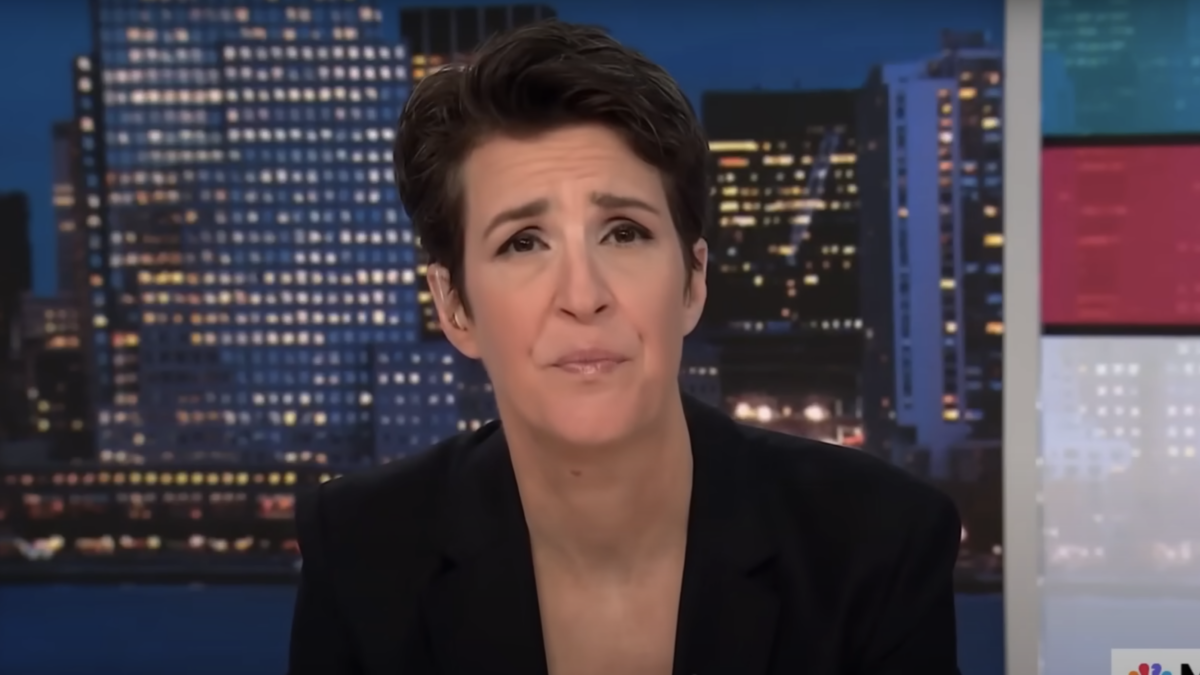

Rachel Maddow

Author David Harsanyi profile

DAVID HARSANYI

VISIT ON TWITTER@DAVIDHARSANYI

MORE ARTICLES

The other day Rachel Maddow, one of the most unhinged conspiracy theorists in major media, described Donald Trump’s alleged pitch to Republicans:

If you pick me, that’ll be the end of politics, and you won’t have to deal with politics anymore. You won’t have to deal with contested elections, you won’t have to deal with contests or divisions when it comes to power, you’ll have a strongman leader and I’ll just do what I want. And won’t that be a lot simpler? That’s what he’s offering. That strongman model is what the Republican base is enthused about.

Funny, because this also happens to be what Maddow is enthused about. It’s what the officials taking leading presidential candidates off ballots are enthused about. So is Joe Biden, who gives angry speeches demonizing opposition voters and demanding one-party rule. Everyone wants his own dictator. Every president wants to be one. Politics can turn normally rational people into raging authoritarians.

The thing about wanna-be dictators, though, is that they have no real way of pulling it off. Don’t get me wrong: the consequences of an imperial presidency are bad enough. But there will be no military coups in America. There will be no Hitler. No political riot is going to overthrow “democracy.” That’s all paranoia. The reality is much more mundane. It’s what we have now — a slow-motion, tedious corrosion of basic standards.

And both sides aren’t equally at fault. The things progressives detest most about our system—a deliberative Senate, federalism, counter-majoritarian institutions, various inconvenient liberties protected by the Bill of Rights, for starters—compel Trump to deal with “politics.”  

Here, for instance, is something I think most Democrats probably know but would never say: If a President Trump blatantly exceeded his constitutional authority, it is highly likely that “conservative” justices would stop him. Yet every time the court renders a decision undercutting the political agenda of the GOP, which is often, the media acts like it’s some big surprise. It’s not. And Trump, for all his bluster last term, didn’t ignore the courts.

Now, if Biden blatantly exceeded his executive authority, as he already often does, what are the chances that a “liberal” majority court would bless his actions? When you have no limiting principles, it all comes down to justifying the morality of the underlying issue. Considering the modern left’s collective superiority complex, that is never a difficult task.

We don’t really need to theorize about how this works, either. Many left-wing politicians and intellectuals — self-styled defenders of “democracy” — not only implore Biden to ignore courts, they press him to declare national emergencies empowering the president to run virtually the entire economy through a massive administrative state. If Trump threatened to take similar power, the media would be convulsing with horror.

Indeed, the contemporary left isn’t working to delegitimize the court because it harbors ethical concerns (the people leading the charge are corrupt), it’s because they want to circumvent a court that still occasionally limits state power and preserves American “democracy.”

Won’t that be a lot simpler? Maybe if Trump wins in 2024, he’ll figure out that the Federalist Society’s principled jurists make no political sense for him and nominate lightweight partisans like Sonia Sotomayor to uphold whatever crackpot theory he wants. Why not?

When the Supreme Court upheld the Civil Rights Act, eliminating racist preferences in schools, Biden said, “We cannot let this decision be the last word. I want to emphasize: We cannot let this decision be the last word.” That is something of a mantra for him.

A few years ago, Biden admitted he didn’t have the constitutional authority to extend (Trump’s) eviction moratorium. An extension would not “pass constitutional muster,” he said. The president, the administration noted, had “not only kicked the tires, he has double, triple, quadruple checked.”

It was illegal, and Biden did it anyway.  Congressional Democrats, tasked to protect the interests of their institution, cheered him on. The same goes for the obviously unconstitutional student loan bailout Biden keeps proposing. High-ranking Democrats, in fact, demand that Biden ignores the Constitution and separation of powers.

If Biden feels like he can dismiss SCOTUS on student loans, or anything else, why shouldn’t Texas ignore SCOTUS on protecting its borders? Maybe Texas should think about taking up the Biden method, which would entail erecting a new, slightly different fence every time the court shoots down the idea.  

All of it is reminiscent of Barack Obama telling Americans he couldn’t pass the DREAM Act because he was not a “king” or an “emperor,” and then doing it anyway. Indeed, the premise of the Obama presidency was the circumvention of “politics,” summed up neatly in the illiberal notion of political “unity.”

Once Obama lost control of Congress in 2010, he not only acted like a person who didn’t “have to deal with politics anymore,” he became the first president in memory to openly champion working around the law-making branch of government. “If Congress won’t act, I will,” he liked to say. People cheered.

Since then, every time Democrats can’t get their way, we are inundated with stories about how the system isn’t working correctly, rather than stories about how the contemporary left is destroying the system to fix the problem.
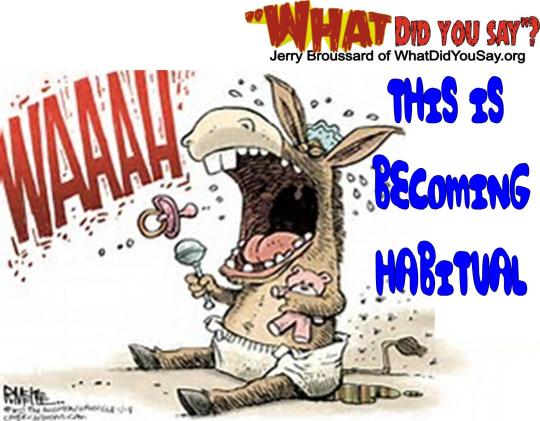
Now, I’m not naïve. Most voters couldn’t care less about these idealistic arguments. I don’t know “what time it is,” apparently. That said, protecting the system is not only a high-minded pursuit, but also the most practical way to preserve your own policy achievements and freedoms.

But you can’t expect the opposition to play by rules when you refuse to honor them. You can’t lecture everyone about accepting elections when you won’t. And you can’t keep acting like you’re saving “democracy” when you’re murdering it.

I mean, you can. It seems like the more norm-busting degradation of the system you promise, the more popular you become these days. But that does not bode well for our future.  


David Harsanyi is a senior editor at The Federalist, a nationally syndicated columnist, a Happy Warrior columnist at National Review, and author of five books—the most recent, Eurotrash: Why America Must Reject the Failed Ideas of a Dying Continent. Follow him on Twitter, @davidharsanyi.

A National Popular Vote Won’t Fix The Electoral College, But Smaller Government Will


Reported by Sukhayl Niyazov DECEMBER 29, 2020

A National Popular Vote Won’t Fix The Electoral College, But Smaller Government Will

The most popular argument against the Electoral College is that it violates the fundamental principle underlying democratic society: political equality, or, commonly phrased as “one person, one vote.”

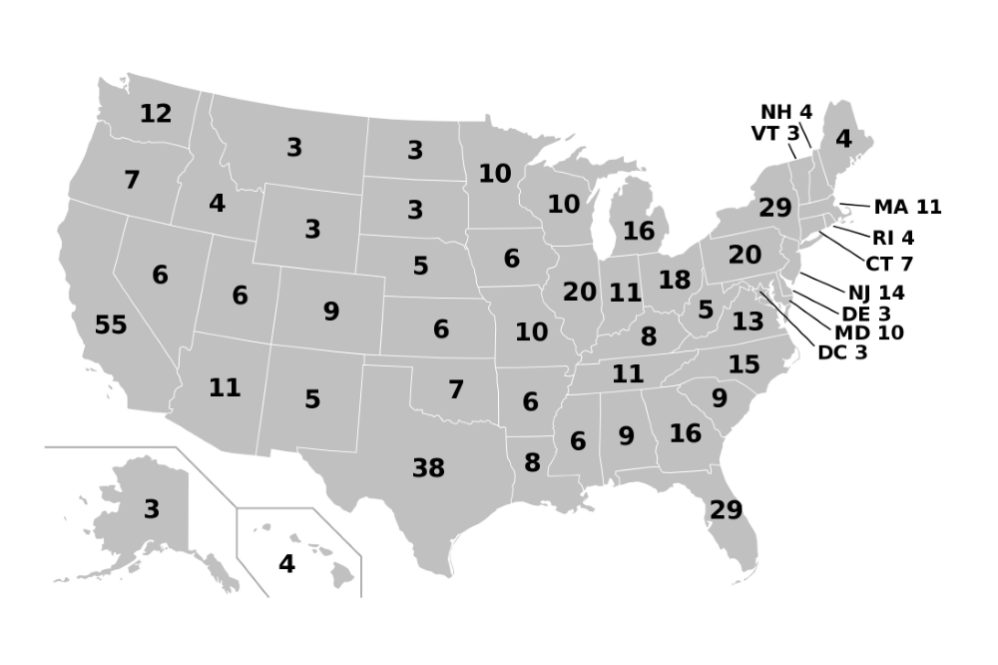
Indeed, because all states are assigned at least three electors regardless of their population size, the Electoral College gives small states a disproportionate number of electors per capita. As a result, a person who receives the largest number of votes does not necessarily win the election, as was the case in the presidential contests of 1876, 1888, 2000, and 2016.

In the wake of the 2020 election, there have been renewed calls to abolish the Electoral College and replace it with a national popular vote. The Washington Post editorial board, for example, writes, “The Electoral College, whatever virtues it may have had for the Founding Fathers, is no longer tenable for American democracy.”

The logic underlying this argument is the following: the actions of the president, and the federal government, directly affect millions of people, and thus citizens, not states, should choose the president.

Why does a voter in Wyoming have four times as much say over who is to lead the country in the next four years than the resident of California, if all men are created equal? Furthermore, critics usually argue the Electoral College leads candidates to focus their efforts on a few swing states — like Florida, Michigan, Pennsylvania, and Wisconsin — while neglecting other regions of the country.

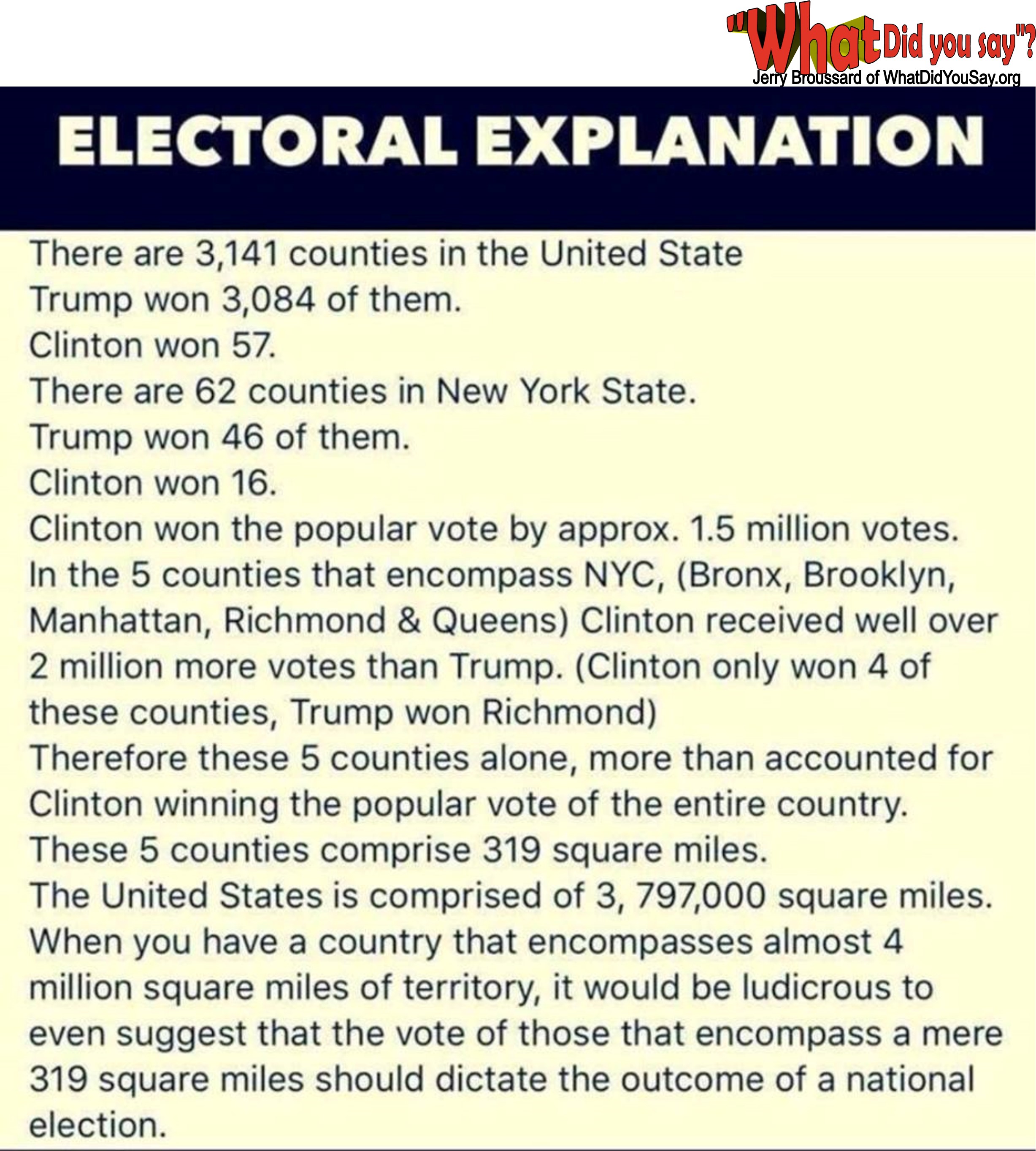
Yet, while it is true that in the current system presidential candidates don’t spend their energy and focus on all states equally, in a system with the popular vote, the “tyranny of the minority” would be even worse. Indeed, could well be enough to win the popular vote of highly dense, urbanized cities in states like California and New York while losing in elections in a vast majority of the country.

But as Dan McLaughlin writes in National Review, “The Electoral College, however, dilutes the influence of “hyperpartisan enclaves that are out of step with the nation,” be it California today or the American South in the 19th century. Thus, thanks to the Electoral College, candidates have to appeal to a geographically broader base that’s more politically, socially, and economically diverse.

Federalism and the Electoral College

The Electoral College is therefore a mainstay of America’s federalist system of governance, centered on the protection of certain rights reserved to the states as entities and resting on the principle of a division of power. America is a union of states, and the president is, in essence, the officer of the states rather than of the American people.

Likewise, an argument can be made that the states, and not the people per se, are sovereign. After all, the U.S. Constitution was ratified not by the American people, but by delegations from 13 states. In an electoral system with a national popular vote, the executive branch would represent the interests of a few highly populated states, disregarding the interests of all other states, shredding the federalism the Founders thought it so necessary to bestow upon the American republic.

The debate about whether the Electoral College should be abolished, however, misses a larger and more important. When the United States was founded, it was not assumed America would ever possess such a massive federal government combined with an imperial presidency, an anemic and gridlocked Congress, and eroded state rights, as we have today.

As George Will points out in a recent column in The Washington Post, “Congress is not even certain of the components of, and hence cannot meaningfully control, the agglomeration of bureaucracies it has created.” Indeed, only three executive agencies existed in 1789. By contrast, today, as the Modernization of Congress report puts it, “While there is no official inventory of federal agencies, one recent count puts the current total at 278 distinct agencies.”

If America were a truly centralized country where the federal government had vastly more power than it already does, elections by popular vote would make sense since the actions of the president would directly affect citizens. This is not the case, however, for a nation such as ours.

In a decentralized federal republic, the fact that states, and not people, elect the president does not necessarily violate the principle of equal representation because national elections do not have as much impact on the lives of the citizens as do those on local and state levels. Indeed, this is why elections on state and local levels are determined by popular vote, since, in decentralized society, they matter more for the majority of ordinary citizens than the federal ones.

Why We Must Decentralize

Unfortunately, a worrying trend is that in today’s America, as we move away from our federalist system and power becomes increasingly concentrated in Washington, D.C. and the executive branch, in particular, presidential elections matter far too much to many people. For the Electoral College to reflect the underlying social dynamics of the nation when it was established, we need more decentralization and localism, when states, and not citizens, elect the president of the union.

Through every constitutional means available, the American people must quickly begin a course to limit executive power, end the imperial presidency, reduce the size of the federal government, give more power to the states, and decentralize decision-making away from Washington. Of course, some tasks can only be performed by the president and the federal government, such as representing the states on the world stage. Otherwise, in spheres that can be managed by states and municipalities, the central government should not be involved.

The Electoral College was created for a decentralized country with a federal system. Modern America, unfortunately, has been steadily moving away from federalism as envisioned by the Founding Fathers. Abolishing the Electoral College is next to impossible in the current political climate since that would require a constitutional amendment, and initiatives like National Popular Vote Interstate Compact are probably unconstitutional.

We Need More Federalism, Not Less

More federalism, therefore, is the only way to address this growing disconnect between the Electoral College and the type of a country it was crafted for. As James Madison notes in Federalist No. 10:

By enlarging too much the number of electors, you render the representatives too little acquainted with all their local circumstances and lesser interests; as by reducing it too much, you render him unduly attached to these, and too little fit to comprehend and pursue great and national objects. The federal Constitution forms a happy combination in this respect; the great and aggregate interests being referred to the national, the local and particular to the State legislatures.

Decentralization and dispersal of power underlie the U.S. Constitution, striking a balance between the rights of states and the federal government, with the Electoral College serving as one of such compromises.

Abolishing the Electoral College would expand the power of the federal government — especially in administering elections — potentially turning states into mere administrative departments of the Washington bureaucracy. Since one of the prime rationales for the existence of the Electoral College is state representation, if the Electoral College is abolished in the name of direct democracy, consistency would require that the Senate, and thus states’ representation, are removed too, with disastrous consequences.

To make the Electoral College relevant again, we need to decentralize federal power and localize the process of decision-making, making politicians closer and thus more accountable to their constituents. Instead of changing the Constitution to abolish the Electoral College, it would be much easier — and much better for the health of our republic — to reduce the size of the federal government so that the Electoral College operates in the environment it was designed for.

ABOUT THE AUTHOR:
Sukhayl Niyazov is an independent author whose work has appeared in The National Interest, Human Events, Global Policy, Law and Liberty, Areo, and Merion West.

School Choir Pulled From Conservative Festival


waving flagPosted On 29 September 2015 By :

A school district in southern Utah has opted to pull their kids out of the upcoming Western Freedom Festival, where they were to perform a medley of patriotic songs in front of the festival’s attendees. According to officials, the decision was made after parents complained about the political leanings of the event.

“We’ve stepped out of our participation,” said Iron County school district spokesman Steve Burton. “It’s our policy not to be involved in events that have a political agenda.”Picture1

According to the festival’s organizers, the event – scheduled for October 23 at Southern Utah University – is intended to celebrate heritage and culture as well as discuss federalism and the importance of keeping private lands out of the hands of the federal government. And while it’s impossible to pretend there isn’t a political agenda here…when is that not the case?

Everything is political to some degree. Every speaker has an agenda, and every event is put on with a purpose. There Truth The New Hate Speechare two (or more) sides to every issue, and it’s ridiculous to pretend otherwise. Critics only bring out the “too political” card when they disagree with the politics in question.

Besides, were the children expected to get up on stage and pontificate on the importance of private land ownership? No, they were going to sing songs in praise of America. And when you think about it, it’s a minor surprise that even that wasn’t considered too political. After all, we live in an era where liberals are constantly complaining about the oppressive history of the American flag.

It’s okay to pull out of events whose topics you don’t agree with, but at least have the courage of your convictions. No We have been torn apartone has the option to stand silently by and refuse to choose a side. By not choosing, you’ve still made a choice. All due credit to Rush.

According to op-ed writer Marcos Camargo, the event has sinister undertones. “Promotion of ‘western values’ sounds a lot like white nationalism,” he wrote in the Utah Independent.

Of course it does. When these liberals can’t argue on the basis of fact, they resort to this kind of name-calling. They go straight to the race card, knowing that even the insinuation of hate speech is enough to cast their enemies in a disturbing light. It doesn’t matter if they have any proof to back up their claims. Just by saying it, they’ve already turned the tide of the debate in their favor.

Iron County fifth graders will be spared the horror of this “white nationalism,” but they will go back to their classrooms and learn a distorted view of American history, learn a twisted interpretation of the Constitution, and complete an education that is inevitably colored by … drum roll, please … politics! There’s no escaping it. There’s simply no way to give a child an unbiased view of the world; it doesn’t exist. What these people want to do is shield them from the views they don’t like.

The Leftist Propagandist In God We Trust freedom combo 2

The Battle Over Coal. And the War on State Rights.


waving flagPosted by on June 04, 2015

The Environmental Protection Agency’s “War on Coal” is a war that the states literally cannot afford to lose. With coal providing almost 40 percent of U.S. electricity and around a half-million American jobs, we all stand to suffer from proposed federal regulations that would force plants to closedrive our electricity bills up, and hinder the competitiveness of U.S. manufacturers in the global market.

But this recent bureaucratic power grab is more appropriately described as a “battle” than a “war.” It is just one fight—albeit an important one—in the larger War on Federalism being waged day after day by a formidable national government in Washington, D.C. The specific power play being made by the EPA in this instance is handily representative of the processes that have steadily expanded federal power over the years. Just like President Barack Obama’s executive fiat on immigration policy, it involves actions that do not quite ignore constitutional boundaries, but simply lawyer around them.burke

Here, the EPA wants to order the states to apply the same crippling carbon dioxide emission standards to existing energy plants—already regulated under a separate section of the Clean Air Actas the federal standards designed for new plants.hell

For decades, the EPA has been administering the federal law according to a common-sense reading of the language, whereby exiting sources of air pollution are regulated under one section and new sources or otherwise unregulated sources are governed by another.

Then came a failed attempt by the Obama administration to shepherd new climate change legislation through Congress. Voilà! Now, citing a dubious ambiguity in the wording of one provision of the decades-old Clean Air Act, the EPA claims that Congress actually authorized it to apply the more stringent standards to existing plants anyway.Worship manditory

The EPA’s attempt to steamroll what most see as a clear, congressionally-constructed boundary on its regulatory authority is made possible by a landmark Supreme Court precedent, a 1984 case called Chevron U.S.A. v. National Resources Defense CouncilThat case gave us the “Chevron Test” for evaluating the extent of agency authority by reviewing Congress’ statutory instructions to the agency. Essentially, if Congress’ direction to the agency is clear, that direction simply must be followed. If, however, there is silence or ambiguity in the language, then courts will uphold the agency’s action as long as it is based on a permissible interpretation of the law. In other words, an interpretive “tie” goes to the bureaucrats.EPA Tyranny

Obama eating the ConstitutionThis judicial policy puts power tools in the hands of bureaucracies that, just by virtue of their consisting of human beings, are already predisposed to chip away at the limitations of their authority. It invites every administrative agency to expand its power at every turn by inventing creative statutory interpretations that can pass the low bar of being considered by some federal judge to be “permissible.” As it turns out, federal bureaucrats are creative geniuses when it comes to “interpreting” their statutory authority. Their creativity mirrors that of the executive, legislative, and judicial branches in interpreting the Constitution itself.

Invariably, all this interpretive creativity comes at the expense of the states. In fact, this very Battle over Coal is an example of how much the states have already lost, for this battle is a tug-of-war between federal agencies and the federal legislature over an area of policy that rightfully belong to the states.

Strategies for winning this Battle over Coal in the short-term—including the usual expensive lawsuits—must not be Obama tearing up the constitutionmistaken for the needed long-term solution to the epidemic erosion of our constitutional federal system. We cannot allow our national government to continue distracting us with countless and repeated skirmishes over the practical and procedural terms of their abuses of power. Instead, we must engage in the larger war over fundamental constitutional principles that the feds are actually waging.

The states are well-equipped to win this War on Federalism decisively, but victory requires them to use the one effectual constitutional tool at their disposal that, until now, they have entirely neglected.

By invoking Article Five’s state-controlled process to propose constitutional amendments, the states can foreclose the feds’ opportunity to lawyer around limitations on their authority. The states can definitively end not only the EPA’s attempt to hijack legislative prerogatives, but also hundreds of other instances of overreaching by bureaucrats, the president, Congress, and even the Supreme Court.freedom

A constitutional amendment could overrule the Chevron case’s “tie goes to the agency” framework and replace it with a rule that where Congress’ intent is unclear, the agency may not act. But more importantly, a constitutional amendment could limit the power of Congress to interfere with policies that the Constitution reserved to the states. For example, an amendment could overturn the current, overbroad interpretation of the Commerce Clause, which was originally intended to merely allow Congress to regulate economic activity that crosses state lines.

Americans must recognize that what is ultimately at stake here is our self-governance. Will the vast majority of our laws be created in the state and local governments that are most responsive to the people, as intended by the Constitution? Or will we instead allow ourselves to be ruled by an elite ruling class in a distant capitol, which hands down high-minded orders and cracks the whip on the backs of the states to carry them out?safe_image

Federalism is a defining characteristic of our exceptional Constitution, and it is under siege. But the War on Federalism is one that the states can win if they use the appropriate constitutional defense.

To learn more about the Article Five Convention of States process, read my five-part series.

Rita Martin Dunaway serves as Staff Counsel for The Convention of States Project and is passionate about restoring constitutional governance in the U.S. Follow her on Facebook (Rita Martin Dunaway) or e-mail her at rita.dunaway@gmail.com.freedom combo 2

Delegates begin planning for changes to U.S. Constitution


http://minutemennews.com/2014/06/delegates-begin-planning-changes-u-s-constitution/

INDIANAPOLIS | Representatives and senators from 29 states met Thursday in the Indiana Statehouse to begin planning for the first state-led revisions to the U.S. Constitution since the nation’s fundamental governing document was enacted in 1789.

The significance of the work undertaken by The Mount Vernon Assembly to prepare for a future Convention of the States was not lost on the 94 official and participating delegates, mostly Republicans, who filled the House chamber.

“Nothing like this has occurred in over two centuries, though certainly the founders of this nation assumed it would have happened long ago,” said Indiana Senate President David Long, R-Fort Wayne, an organizer of the meeting.

Article V of the U.S. Constitution requires Congress call a Convention of the States for proposing constitutional amendments if legislatures in two-thirds of the states (34 states) request one. If the convention approves an amendment, it then can be ratified by three-fourths of the states (38 states) and added to the Constitution without additional congressional approval.

However, because an Article V convention never has been called, there are no clear procedures on how it would begin, what rules the convention would follow or whether it could be limited in scope.

The Mount Vernon Assembly, which organized last December at George Washington’s Virginia estate and is planning to change its name to the Assembly of State Legislatures, has taken it upon itself to start answering those questions to ensure a future Convention of the States gets off on the right foot.

“It has been a failure on the part of state legislatures for not stepping up for the past 200 years and saying, here’s how we’re going to do it, so that’s what we’re doing,” said state Rep. Chris Kapenga, a Wisconsin Republican.

“It’s time we accept the responsibility given us because there’s little debate in state legislatures, or in the public, that something’s not right in Washington.”

Throughout the morning, delegates discussed their organizing principles and whether they were being too deliberate in their planning.

Kapenga pushed back on the few lawmakers who wanted to jump ahead to debating amendment proposals that someday could be considered by a Convention of the States.

“This is the Constitution of the United States — we have to be very cautious and go through this process where we make sure anything that we put down is debated and discussed, and debated and discussed, and the final product is solid,” Kapenga said.

In the afternoon, delegates organized into four committees to begin tackling detailed planning questions for a Convention of the States, including how many delegates each state should have, whether states must send Congress an identical request and whether past state calls for Article V conventions, such as those submitted by Indiana in 1861 and 1979, are still valid.

State Sen. Jim Arnold, D-LaPorte, was appointed co-chairman of the Judiciary Committee. He will help shape answers to those questions and others ahead of the assembly’s December meeting, where its proposed rules for a Convention of the States will be approved.

Ultimately, the Convention of the States, if one ever is called, must decide whether to accept the rules and procedures proposed by the Assembly of State Legislatures.

Long said regardless of that decision, the work of planning and preparing for a convention has reminded states of their rights under America’s federalist system of government and their role in the constitutional amendment process.

“States’ rights has never been, nor should it ever be, a partisan issue,” Long said. “It is instead a constitutionally based concept that has made us the great country that we are today — 50 independent states, governed separately but united together.”

Copyright 2014 nwitimes.com. All rights reserved. This material may not be published, broadcast, rewritten or redistributed.

<!– AP Usage Tag

–>


Tag Cloud