
Perspectives; Thoughts; Comments; Opinions; Discussions

Posts tagged ‘automobile’

COMMENTARY: Man Plugs $80k+ Electric Truck Into His House, Finds Out It Will Take Over 4 Days to Charge


 By C. Douglas Golden | October 1, 2022

Read more at https://www.westernjournal.com/man-plugs-80k-electric-truck-house-finds-will-take-4-days-charge/

An electric Hummer is seen at General Motors Factory Zero in Detroit, Michigan, in a file photo from November 2021. (Mandel Ngan – AFP / Getty Images)

Congratulations. You’ve just purchased one of the most expensive high-performance electric trucks on the market. You’ve gone green and you’ve done it in style with the GMC Hummer, starting at $86,645. That’s right — the Hummer’s now a green vehicle! What was once the biggest villain in the left’s war on fossil fuels is now the poster child for responsible off-roading. That’s a hefty chunk of change, but at least you’ll be able to save a bit with government incentives. Most importantly, you can charge the car at home just like it was any other appliance. Easy, convenient and cheap, right?

Well, if you have a day or four to spare, sure.

In a viral video from a YouTube channel that specializes in electric vehicles, a man who tries to plug the Hummer into his home to charge finds it will take, at best, one day to charge — and that’s with special equipment installed. Without it, you could be there for four days.

The video begins with standard 120V charging — or Level 1 charging, to use official jargon. This is the standard current your home already offers.

“Right now it’s about 6 p.m. on Tuesday,” the man says. “And it says it will be full by Saturday at 10:55 [p.m.], which is four-plus days of charging. Wow.”

To be fair, however, this won’t be how most Hummer owners will be charging their vehicle. Level 2 chargers are upgraded home stations which deliver a significantly higher amount of electricity than your regular home circuit would be able to deliver — but they require special equipment and installation.

According to Compare.com, the cost of a Level 2 charger is about $500 without installation, which must be done by a professional electrician. However, our intrepid Hummer owner had one of those — the JuiceBox, a 240v charger, installed in his garage. How much difference did that make? Not as much as you might think.

“Now it says it will be done tomorrow by 6:30 [p.m.],” the video narrator says. “So, about 24 hours of charging from four percent to 100 percent.”

Of course, you don’t have to go to full charge; the vehicle’s screen says the Level 2 charger was adding 14 miles of range per hour. However, when you can fill a gas-powered truck in five minutes and not have to worry about installing a fast charger or leaving your truck plugged in every night, that’s not exactly easy or convenient.

And by the way, it’s not entirely cheap, either — especially if you decide you don’t want to charge your Hummer at home but at fast-charging stations that can get the job done in two hours. Car and Driver went to an Electrify America charging station, where it cost over $100 to “fill up” the Hummer at 43 cents per kilowatt hour.

This is roughly consistent with how much it would cost to fill up a gas-powered Hummer made in the final production year — although Electrify America does provide a membership program that reduces the cost by roughly one-quarter. If you charge it at home, you’ll only be spending about $35 to fill it up — but you’ll be waiting quite a while.

And, by the by, don’t expect to use your electric truck to do truck-like things quite as well as gas-powered trucks do. Automotive YouTuber Tyler “Hoovie” Hoover put Ford’s F-150 Lightning — another electric truck, although somewhat more modestly priced than the Hummer — to the test by towing an empty aluminum trailer 32 miles, and then assessing how well it handled its maximum towing capacity by then ferrying a recently purchased 1930 Ford Model A pickup truck back to home base.

Hoovie called the experience a “complete and total disaster from beginning to end.” He started with a 200-mile charge but lost 68 miles of range in the 32 miles he was towing just the aluminum trailer. Once the Model A was aboard, he lost “almost 90 miles of range in 30 miles.”

Cheer up, Hoovie. Plug that baby into a Level 1 charger and you’ll be ready to make a return trip in another few days.

Now, I don’t pretend that most — in fact, almost any — Hummer owners are going to be using Level 1. If you can drop a cool $86k on a retro-styled EV pickup truck, you can also get a Level 2 charger installed in your garage without your bank account incurring too much of a scrape. That still means 24 hours of charging, though, something that could be critical in an emergency.

Say you live in the state of California, which plans to outlaw the sale of new gas vehicles by 2035. Let’s also say your residence is suddenly threatened by a wildfire — I know, a very unusual thing in California, but we’re just spitballing hypotheticals here. If you only have 10 percent charge and you have to load everything you can into your vehicle, you don’t have a day to get a full tank. Good luck getting far and good luck finding an open fast-charging station on the highway, particularly in times of natural disaster.

Look, this isn’t to say electric vehicles don’t have their time and place. If you don’t mind the charging times and high price, the Hummer is actually a pretty sweet ride; it can go from 0-60 mph in 3.3 seconds, something the original Hummer might not have been able to do in 3.3 hours. It’s a high-tech, versatile vehicle that, from all appearances, is a blast. But let’s be clear: The Hummer and its electric brethren aren’t at the point where they can replace gas-powered trucks, the same way EVs across the spectrum aren’t at the point where they can replace equivalent internal-combustion vehicles. Why are we on the precipice, then, of forcing new-car buyers to pay more for a vehicle that’s less convenient and often can’t do the work they need it to do?

EV technology won’t be ready to replace gas-powered cars anytime soon, and ignoring reality doesn’t make it go away — no matter how many pro-EV laws the Democrats pass.

C. Douglas Golden

Contributor, Commentary

C. Douglas Golden is a writer who splits his time between the United States and Southeast Asia. Specializing in political commentary and world affairs, he’s written for Conservative Tribune and The Western Journal since 2014.

@CillianZeal

Facebook

Man Learns He Needs New EV Battery, Hit with $30,000 Price Tag – More Than Car Itself


 By Jack Davis | August 30, 2022

Read more at https://www.westernjournal.com/man-learns-needs-new-ev-battery-hit-30000-price-tag-car/

In a case of highly charged sticker shock, a Florida Chevrolet dealer admits that it offered to replace the battery in a hybrid car for more than the vehicle is worth.

As reported by the website AutoEvolution, the case of the almost-$30,000 battery was being bandied about on social media for days, with some folks believing the tale and other relegating it to the pile of urban myths. The story was based on a copy of an estimate for the battery of a 2012 Chevrolet Volt that was making the rounds. The Volt was a hybrid that was produced as Chevy was dabbling in the electric vehicle market. Its place in Chevrolet’s lineup has now been taken by the Bolt.

The estimate said that getting the battery would set the car’s owner back $26,853.99. Other costs brought the total bill to $29,842.15 — essentially $30,000.

According to the automotive site Edmunds, a 2012 Volt is estimated to go for between $7,999 and $17,590 these days. Chevrolet advertises that its new Bolt starts at $25,000.

In the end, the truth about a used car came from a car dealer – in this case Roger Dean Chevrolet in Cape Coral, which prepared the estimate.

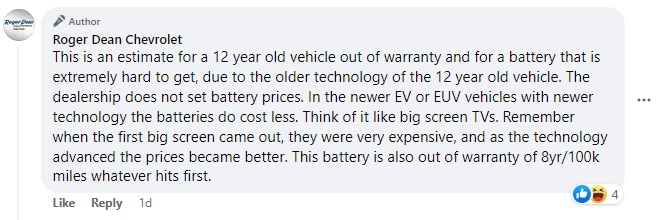
This is an estimate for a 12 year old vehicle out of warranty and for a battery that is extremely hard to get, due to the older technology of the 12 year old vehicle,” the dealership posted on Facebook in an attempt to set the record straight.

The comment from Roger Dean Chevrolet
(Roger Dean Chevrolet / Facebook)

The dealership also used this controversy as a chance for a sales pitch on newer electric vehicles.

“The dealership does not set battery prices. In the newer EV or EUV vehicles with newer technology the batteries do cost less. Think of it like big screen TVs. Remember when the first big screen came out, they were very expensive, and as the technology advanced the prices became better. This battery is also out of warranty of 8yr/100k miles whatever hits first,” the posting stated.

By way of context, an April report in Consumer Affairs gave a ballpark range of $4,000 to $10,000 to replace a gasoline-powered engine.

When seeking to learn how electric vehicle owners felt about the tale of the big-ticket battery, WBVH-TV in Fort Myers, Florida, visited a charging station and interviewed a man the station identified only as “Ian.”

“Thirty thousand dollars is a lot to fix anything on a car, especially when the car itself could be, like, worth less than that,” the man said.

Ian, who leases a Bolt, said things have changed in the EV market.

“As far as electric cars go, they’re being made in better ways now,” he said.

Related:

Electric Only: 2 More States Fall in Line with California, Set to Ban Sale of Gas and Diesel Cars

“I feel like electric vehicle space is innovating a lot. It’s moving on past the initial, like, if something goes wrong with your battery, you hit a rock or something and it messes up your battery you need to spend the entire amount you spent on your car to fix it.

“I’m like ‘well, OK that’s gotta suck for that person’,” Ian said. “I think now that might not be as much of an issue for other people with newer cars.”

Jack Davis

Contributor,

Jack Davis is a freelance writer who joined The Western Journal in July 2015 and chronicled the campaign that saw President Donald Trump elected. Since then, he has written extensively for The Western Journal on the Trump administration as well as foreign policy and military issues.

Hidden on Page 508 of the Infrastructure Bill Is a Plan to Make It Too Expensive to Drive a Car


Reported by Taylor Penley | August 4, 2021

Read more at https://www.westernjournal.com/hidden-page-508-infrastructure-bill-plan-make-expensive-drive-car/

The cost of living is on the rise, calls for yet another wave of pandemic restrictions have begun and now, buried deep in the so-called bipartisan infrastructure bill, the left has laid out yet another idea to bring Americans to their knees. Make no mistake: The suffering is intentional, goal-oriented and not bound to stop anytime soon. Still, one proposal in the 2,702 page infrastructure bill seems especially cruel — cruel enough to make it too expensive for many Americans to even drive a car.

Nick Short of the Claremont Institute highlighted an item on Pages 508-519 of the bill that would introduce a national per-mile motor vehicle user fee on a trial basis.

“Buried on page 508 of the 2,702 page infrastructure bill is a pilot program for a national motor vehicle per-mile user fee (MBUF) which is basically a long-term plan to make it too expensive to drive a car,” Short said Tuesday on Twitter.

The pilot program is set up “to test the design, acceptance, implementation, and financial sustainability of a national motor vehicle per-mile user fee, to address the need for additional revenue for surface transportation infrastructure and a national motor vehicle per-mile user fee” and “to provide recommendations relating to the adoption and implementation of a national motor vehicle per-mile user fee,” the bill says.

An article from The Lid Blog attached to Short’s tweet detailed the proposal even further, breaking down each component, from the program’s objectives to its proposal that “volunteers” from each state should discover different ways to collect data on miles driven by “both commercial and private vehicle operators.”

On Page 513, the proposal says that the “Secretary of the Treasury shall establish, on an annual basis, per-mile user fees for passenger motor vehicles, light trucks, and medium- and heavy-duty trucks.” In theory, these per-mile user fees would vary by vehicle contingent upon several factors, including — you guessed it — environmental impact.

To ease any apprehension about participating in the pilot program, the measure indicates that participants’ identities will be protected, perhaps, as The Lid said, to prevent ostracization “if this happens and achieves the desired result.”

The left can chalk up this test run of what eventually might turn into a full-blown measure to make owning a vehicle next-to-impossible as an effort to be “environmentally conscious,” but is it instead another way to cripple our existing ways of life?

We might dismiss it now, but imagine telling yourself five years ago that the government would order small business closures, codify when and how Americans could worship and adopt an increasingly draconian do as I say, not as I do” policy to address a global pandemic.

From the way we work to the way we breathe, so many aspects of our lives have already changed — albeit willingly, for some. What’s so different about changing how we get to one place from another?

With $10 million dedicated to this program for each year from 2022 to 2026, it’s easy to see how the government doles out what it acquires from hardworking Americans.

Any Republican lawmakers who vote in favor of this “bipartisan” bill have no right to label themselves “conservative.”

This proposal is the antithesis of conservatism.

Taylor PenleyContributor,

Taylor Penley is a political commentator residing in Northwest Georgia. She holds a BA in English with minors in rhetoric/writing and global studies from Dalton State College. As a student, she worked in government relations and interned for Georgia’s 14th congressional district. She previously published an article with Future Female Leaders and published a rhetorical analysis of President Reagan’s Brandenburg Gate Address in a collegiate journal. She aspires to earn an MA and a PhD in journalism in the near future.

Scam of the Century: Scientific Study Destroys Electric Car Debate


Reported By C. Douglas Golden | Published April 23, 2019 at 9:49am

If you think you’re saving the environment by driving a Tesla, well, let me let you in on a bit of a secret: You could perhaps emit less carbon if you went with a diesel car. The findings of a new study by a group of German scientists seem counterintuitive at first. They found that electric vehicles in their home country accounted for more emissions than those smoggy diesels. Until, that is, you realize that “zero emissions” vehicles aren’t really so zero emissions.

“When CO2 emissions linked to the production of batteries and the German energy mix — in which coal still plays an important role — are taken into consideration, electric vehicles emit 11% to 28% more than their diesel counterparts, according to the study, presented on Wednesday at the Ifo Institute in Munich,” the Brussels Times reported.

“Mining and processing the lithium, cobalt and manganese used for batteries consume a great deal of energy,” the report said. “A Tesla Model 3 battery, for example, represents between 11 and 15 tons of CO2.

“Given a lifetime of 10 years and an annual travel distance of 15,000 kilometres, this translates into 73 to 98 grams of CO2 per kilometre, scientists Christoph Buchal, Hans-Dieter Karl and Hans-Werner Sinn noted in their study.”

When you factor in the energy needed to charge the batteries, this ups that total to 156 to 180 grams of CO2 per kilometer.

The study’s authors recommended that instead of pushing for the adoption of “zero emission” electric cars, European officials should instead move toward other sources of power for automobiles — namely methane, “whose emissions are one-third less than those of diesel motors.”

This, by the way, is hardly the only study that’s questioned whether electric cars are really as environmentally friendly as their proponents claim. A 2017 study by researchers at the University of Michigan found that the amount of CO2 emitted by electric cars varied wildly by country, but it certainly wasn’t zero.

“The report — authored by Michael Sivak and Brandon Schoettle — notes that an electric car recharged by a coal-fired plant produces as much CO2 as a gasoline-powered car that gets 29 miles per gallon,” Investors Business Daily reported. “(For context, the average mpg of all the cars, SUVs, vans and light trucks sold in the U.S. over the past year is 25.2 mpg.) A plug-in recharged by a natural gas-powered plant is like driving a car that gets 58 miles per gallon.

“Solar, wind and geothermal do far better on this score, but they generate a small portion of the nation’s electricity. More than 64% of electricity is generated by coal, natural gas or other fossil fuels.

“The U of M researchers calculate that, given the energy mix in the U.S., the average plug-in produces as much CO2 as a conventional car that gets 55.4 miles per gallon.”

That’s not terrible, but it’s not great, either. And keep in mind, the cost of electricity goes up the more renewables you throw into the mix, which dissuades people from adopting them.

For other countries, the cars fare even worse. In China, which has been pushing widespread adoption of electric vehicles, the cars put out as much CO2 as a car that gets 40 miles per gallon.

“And even this exaggerates the environmental benefits of electric cars because the report doesn’t take into account the additional CO2 emissions involved in making batteries,”the IBD report said.

“A separate study from the Union of Concerned Scientists found that, depending on the type of plug-in being built, manufacturing a battery-powered car generates anywhere from 15% to 68% more CO2 emissions than a conventional gas-powered car,”the report said. “The reason is that producing the batteries is incredibly energy intensive.”

Now, if you like owning an electric car, that’s fine. But if your reason for owning it is that you think you’re doing the environment a favor, you’re wrong. The idea that these vehicles have “zero emissions” might be one of the biggest scams of the 21st century, particularly given how expensive renewable energy currently is. No matter what owners of these vehicles may believe, smug can’t eliminate smog.

ABOUT THE AUTHOR: 

Summary

More Info Recent Posts Contact

C. Douglas Golden is a writer who splits his time between the United States and Southeast Asia.

North Carolina House Passes Bill To Protect Motorists Who Hit Protesters While Driving


Reported

URL of the original posting site: http://conservativetribune.com/north-carolina-protect-motorists/

Advertisement – story continues below

A bill that has passed North Carolina’s House of Representatives would shield motorists who unintentionally hit protesters blocking roads from civil liability, WFAE reported.

House Bill 330, introduced by Rep. Justin Burr, “provides that a person driving an automobile while exercising due care is immune for civil liability for any injury to another if the injured person was participating in a demonstration or protest and blocking traffic.”

It passed the House of Representatives by a 67-48 vote on Thursday, the Raleigh News & Observer reported.

“As we’ve seen, time and time again, as folks run out in the middle of the streets and the interstates in Charlotte and attempt to block traffic,” Burr said. The Republican said he wants to make sure “drivers don’t have to fear driving through Charlotte or anywhere in North Carolina.”

“This bill does not allow for the driver of a vehicle to target protesters intentionally,” he added. “It does protect individuals who are rightfully trying to drive down the road.”

Protests blocking roads and highways were common in Charlotte after the death of Keith Lamont Scott last year.

“These people are nuts to run in front of cars like they do … and say, ‘me and my buddy here are going to stop this two-and-a-half-ton vehicle,’” Rep. Michael Speciale, who supports the bill, said. “If somebody does bump somebody, why should they be held liable?”

Needless to say, Democrats pitched a fit.

We all know this is being done to try to make a point about protests,” said Democrat Greg Meyer. “It is just going to embarrass us. There is no good reason to pass this bill.” >>>>>>>>>>>>>>>>

Yes, apparently, protesters blocking roads for no good reason aren’t going to embarrass the state of North Carolina, but a bill protecting motorists from lawsuits will.

The bill now heads to the Senate for approval. One hopes the upper chamber acts quickly and passes this bill.

Tag Cloud