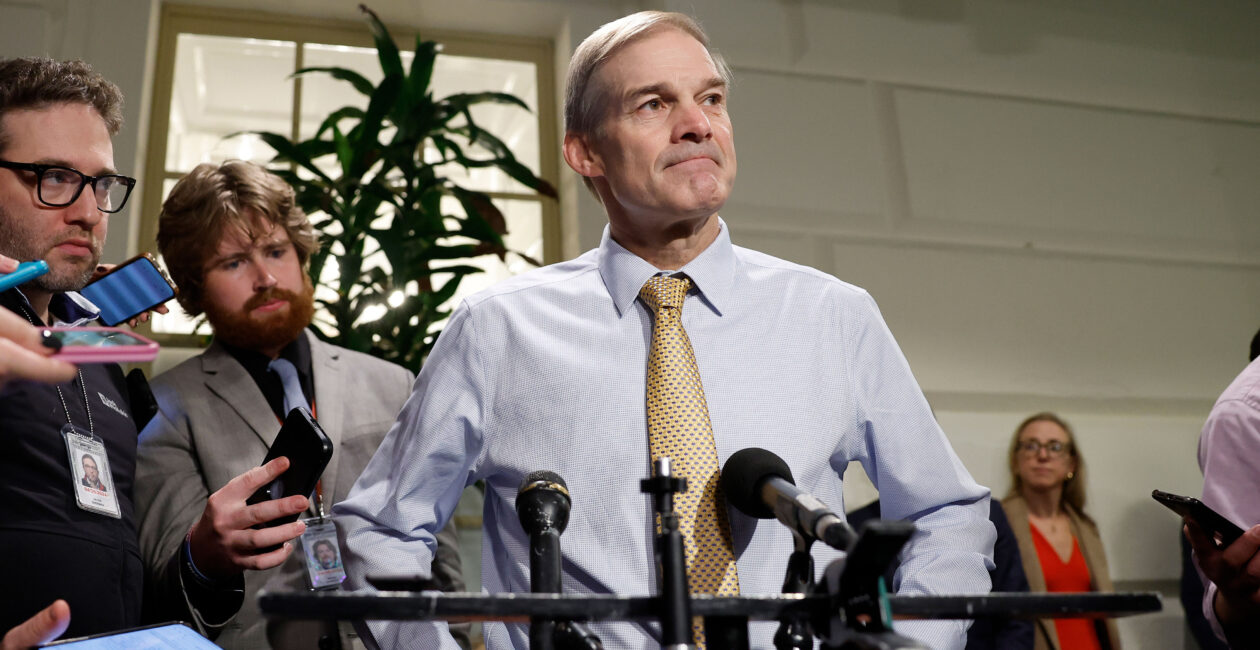
“The federal government, disinformation ‘experts’ at universities, Big Tech, and others worked together through the Election Integrity Partnership to monitor & censor Americans’ speech,” Rep. Jim Jordan, pictured Oct. 20, posted on X. (Photo: Anna Moneymaker/Getty Images)
The federal government coordinated with an array of entities to censor Americans’ speech online, a newly released report from the Select Subcommittee on the Weaponization of the Federal Government shows. In particular, the report shows that the Department of Homeland Security worked with Stanford University and the Global Engagement Center, which works across agencies but sits under the State Department, to create a streamlined process for identifying and censoring posts.
These groups formed the Election Integrity Partnership, which the report shows worked to censor and limit certain posts going into the 2020 presidential election. The report argues the federal government was “heavy handed” with universities and social media companies and censored conservative viewpoints far more often than liberal points of view under the guise of combating disinformation.
“Created in the summer of 2020 ‘at the request’ of the Cybersecurity and Infrastructure Security Agency (CISA), the EIP provided a way for the federal government to launder its censorship activities in hopes of bypassing both the First Amendment and public scrutiny,” the report said.
The report lays out how EIP analysts searched social media sites for undesirable content.
From the report:
The EIP’s misinformation ‘analysts’ next scoured the internet for additional examples for censorship. If the submitted report flagged a Facebook post, for example, the EIP analysts searched for similar content on Twitter, YouTube, TikTok, Reddit, and other major social media platforms. Once all of the offending links were compiled, the EIP sent the most significant ones directly to Big Tech with specific recommendations on how the social media platforms should censor the posts, such as reducing the posts’ ‘discoverability,’ ‘suspending [an account’s] ability to continue tweeting for 12 hours,’ ‘monitoring if any of the tagged influencer accounts retweet’ a particular user, and, of course, removing thousands of Americans’ posts.
This report is the latest in a series of reports, including the “Twitter Files,” which show the federal government pressured private and nonprofit organizations to quiet certain viewpoints. Much of this push for censorship was fueled by concerns that former President Donald Trump was propelled to the White House by misleading news and content on social media sites.
House Speaker Mike Johnson, R-La., sparked headlines last month when he said that Twitter was an “FBI subsidiary” before billionaire Elon Musk took over. Johnson raised concerns again after this latest report.
Sen. Rand Paul, R-Ky., pointed to the report as well, pushing for his legislation, the Free Speech Protection Act. Paul said that under this legislation, which he co-wrote with Rep. Jim Jordan, R-Ohio, the government “will be stripped of its ability to shroud its actions in secrecy and infringe upon the First Amendment rights of the American people.”
This latest report includes documents obtained from Standard that show examples of the censorship and the coordination between federal and private entities.
“The American people deserve to know if they were targeted by their own government and so-called ‘disinformation’ experts,” Jordan, who leads the weaponization committee, wrote on X.
WASHINGTON — A new survey reveals that most Americans support religious liberty protections for medical professionals and institutions opposed to participating in procedures that violate their beliefs and commitment to “do no harm,” even as younger Americans express more skepticism about religious liberty protections.
The Becket Fund for Religious Liberty unveiled the top findings of its 2022 Religious Freedom Index at its headquarters Tuesday. The fourth annual survey, conducted in conjunction with Heart and Minds Strategies, is based on responses collected from 1,004 adults in the United States from Sept. 28 to Oct. 5. The full report is slated for release Wednesday.
As Becket Fund for Religious Liberty President and CEO Mark Rienzi explained, the Religious Freedom Index asks “the same questions year after year [to] a big number people to get a sense of how the American people are feeling about religious liberty for themselves, for other people, for people of minority faiths, [and] people of faiths that they don’t necessarily share.”
One question on the survey asked respondents to react to statements related to religious objections to assisted suicide, abortion and sex change procedures within the medical community. Seventy-three percent of those surveyed agreed that “individual physicians should be allowed to opt out of assisted suicide, elective abortion, or sex change procedures” if performing such procedures goes against their religious beliefs or their commitment to “do no harm.”
When asked if they believed that “hospitals and healthcare systems which have ethical objections or are run by religious organizations should be allowed to refuse to perform elective abortions,” 62% answered in the affirmative. Additionally, a majority (59%) of those surveyed believed that “medical students should be able to opt out of instruction regarding physician-assisted suicide, elective abortions, and sex change procedures during training.”
Only half of respondents expressed support for allowing “hospitals and healthcare systems with religious objections to assisted suicide, elective abortions, and sex change procedures” to “only employ medical professionals who agree with that position.”
Achieving 74% support, the most popular idea introduced in the Religious Freedom Index states that “Patients and families should have access to healthcare facilities that share their beliefs about controversial procedures such as assisted suicide, elective abortion, or sex change procedures.”
The release of the 2022 Religious Freedom Index comes after the Biden administration has found itself in court over a mandate it issued forcing medical organizations to perform gender transition surgeries. The United States Court of Appeals for the Fifth Circuit struck down the mandate and the Biden administration did not appeal to the U.S. Supreme Court, leaving the decision in place.
Last year’s survey included a question measuring support for “freedom for healthcare workers with religious objections to abortion to not participate in abortion procedures.” Seventy-five percent of respondents either completely or mostly accepted allowing healthcare workers to opt out of performing abortions if they could not do so in good conscience.
At the same time, 44% of those surveyed believed that hospitals and healthcare systems run by religious organizations should have the ability to “set policies and standards that reflect the organization’s religious beliefs.”
The questions about the conscience rights of hospitals and healthcare workers constitute a small fraction of the inquiries posed to Americans in this year’s Religious Freedom Index. As in previous years, the survey asked Americans for their views on religion and policy, religion in action, religion in society, religious pluralism, church and state and religion sharing.
Based on responses to a series of questions, Becket calculated a dimension score on a scale of 0 to 100 for each of the subcategories examined, with 0 indicating “complete opposition for the principle of religious freedom at issue” and a score of 100 demonstrating “robust support for the same principle.” The Religious Freedom Index is a composite score calculated after combining the dimension scores.
Heart and Mind Strategies CEO Dee Allsop elaborated on the dimensions examined in the Religious Freedom Index at the event Tuesday. According to Allsop, questions about religious pluralism examine respondents’ views about “freedoms to choose your religion, and to be able to pray and pursue your beliefs.” The religious sharing dimension measures Americans’ beliefs pertaining to the ability to “talk about and preach about your faith.”
Questions about church and state survey public opinion about “government being involved in religion and religion in government.” The religion in society dimension seeks to determine “whether or not religion is part of the problem or part of the solution” to societal problems.
The religion and policy dimension queries respondents for their views about marriage and whether or not religious beliefs “should be guiding the way that we vote.” The religion in action dimension is based on responses to questions about whether or not there should be “freedom for people of faith to follow their own religious beliefs when they’re at work and in their profession.”
As panelists explained at the press conference, the overall Religious Freedom Index stood at 68 this year, showing no change from 2021. However, the changes in the index dimension scores from 2021 varied widely.
As in previous surveys, respondents demonstrated the highest level of support for religious pluralism. The dimension score for religious pluralism came in at 84 in 2022, an increase from 80 in 2021. The dimension scores for religious sharing and religion in action barely budged from 71 to 72 and 67 to 68, respectively.
On the other hand, support for religion in society, religion and policy, church and state and religion in action declined compared to last year. The dimension score for religion and policy dropped by three points from 68 to 65 between 2021 and 2022. The religion in society dimension score also decreased by three points, from 65 to 62.
Mirroring the results of previous surveys, the dimension dealing with church and state received the lowest score in 2022, dropping from 58 to 56 over the past year.
A group of panelists, moderated by Becket Law Executive Director Montse Alvarado, discussed the findings from the Religious Freedom Index and their implications for American society as a whole at the event Tuesday. With the U.S. Supreme Court case 303 Creative LLC v. Elenis case in the news, Americans indicated that they “overwhelmingly support” the right of a photographer not to participate in a same-sex wedding if doing so conflicts with their religious beliefs, regardless of what those beliefs are.
The 303 Creative case centers on Colorado-based website designer Lorie Smith, who is challenging Colorado anti-discrimination law out of concern that it would force her to create websites for same-sex marriages in violation of her religious convictions about marriage as a union between a man and a woman. Oral arguments in the 303 Creative case took place Monday.
One panelist, Nick Tomaino of The Wall Street Journal, expressed gratitude for “the durable support for people like Lorie,” noting that the Religious Freedom Index found “about seven in 10 people thinking that Lorie Smith and others like her should be able to practice their faith.” At the same time, he highlighted a trend from the survey revealing that “Gen Z women aren’t registering their support.”
Other panelists also cited Gen Zers’ beliefs about religious freedom issues as a cause for concern going forward. Stephanie Slade of Reason Magazine pointed to statistics illustrating “abstract” support for religious liberty among the youngest Americans that fades when respondents are presented with a specific example: “Among Gen Z, you have a very high number (86%) who say … they support freedom of people or groups to choose not to participate in actions or work that violate their sincere religious beliefs and conscience.”
“When you put a specific example to them and you ask ‘should an individual physician, for example, be able to opt out of providing, say, being involved in abortion or physician-assisted suicide’ or something like that, support drops 50% among the Gen Z cohort,” she said.
Another panelist, Josh Good, director of the Faith Angle Forum at the Ethics and Public Policy Center, attributed the hostility toward religious liberty among younger Americans to a “blind spot when it comes to religion” in American newsrooms. Tomaino suggested that having “religious practitioners in newsrooms” could help address this “blind spot.”
Tomaino contended that “there might be a caricature that newsrooms treat religion as something of a strange species.” Alvarado lamented the Religious Freedom Index’s finding that “37% of Americans had never heard of pregnancy centers being in any way being affected by post-Roe reality,” such as vandalism and bombings, as a consequence of media bias.
Alvarado and Slade suggested that had these people known about the targeting of pro-life pregnancy centers following the Dobbs v. Jackson Women’s Health Organization, which determined that the U.S. Constitution did not contain a right to abortion, they would have become more sympathetic to arguments in favor of religious liberty.
“Story selection is a form of bias,” Slade asserted. “These stories are not getting the coverage that they deserve and they are not getting the coverage they would get if … when there are, in some cases, violence or any kind of harassment or attacks on an abortion provider, for example, these same journalists would know that this is a story and it deserves coverage and it’s a big deal.”
According to Slade, “In a healthy media ecosystem, we need people who are going out and just reporting the facts that are true.” She portrayed the current state of American media as focused on “the pure outrage-inducing opinion cable news-style journalism as opposed to reporting the facts,” where journalists see themselves on an “existential mission to represent the good against the evil.”
Slade also acknowledged that the irreligiosity of Gen Z compared to other generations might also play a role in their apparent hostility toward religious liberty: “Gen Z is much less religious themselves, they’re much less likely to think that religion’s part of the solution rather than part of the problem.”
“They’re much less supportive of freedom for people to run their businesses the way they want, for religious nonprofits to make employment decisions based on the tenets of their faith, which is a really important part of being a faith-based nonprofit, they’re much less likely to … support freedom to believe that certain behaviors are sinful.”
After Slade reiterated that Gen Z has “less sympathy and understanding of the value of religion in society,” Tomaino pointed to academic influence as a reason why. “The water they swim in universities tends to be overtly hostile to the faith,” he concluded. He circled back to the role the media plays in shaping public opinion: “Having news coverage of the positive contributions that faith organizations make is especially important.”
When Tomaino clarified that “males registered slightly more sympathy to religious causes” than females, Alvarado responded, “they’re more religious themselves.” Alvarado and the other panelists repeatedly stressed the importance of religious liberty in a pluralistic society, with the Becket Fund Executive Director sharing a quote from noted theologian Rabbi Jonathan Sacks: “The Tree of Liberty has religious roots and don’t think that you can sever those roots and have the Tree of Liberty survive.”
For his part, Good offered up his opinion that “People being more religious, not less religious, is the key to understanding pluralism better.”
Discussing other takeaways of the 2022 Religious Freedom Index, Allsop noted that when asked if “religion is part of the solution to the problems we face in our society or part of the problem,” respondents were split down the middle. This constituted a dramatic drop from the 61% who saw religion as a solution to societal problems in 2021.
“Catholics in particular and non-Catholic Christians overwhelmingly say that they feel completely or a good amount accepted in our society,” he said. Stressing that feelings of acceptance were “not quite the same for those that are religious, non-Christians,” he reported that “less than half of them are feeling that high level of acceptance in our society.” Additionally, 89% of Americans agree that “sacred sites and religious practices of Native American Indians ought to be protected.”
When asked about the First Amendment, “Less than half of Americans recognize that freedom of religion is one of the protected rights in the First Amendment,” Allsop added. “Most Americans, even though they can’t find it in the First Amendment, they nevertheless feel that religious freedom plays a really important role and provides an important good in our society.”
Image: Jailed Teacher Claims Americans Held in ‘North Korean Gulag’ / Businessman James Leigh
A Canadian security consultant who was interrogated for two and a half days in North Korea says he spoke at length with a prisoner in a neighboring cell who identified himself as 58-year-old Tony Kim, the American professor recently imprisoned by the rogue regime of dictator Kim Jong Un.
James Leigh, a businessman said to have global contacts in the intelligence community, tells Newsmax that he traveled to North Korea at the invitation of one of North Korea’s military leaders to attend its Military Foundation Day on April 25. But when Leigh arrived at the airport in Pyongyang on April 22, he was searched, detained, and interrogated for several days, before finally being allowed to continue his journey.
While imprisoned, Leigh says he spoke through paper-thin walls to another detainee who was being beaten and interrogated in an adjoining room. That prisoner identified himself as Prof. Tony Kim.
The North Korean government confirmed on Wednesday that Prof. Kim has been arrested and charged with “acts of hostility” and trying to undermine Kim Jong Un’s Hermit Kingdom. He was a visiting professor of accounting at North Korea’s University of Science and Technology. According to Leigh, Prof. Kim told him that many other foreign nationals have been secretly arrested and imprisoned in North Korea.
Prof. Kim told Leigh an associate had visited the facility where the prisoners are housed. According to Prof. Kim’s account as related by Leigh, locals refer to that prison as “the house of people with no name” or “the place without a name” — Leigh was uncertain of the precise phrase due to language difficulties.
“He was pretty specific about that,”says Leigh. “He knew about that. That was something he really wanted me to know. … There were Americans and Europeans. … He was pretty specific because that was probably where he was going.”
During his interrogation, Leigh says, he saw large filing cabinets stuffed with thick files bearing Western-sounding names. One name he specifically recalls seeing was “Brian.” Another name was French or Italian. But he says he cannot be certain whether those files represented Westerners secretly consigned to the North Korean equivalent of a Soviet-era “gulag archipelago.”
According to Leigh, Prof. Kim said he wanted to leave North Korea because he was suffering undue criticism from his boss. The teacher was reportedly arrested at the airport along with his wife, although she was later released and has returned to the United States.
Two other Americans are currently known to be imprisoned in North Korea. In March, the North Koreans sentenced a 21-year-old University of Virginia student, Otto F. Warmbier, to 15 years of hard labor for taking a propaganda poster down off the wall of a hotel. Another prisoner, businessman Kim Dong Chul, a former Virginia resident, was arrested in October 2015 and is being held on suspicion of espionage.
The account Leigh received from Prof. Kim, if substantiated, would indicate that North Korea has pursued a more widespread, systematic practice of imprisoning Westerners.
“He says there a lot more Americans than we know about being held,”says Leigh, who adds that given the thousands of U.S. ex-pats living in Asia and the limited resources available to track their whereabouts when they go missing, he does not find Prof. Kim’s claim farfetched or improbable.
In response to Prof. Kim’s arrest, former U.S. Ambassador to the U.N. John Bolton told Fox News on Wednesday: “For far too long, North Korea has taken Americans hostage to use as bargaining chips. The Trump Administration is the right time to put a stop to this once and for all.”
Leigh says Prof. Kim’s interrogation reflected an odd fixation on U.S. President Donald J. Trump.
“They were saying to him ‘Who sent you, did Donald Trump’s team sent you? Did the pig Donald Trump [send you].’
“They were calling Donald Trump ‘the pig Donald Trump’ and ‘the war-crazy Donald Trump’ and ‘the killer-of-innocent-people Donald Trump.’ They didn’t say America. They kept saying Donald Trump. Which I thought was odd. I thought they’d go, ‘Well, the Americans … but they kept saying, ‘Were you sent by the pig Donald Trump?'”
In his account to Newsmax, Leigh described hour upon hour of prisoner abuse occurring in the room next door.
“One time, I heard a piece of wood break,” he recounts. “Whether it was a piece of wood or a cane they were using, I heard it break. And I heard thuds that sounded like a body falling on the floor. So he was being beat up, lightly, I don’t think hard, but he was being slapped around and hit. You’ve got to imagine, this was going on for a day, 24 hours at least.”
In between the beatings, the two prisoners spoke. He said Prof. Kim, a South Korean, told him he had agreed to teach in the North against his family’s wishes because he hoped the exchange of ideas would help contribute to mutual understanding.
“He took it because it’s a job,”Leigh said, “but also he felt he could do something special and make a difference.”
Leigh says after he was released officials took him to his hotel, where he continued to be under rather obvious surveillance for the remainder of his trip. He did attend the military parade, and was seated among other foreign nationals in a section about 50 yards from dictator Kim Jong Un.
One observer seated next to him, a Russian, told Leigh that foreigners are always seated near the strongman, to protect him from a surprise missile or drone attack due to the risk of collateral casualties.
“He was stocky,” Leigh says of Kim, “and he also wasn’t free and relaxed. He was very stiff, almost marching, very tense. He was just in and out, like he didn’t want to be there.”
He says during the parade he saw “some interesting looking missiles.”
“They would have been medium range missiles most likely, judging from the length of them,”he says. “I’m not an expert on missiles, but they would have been intermediate range, the type they would use on Japan or South Korea, but not the type that would be American bound.”
Leigh reports seeing several indications that North Korea is now in a state of high military alert: Soldiers toting rifles, military vehicles rushing through the streets, and men walking about carrying what he understood to be military equipment contained in government-issue duffel bags.
“Their people are aware now that there’s a chance of war. You can see it in their faces… There’s a lot of military movement, it’s like an ant hill going on.”
Leigh says loudspeakers in North Korea continually spout messages like: “Prepare to honor your country and your leader, and never be afraid if you’re right.”
He said during his two-and-a-half day imprisonment, Prof. Kim told him, “There’s a lot more Americans locked up here than anyone knows.
“I said, ‘Are you serious?'”
“He said, ‘Yeah, Canadians, Americans, Europeans. There’s a whole place to hold them.'”
Leigh credits Prof. Kim’s whispered advice from the other side of the paper-thin wall for his eventual release. His fellow prisoner told him that under no circumstances could he respond with anger toward his interrogators, but to never agree to any accusations of espionage no matter how exhausted he might become.
Leigh says Prof. Kim speculated the foreign nationals would be used as leverage in case the regime comes under attack, but that the instructor didn’t know whether the victims had been arrested or kidnapped.
Leigh, who was permitted to leave the country on the 27th, calls his captivity “a near-death experience” that has scarred him for life. The hardest part, he says, was knowing that he had to leave Prof. Kim behind.
“You know, there was nothing I could do,”he said, growing emotional. “I knew there was nothing I could do. Had I tried to interfere, it probably would have changed the direction I was going. I thought to myself, ‘the most valuable thing I can do is get out of here and tell this story.'”
He says Prof. Kim’s last words to him were “Stay quiet, keep your head down, and get the hell out of here.”
American Family Association
American Family Association (AFA), a non-profit 501(c)(3) organization, was founded in 1977 by Donald E. Wildmon, who was the pastor of First United Methodist Church in Southaven, Mississippi, at the time. Since 1977, AFA has been on the frontlines of Ame
NEWSMAX
News, Opinion, Interviews, Research and discussion
Opinion
American Family Association
American Family Association (AFA), a non-profit 501(c)(3) organization, was founded in 1977 by Donald E. Wildmon, who was the pastor of First United Methodist Church in Southaven, Mississippi, at the time. Since 1977, AFA has been on the frontlines of Ame
American Family Association
American Family Association (AFA), a non-profit 501(c)(3) organization, was founded in 1977 by Donald E. Wildmon, who was the pastor of First United Methodist Church in Southaven, Mississippi, at the time. Since 1977, AFA has been on the frontlines of Ame
You Version
Bible Translations, Devotional Tools and Plans, BLOG, free mobile application; notes and more
Political
American Family Association
American Family Association (AFA), a non-profit 501(c)(3) organization, was founded in 1977 by Donald E. Wildmon, who was the pastor of First United Methodist Church in Southaven, Mississippi, at the time. Since 1977, AFA has been on the frontlines of Ame
NEWSMAX
News, Opinion, Interviews, Research and discussion
Spiritual
American Family Association
American Family Association (AFA), a non-profit 501(c)(3) organization, was founded in 1977 by Donald E. Wildmon, who was the pastor of First United Methodist Church in Southaven, Mississippi, at the time. Since 1977, AFA has been on the frontlines of Ame
Bible Gateway
The Bible Gateway is a tool for reading and researching scripture online — all in the language or translation of your choice! It provides advanced searching capabilities, which allow readers to find and compare particular passages in scripture based on


 What Did You Say?
You must be logged in to post a comment.